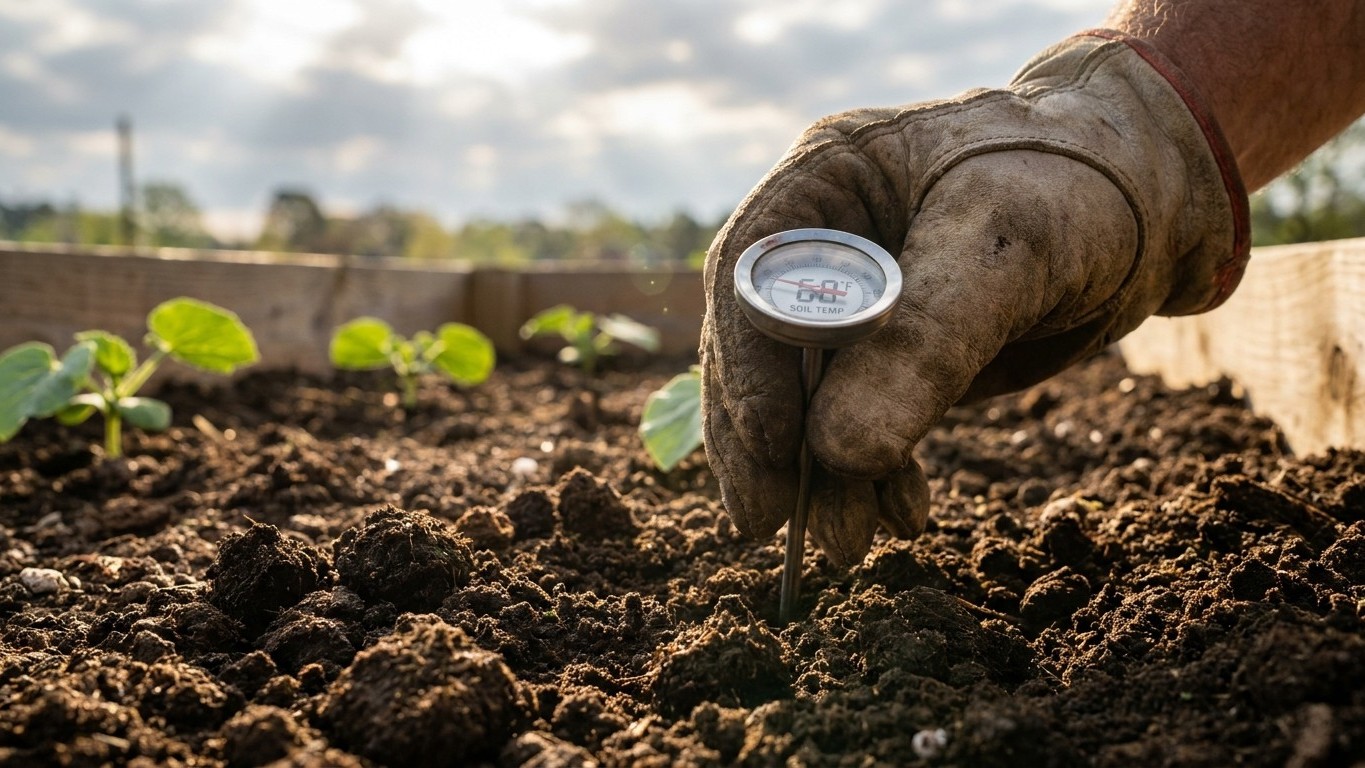

Melons need soil at 65-70°F to germinate and grow well, which in Pennsylvania usually means waiting until late May near Philadelphia and into mid-June across the northern tier and the Allegheny highlands. The state’s USDA hardiness zone spans 5a to 7b, so the calendar that works in one county can leave a gardener two counties north still watching for frost.
When the soil is warm enough in Pennsylvania

The question every melon grower asks first is simple: when can I put seed or transplant in the ground? For the reference station behind Pennsylvania’s climate normals, NOAA NCEI puts the last spring frost between March 29 and April 6 (1991-2020 Climate Normals, 32°F freeze probabilities). That date belongs to Philadelphia, and the same NOAA caution attached to it is worth repeating here: Philadelphia is the mildest corner of the state, and the northern tier and the Alleghenies typically run two to four weeks later in spring. A gardener in Erie or in the ridge-and-valley country around Altoona should treat late April or early May as their working target, not late March.
But a frost date is a proxy, not the real signal. Melons don’t care what the calendar says about frost risk; they care about soil temperature, and soil warms on its own schedule, days or even weeks after the air stops threatening to freeze. A frost-free morning in early April can still sit over ground barely above 50°F, and melon seed dropped into that soil will rot before it sprouts. The safer read is: wait until the frost date has passed and the soil has had time to catch up, which in practice often means adding one to two weeks onto whatever the frost calendar suggests.
It’s also worth being honest about what a frost date actually represents. NOAA’s 30-70% probability band means exactly that: a probability, not a promise. A last frost falling on April 6 doesn’t guarantee nothing colder happens after that date, only that the odds of a freeze have dropped into that middle range. Gardeners who’ve been burned by a late cold snap in early May know this already; the calendar gives a planning window, not a guarantee.
Where the zone map earns its keep is in setting expectations before you even open a seed packet. Pennsylvania’s 5a-7b range (USDA Plant Hardiness Zone Map 2023) is built on one number, the average annual extreme minimum temperature, and it’s a statewide range rather than a single figure. Treat Philadelphia as the reference point for early planting and treat the rest of the state as running behind it, sometimes considerably.
The practical move is to warm the soil actively rather than wait on it passively: black plastic mulch, raised beds that drain and heat faster than flat ground, or row cover pulled over the bed for the first couple of weeks after transplanting. None of that replaces checking the soil with a thermometer, but it shortens the wait in a state where spring can be slow to commit.
How long the season lasts here
Subtracting one frost date from the other gives the frost-free window, and at the Pennsylvania reference station both dates come from the same NOAA source, so the math holds. Using the earlier end of each range (April 6 to November 5), the window runs about 213 days. Using the later end of each range (March 29 to November 16), it stretches to roughly 232 days. Either way, that’s somewhere between seven and just under eight months without a killing frost, at least for the mild corner of the state that Philadelphia represents.
Away from that reference point, the window shrinks. The northern tier and the Alleghenies push the spring end back two to four weeks, and cooler mountain valleys generally see fall frost arrive earlier too, so a grower in those regions should plan around a season closer to five or six months rather than seven.
What that length allows matters more than the number itself. A seven-month window is long enough that a single melon planting doesn’t have to be the only shot of the year. Melons planted in late May or early June, following a Philadelphia-area timeline, still leave enough season afterward to consider a second, later sowing if the first planting runs into trouble, whether that’s a pest outbreak, a patchy germination, or a plant that simply underperforms. In the shorter mountain season, that safety margin disappears; the first planting is effectively the only planting, which raises the stakes on getting timing and soil warmth right the first time.
That length also changes the transplant-versus-direct-seed decision. With months to spare, gardeners can afford to direct-seed and accept a slower start, or transplant seedlings started indoors and risk transplant shock, since there’s runway to recover either way. In a compressed mountain season, transplants become the more reliable choice precisely because they buy back the weeks a direct-seeded melon would otherwise spend just getting established. Anyone weighing a second planting, or timing a transplant against the first sowing, should work through the succession sowing guide elsewhere on this site, which covers the spacing and staggering decisions in more depth than a single frost-date calculation can.
Heat and water in Pennsylvania

Melons ripen on accumulated warmth, not on the calendar, and the Philadelphia reference station averages 24.0 days a year at or above 90°F (NOAA NCEI Climate Normals, 1991-2020). That’s a moderate number, nowhere near the heat load of the Deep South or the desert Southwest, and it means Pennsylvania isn’t a territory where melons ripen on autopilot once the weather turns warm. Heat accumulation is the limiting factor here, more than sowing date, which is exactly why the soil-warming techniques discussed above (plastic mulch, raised beds, row cover) carry more weight in this state than they would somewhere with a longer run of 90-degree days to make up for a slow start.
Rainfall tells a different part of the story. Summer rain across June, July and August averages about 12.7 inches at the same reference station, split fairly evenly: 4.04 inches in June, 4.38 in July, 4.29 in August. June, slightly counterintuitively, is the driest of the three summer months. That’s a respectable amount of water, roughly an inch a week, and it’s not the kind of dry, sun-baked summer where irrigation alone decides whether a melon patch survives.
The bigger risk in a Pennsylvania summer isn’t drought stress, it’s the combination of humidity and moderate heat that favors fungal disease. Powdery mildew and downy mildew both thrive in exactly the conditions this state tends to produce: warm but not scorching days, regular rain, and the humidity that lingers afterward in the Mid-Atlantic air. A cool, damp stretch in July doesn’t just slow ripening, it opens the door to mildew working its way across the leaves before the fruit has finished sizing up.
That reshapes the priority list for anyone growing melons here. Airflow between plants, avoiding overhead watering late in the day, and choosing planting sites that dry out after rain rather than staying soggy all matter more in Pennsylvania than they would in a hot, dry climate where the main concern is simply keeping enough water on the roots. And because 24 days above 90°F is a count at one reference station, not a description of the whole state, gardeners in the warmer river valleys of the south-central counties should expect a bit more heat than that number implies, while higher elevations will see less.
Which melons suit Pennsylvania
Put the season length and the disease pressure together, and the type of melon that makes sense here starts to answer itself. A season that’s generous near Philadelphia but noticeably shorter in the mountains favors earlier-maturing types over the long-season watermelon varieties that need a full hot summer to size up properly; muskmelon and cantaloupe types, which generally need less time from planting to ripe fruit, carry less risk if the season runs short or a planting gets delayed.
The humidity and moderate heat load push disease resistance to the top of the list, ahead of sweetness or size. A vine that resists powdery and downy mildew has a real shot at finishing its fruit in a Pennsylvania summer; one that doesn’t may lose its leaves to disease before the melons are ready, no matter how promising the fruit looked in July. Airflow-friendly spacing and staked or trellised growth, which several types tolerate better than others, also help here more than in a drier climate where fungal pressure is lower to begin with.
None of that points to a specific variety name, and that’s a deliberate choice rather than an oversight. Variety trials run by Penn State Extension test named cultivars against Pennsylvania’s actual soils, actual humidity, and actual disease pressure year over year, results this page simply doesn’t have and shouldn’t guess at. A variety that performs well in a trial garden outside State College may or may not be the one sold at a local nursery, and naming one here without that local trial data would be a recommendation built on nothing.
The useful takeaway is the type, not the label: look for early-to-midseason muskmelon or cantaloupe types with documented resistance to powdery and downy mildew, and confirm the specific varieties available locally through Penn State Extension’s current trial recommendations, which change as new resistant lines get tested. That’s a more reliable path than any single name printed on a seed packet.