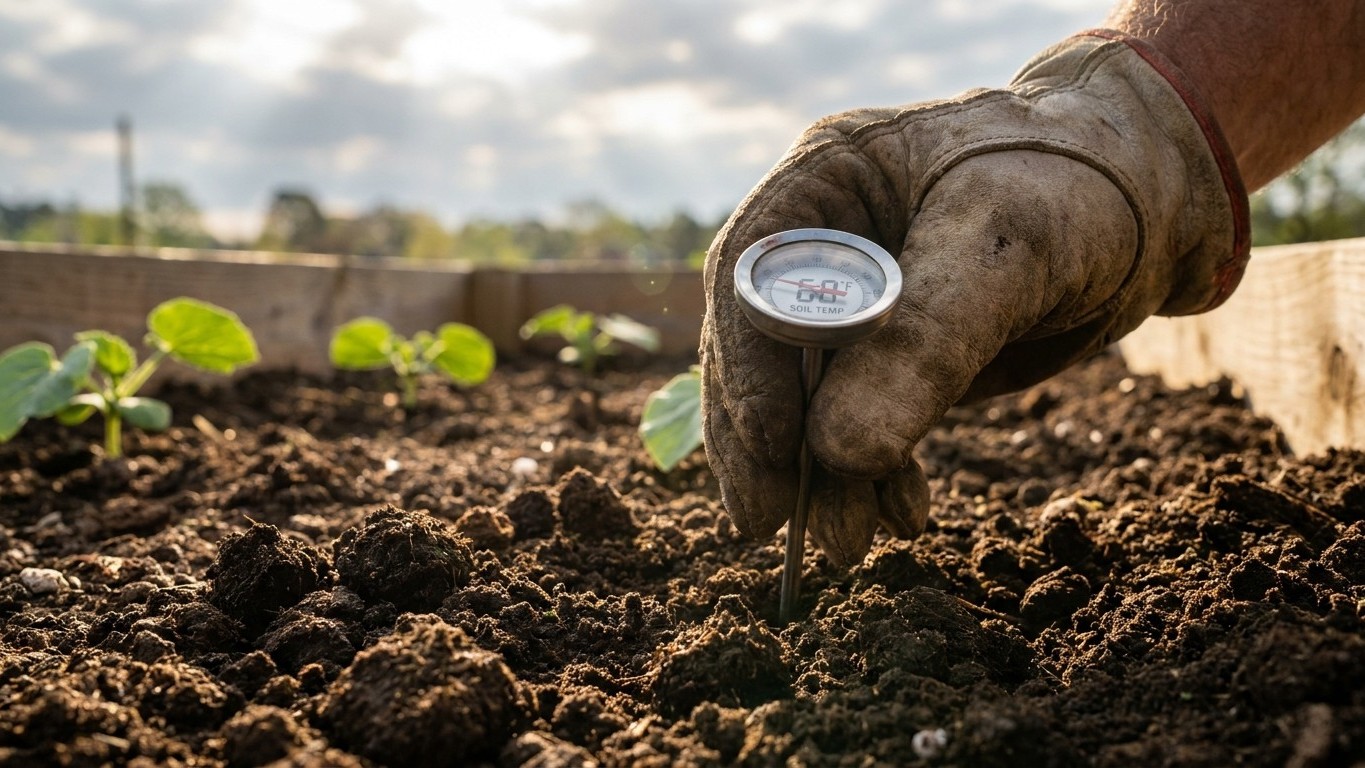

Soil temperature settles the sowing date for melons in Colorado, not the frost calendar. On the Front Range, that means waiting until well after frost risk clears in May, watching the ground rather than the sky. Getting melons to ripen here comes down to three things: timing sowing to real soil warmth, working inside a season that runs roughly 142 to 164 days, and managing irrigation through a summer that’s warm on the plains but consistently dry.
When the soil is warm enough in Colorado

NOAA’s 1991-2020 climate normals put the last spring frost along the Front Range at May 1 to May 11, based on 32°F freeze probabilities recorded at station USW00003017. That’s a probability window, not a guarantee: some years clear it by late April, others carry frost risk into the second week of May. Melons don’t respond to that date directly. They respond to soil temperature, and soil doesn’t warm up the moment frost risk drops below the range NOAA uses to define that window.
Clay soil, common across much of the Denver metro area and the wider Front Range, holds winter’s cold longer than sandy ground does, and it warms more slowly once air temperatures climb. That lag is the reason experienced growers wait past the last frost date before sowing melons directly, and often lean on practices that push soil temperature up faster: dark mulch laid over the bed a week or two before sowing, raised rows that drain and warm quicker than flat ground, or a floating row cover pulled over young plants on cool nights. None of these guarantee an earlier harvest; they just close the gap between air warmth and root-zone warmth, which is what a melon seed actually reads.
Why elevation changes the answer
Colorado’s USDA Plant Hardiness Zone Map, the 2023 edition built on 1991-2020 extreme minimum temperatures, spans zone 3b to 7b across the state, and that spread explains why a single planting date can’t govern the whole territory. Denver, the reference city behind most of this page’s figures, sits toward the milder end of that range. A mountain town two hours west can fall in a colder band with a growing season measured in weeks rather than months, and can still see frost in July. The western slope runs on its own pattern again, shaped by different elevation and air drainage, so a gardener in Grand Junction is working from a different set of normals than one in Aurora, even under the same state line.
That’s the real argument for treating the May 1 to May 11 window as a starting point rather than a fixed date: check the soil, not just the calendar, and adjust further if gardening above the plains.
How long the season lasts here
Subtract the two frost windows NOAA tracks at station USW00003017 and the Front Range growing season runs somewhere between 142 and 164 days: from a last spring frost anywhere between May 1 and May 11, to a first fall frost anywhere between September 30 and October 12. That range is wide enough to matter. A gardener working from the earlier end of both windows gets closer to five months of frost-free ground; one working from the later spring date and the earlier fall date gets noticeably less.
Melons are long-season plants by nature, and even at the top of that 164-day range, a Colorado grower is working close to the edge rather than with room to spare. That changes the strategy in a specific way: a single, well-timed sowing, made as soon as soil warmth allows, is usually the whole plan, not the first of two. Where the season runs shorter, starting seedlings indoors and transplanting once the soil has warmed can recover some of the lost weeks, though it means checking that the young plants aren’t pot-bound or root-stressed before they go into the ground, since melons resent having their roots disturbed more than many transplanted vegetables do.
Succession sowing, planting a second round of the same crop a few weeks after the first, works well for quick-maturing vegetables that leave enough season left to squeeze in a second harvest. Melons rarely allow that here. Even a 164-day window is mostly consumed getting a single planting from seed to ripe fruit, which is why this territory’s season length points toward one careful sowing rather than a staggered planting schedule. The site’s guide to succession sowing covers which crops can fit a second round in a Colorado-length season and which, like melons, generally can’t.
Heat and water in Colorado

Denver’s reference station averages 39.6 days a year at or above 90°F, a solid but not extreme heat load by melon standards. Melons ripen on accumulated warmth more than on any single scorching afternoon, which is why that count matters more than it first appears: enough hot days to push sugar development along through the season, without so many that plants spend most of the summer under heat stress.
Rain does less of the work here. Summer rainfall across June, July and August averages about 5.7 inches at the same station, out of roughly 14.5 inches for the full year, and it isn’t spread evenly. June brings about 1.94 inches, July 2.14, and August, the driest of the three, just 1.58 inches. That combination, meaningful heat load paired with a thin, late-summer rainfall total, hands most of the water decisions to the gardener rather than the weather. An August with under two inches of rain arriving right as fruit is sizing and sugars are concentrating means irrigation decides how large the melons get, and the final two or three weeks of watering before harvest decide how sweet they turn out.
The 39.6-day figure describes the Denver reference station, not every yard across the region; a plot with more shade, higher elevation, or closer to the foothills can run noticeably cooler, and the number says nothing about any single week’s forecast. How far that summer rain actually goes also depends on what it lands on: clay soil, common along the Front Range, holds moisture longer than sandy ground would, which softens some of August’s dry stretch but doesn’t remove the need for a consistent watering routine once fruit sets. A rain gauge kept on the actual plot through the season tells a grower more than any regional average can.
Which melons suit Colorado
None of this points toward a single named variety, and that’s deliberate. The varieties that perform well in one Colorado county don’t always perform the same way two hours away, and this page has no way to know which seed lots were trialed against a Front Range spring or a western slope frost. What the region’s own numbers do support is a way to choose by type.
A growing window that tops out around 164 days, short by national standards even at its best, favors melon types selected for earlier maturity over those bred for a longer, steadier run of warmth. A heat load that’s meaningful but not extreme, paired with thin summer rain, favors setups that keep fruit off damp soil and give vines airflow: raised beds, mulch under developing fruit, and spacing that lets air move through the foliage. Lower humidity here also means fungal disease pressure runs lower than in wetter climates, though it isn’t absent, particularly where clay soil holds moisture around the base of a plant.
| Melon type | Typical season need | Heat & drought tolerance | Fit for Colorado’s climate |
|---|---|---|---|
| Cantaloupe / muskmelon types | Shorter, earlier-maturing options widely available | Moderate; benefit from consistent watering during sizing | Generally the best match for a shorter Front Range window |
| Watermelon types | Often longer season needed to finish well | Good heat tolerance once established; deep roots help with dry spells | Workable in warmer valleys with the full season length, tighter elsewhere |
| Honeydew types | Long, steady warm stretch needed to ripen fully | Lower tolerance for cool nights and short seasons | Least suited to Colorado’s shorter, cooler-edged window |
Colorado State University Extension, at extension.colostate.edu, publishes the variety trial results and county-level planting guidance that this page can’t replicate, since that information changes with each growing season and each part of the state. That’s the resource worth checking before buying seed, rather than a name picked from a national catalog that may never have been tested against a Front Range spring or a mountain-town frost.