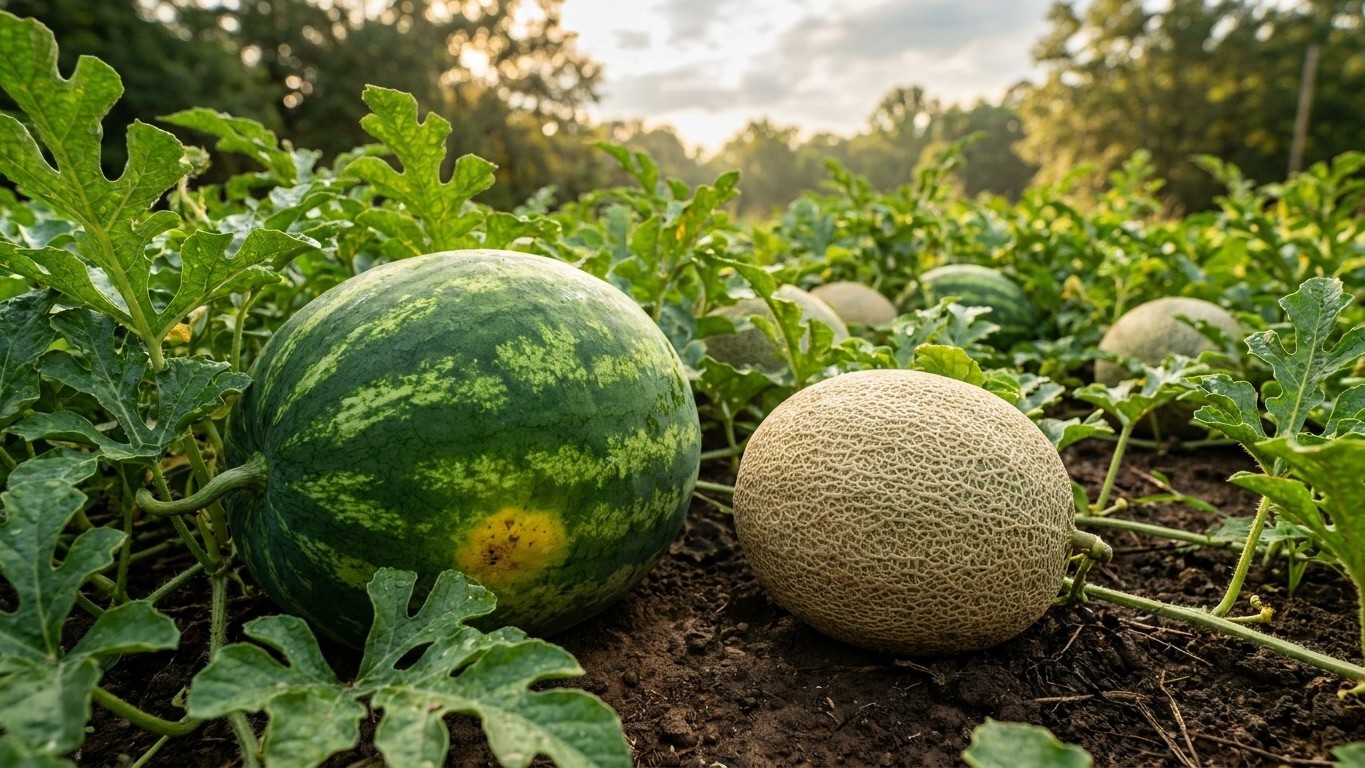

For British Columbia’s coastal and lowland gardens, the melons worth planting are the fast ones: short-season muskmelons and icebox-type watermelons bred to ripen on heat units this province rarely produces. Large dessert watermelons and true honeydews, the kind that need a long run of hot days, are a gamble here rather than a plan.
The short answer for British Columbia
Start with the two numbers that actually decide this: an average last spring frost of March 18 and an average first fall frost of November 10, both measured at the Vancouver Int’l A station. On paper that’s a season stretching close to eight months. In practice it means almost nothing for melons, because these dates are means, not safe planting or harvest markers. In half of all years, frost arrives later than March 18 in spring, and the fall date works the same way in reverse. Treat the window as a midpoint you’re gambling around, not a calendar you can plant against with confidence.
The number that matters more for melons specifically is days above 90F, and for this reference station it sits at exactly 0.0 per year. Melons are heat-accumulators. They don’t just need frost-free days, they need a stack of genuinely hot ones to push sugar into the fruit and finish ripening before the season closes. A region that never crosses 90F is a region that can grow melons, but only the types built to finish on moderate warmth rather than a heat wave.
That’s why the decision here is best made by type rather than by chasing a specific cultivar name. Short-season, quick-maturing muskmelon and cantaloupe types are the safer bet, since breeders have selected many of them specifically for northern and maritime climates where heat units run low. Icebox-type watermelons, the smaller, faster-maturing category, beat the large dessert types for the same reason: less total heat required, less time on the vine waiting for a summer that doesn’t have much heat to give. Honeydew and casaba types sit at the bottom of the list for BC gardens, since they typically demand both a longer season and more sustained warmth than the muskmelon group.
Hardiness zone matters less for melons than for perennials, since melons are replanted every year rather than surviving winter in the ground. Still, worth flagging: the reference city here sits in Canadian zone 9a, a figure built on Canada’s own seven-variable system and not convertible to a USDA zone. Don’t use it to compare against varieties bred and rated for a US zone number, and don’t treat it as a province-wide fact. It describes one station, not the whole territory.
What will not work here

Long-season melon varieties bred for hot interior or continental climates are the clearest failure case in this territory. Those varieties are selected to accumulate heat units fast, on the assumption that plenty of 90-plus days are available to burn through a long ripening curve. With 0.0 such days at the reference station, that assumption collapses. The vine can grow, flower, and even set fruit here, and still run out of usable heat before the sugars develop. A melon that reaches the vine in October without ripening isn’t a late harvest. It’s a failed one.
Reaching the average fall frost date of November 10 is not a finish line either. Heat accumulates unevenly across a season, and a cool, overcast August, common along this coast, can erase weeks of progress that a calendar alone wouldn’t show. A gardener who plants a long-season type and simply counts down to November 10 is measuring the wrong thing. What matters is the running total of warm days, not the days remaining until frost.
Rainfall tells a smaller but real part of the story. Summer rainfall here averages about 5.0 inches across June, July, and August, with July the driest month at 1.4 inches. That’s a dry enough summer that melons won’t suffer from constant wet feet or the fungal pressure that plagues muskmelon crowns in humid climates. But dry and cool is not the same as dry and warm: low rainfall doesn’t compensate for a heat deficit, and gardeners still need to water through fruit set, since neither June’s 2.12 inches nor July’s 1.4 inches is enough on its own to carry a melon crop through peak demand.
Close spacing, the kind that works in humid regions to manage air within a sea of foliage, isn’t the risk here that it is elsewhere. The bigger mistake in this territory is planting a variety selected for someone else’s heat, then blaming the season when it fails to ripen.
What changes across British Columbia
British Columbia is not one growing climate, and the hardiness zone figure above makes that plain on its own: 9a describes the reference city used in these facts, not the province. A territory this size, running from mild coastal lowlands through mountain valleys to interior plateaus, does not compress into a single number, and treating it as one is the fastest way to misjudge a melon planting.
The practical shift a gardener needs to make is about heat, not just cold tolerance. Interior valleys in this province can run considerably hotter and drier in summer than the coastal reference station used for these figures, which changes the melon math entirely: a longer-season type that fails on the coast for lack of heat may ripen without trouble a few hundred miles inland. The reverse also holds. Northern districts and higher-elevation gardens run weeks behind the coastal averages on both ends of the season, meaning a shorter effective window than even the already-uncertain March 18 to November 10 spread suggests.
What can be said plainly: if your garden sits inland or at elevation relative to the coast, expect the season to open later and close earlier than these numbers imply, and expect summer heat to run either higher or lower than the 0.0 days-above-90F figure, depending on which direction you’ve moved from the reference point. Natural Resources Canada’s hardiness zone map is the tool built for narrowing that down to a municipality, and it’s worth checking before committing bed space to a longer-season melon type on the assumption that “British Columbia” describes one climate.
Where to check this for your own county
Everything above comes from a single reference station and a single reference city. That’s useful for a province-wide starting point, but it is not a substitute for what your local growing region actually experiences, and the gap between the two can be the difference between a ripened melon and a vine full of green fruit in October.
British Columbia’s Ministry of Agriculture and Food publishes regional guidance at www2.gov.bc.ca/gov/content/industry/agriculture-seafood. What’s worth pulling from that source specifically: a planting calendar built for your local region rather than the province as a whole, and any list of varieties that have actually been trialled in your county or regional district. Provincial or state-level advice is built to be broadly true across a wide area. A county-level or regional-district recommendation is built to be precisely true for a much smaller one, and precisely true beats broadly true every time the two disagree.
This matters more for melons than for many crops, because the heat-unit gap between BC’s regions is large enough to flip a variety recommendation entirely. A type that struggles on the coast, for the reasons laid out above, may be a standard, reliable choice in a warmer interior district covered by the same provincial guidance. The provincial source is the right place to find out which side of that line your specific area falls on, since it speaks to the reference point its figures were built from.
Checking this against your own garden
None of the dates or averages above outrank what’s actually happening in your own soil this season. Three things to watch, none requiring equipment beyond your own hands and eyes, tell you more about your specific garden than a provincial frost date ever will.
First, soil warmth by feel. Push a hand into the planting bed a few inches down. If it still feels cold and damp rather than warmed by the sun, melon seed or transplants will sit and sulk rather than grow, regardless of what the calendar says about frost having passed weeks earlier.
Second, the first flush of male flowers. Melon plants typically produce male flowers before female ones, and a strong early show of males, followed a week or two later by flowers with a small swelling at the base (the female flowers), signals the plant has enough accumulated warmth to move into fruit-setting mode. A vine that flowers weakly or drops flowers without setting fruit is telling you the season hasn’t delivered enough heat yet, whatever the average days-above-90F figure claims for the wider region.
Third, the first true leaves. The initial rounded seed leaves don’t tell you much, but the jump to true, lobed melon leaves marks the point where the plant has moved past its most fragile stage. Slow true-leaf development compared to what you’ve seen in past seasons is often the clearest early sign that your specific plot is running cooler than the provincial averages this year, and that a shorter-season variety next time would be the safer call.