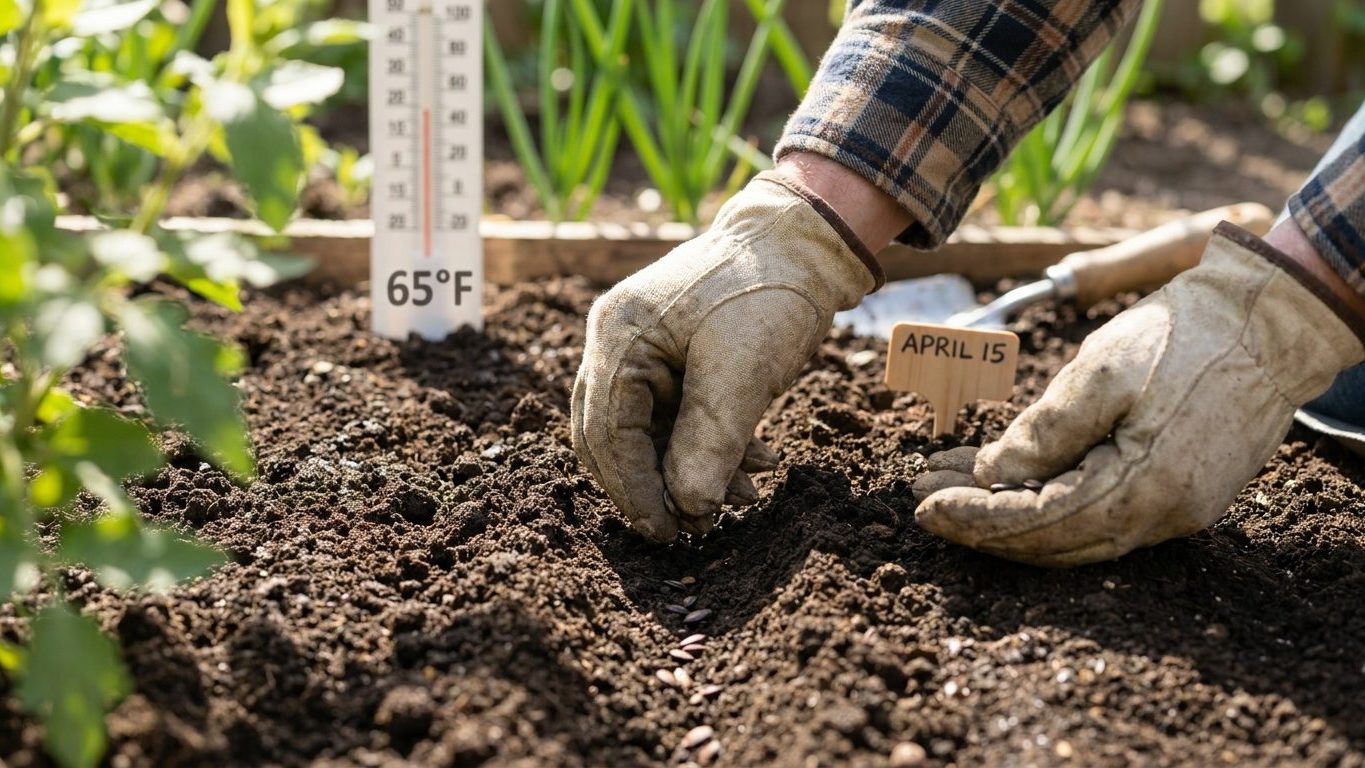

In Delaware, melons go into the ground or the garden bed once the soil has warmed well past the last frost, roughly late April to mid-May depending on where you sit in the state. That answer comes straight from the frost data for the reference station, but frost dates are only a starting point. What actually decides your planting day is soil temperature, and that lags behind the calendar.
The short answer for Delaware
The last spring frost at the reference station (USW00013781) falls between April 3 and April 14, and the first fall frost arrives between October 26 and November 7. Those dates aren’t a hard line, they mark the window where a 32F freeze has a 30 to 70 percent chance of happening, based on 1991-2020 NOAA climate normals. In plain terms, April 3 is early enough that a freeze is somewhat likely, and April 14 is late enough that the odds have dropped substantially. Neither date is a guarantee.
Melons don’t care about frost the way lettuce or peas do. They care about soil temperature, and that’s the number that actually governs your calendar. Melon seed germinates poorly below 65F and stalls entirely below 60F, so gardeners who direct-sow typically wait two to three weeks past the last frost date to let the ground catch up. That pushes a realistic direct-sow window to late April into mid-May for most of the state. If you’re setting out transplants instead, you can move a little earlier since the plants aren’t waiting on soil to trigger germination, but a cold snap will still stunt them even without frost.
Run the math backward from the fall side and the picture gets more interesting. Counting from the earliest likely fall frost (October 26) back to the latest safe spring planting (mid-May) gives a frost-free stretch of roughly five and a half months. Most melon varieties need somewhere between 65 and 100 days to mature, so even a mid-May planting leaves comfortable room for a full-season melon to ripen before the first frost risk climbs back up in late October. That cushion is the real story here: Delaware’s growing season is generous enough that timing errors of a week or two rarely sink the crop.
What this page can’t tell you is which end of that April 3 to April 14 range applies to your yard, or whether your county extension office trials different windows for different varieties. Those are county-level answers, and they live at the state extension service, not in a statewide frost table.
What will not work here
Season length isn’t the trap in Delaware. With a frost-free stretch of somewhere around 195 to 215 days at the reference station, even a slow, 100-day melon has margin to spare if it goes in by mid-May. The failure mode here is different, and it comes from two other numbers: rainfall pattern and humidity.
Summer rain totals about 13.1 inches across June, July and August, broken down as 4.67 inches in June, 4.41 in July, and 3.98 in August, the driest of the three. That’s not a drought pattern, but it’s also not evenly distributed, and it tends to arrive as thunderstorms rather than steady soaking rain. A grower who assumes “13 inches of rain means I don’t need to water” is setting up for trouble in August specifically, when rainfall drops and the plant is often carrying its heaviest fruit load. Combine that dry stretch with 17.6 days a year at 90F or hotter, and you get exactly the conditions that stress a shallow-rooted crop like melon: heat pulling moisture out of the leaves faster than a spotty August rain can replace it in the soil. Watering on a weekly schedule and hoping the sky fills the gaps is a common way to lose fruit to blossom-end rot or splitting once a heavy rain finally does show up after a dry stretch.
The other side of that same coin is humidity. Delaware’s rain doesn’t just fall, it lingers in the air afterward, and that combination of warm nights and wet foliage is prime territory for powdery mildew and downworm fungal issues on melon vines. Growers who plant on tight spacing to save space, thinking they’ll thin later, often don’t thin in time. Dense canopies trap moisture against the leaves and speed up disease spread, especially once vines start sprawling into each other in July. Wide spacing and good airflow matter more here than in a drier climate, because the fungal pressure builds from ambient humidity as much as from direct rainfall.
None of this means melons struggle in Delaware. It means the failure points are watering discipline in August and airflow management in midsummer, not the length of the season or the date of first frost.
What changes across Delaware
Delaware sits across USDA Hardiness Zones 7a to 8a, based on the 2023 USDA Plant Hardiness Zone Map using 1991-2020 averages. That’s a real spread inside a small state, and it’s built entirely on one measurement: the average annual extreme minimum winter temperature. It doesn’t directly measure frost timing, growing season length, or summer heat, but it’s a reasonable proxy for how much colder the northern part of the state runs compared to the south.
A zone 7a location, likely found further north or at any higher elevation the state has, tends to run colder in winter and can see a later last frost in spring than a zone 8a spot near the coast or in the southern counties. That difference doesn’t just shift your planting date by a few days, it can also affect how reliably a longer-season melon variety finishes before fall frost arrives. A gardener in the milder 8a end of the range has more room to gamble on a 90-plus day variety; someone in the cooler 7a end benefits from leaning toward the shorter end of the maturity spectrum, just to build in a buffer.
There’s no way to give a single statewide planting date that fits both ends of that zone range accurately, and this page isn’t going to pretend otherwise. The frost data cited above comes from one reference station, and it will run early or late depending on where you actually garden relative to that station. Coastal areas moderate faster in spring and hold heat longer into fall. Inland and low-lying spots collect cold air and frost earlier and later than the airport-station numbers suggest.
If you want to know which zone your specific property falls into, the USDA’s interactive hardiness zone map is the tool for that, not a guess based on which part of the state you live in generally. Zone boundaries can shift meaningfully within a single county, especially near rivers, low areas, or elevation changes.
Where to check this for your own county
Everything above is a state-level picture built from one weather station and one statewide hardiness map. Neither one knows your county’s soil, your local frost pockets, or which melon varieties have actually performed well in trials near you. That’s what the University of Delaware Cooperative Extension is for, and it’s the next stop if you want an answer sharper than this page can give.
You’ll find it at the University of Delaware Cooperative Extension. Look specifically for two things once you’re there: a county-level planting calendar, if one is published, and any variety trial results for melons or cucurbits generally. Extension offices in melon-growing states often maintain lists of cultivars that have held up against local disease pressure and heat load, which is more useful than a generic “days to maturity” number printed on a seed packet.
A county recommendation beats a state one every time, because it’s built from local trial plots, local extension agents fielding local questions, and local soil and pest conditions rather than a single airport weather station averaged over thirty years. This page gives you the state-level starting point: frost windows, heat load, rainfall pattern, hardiness zone range. Your county extension office gives you the version calibrated to where you actually garden. If the two disagree, trust the county source.
It’s also worth calling or emailing your local extension office directly if the website doesn’t have a published melon-specific calendar. Many county agents answer planting-date questions directly, especially during the spring rush, and they’ll often know which years ran early or late compared to the long-term averages this page relies on.
Checking this against your own garden
Every date on this page is an average built from thirty years of weather data at one station. Your garden isn’t an average, and three simple observations will tell you more about your actual planting window than any calendar.
Start with soil warmth, checked by feel rather than a thermometer most people don’t own. Push your hand a couple inches into the bed in the morning. If the soil feels cool and slightly damp in a way that makes you want to pull your hand back, it’s still too cold for melon seed to germinate reliably, regardless of what the frost date table says. Soil that feels closer to room temperature, even in the early morning, is a much better sign that germination will happen quickly rather than sitting and rotting.
Second, watch for the first flush of male flowers on any early-planted cucurbit relative in your garden, like squash or cucumber, if you’ve got one in the ground already. Male flowers typically appear before female ones and before fruiting begins, and their timing tells you how your particular microclimate is tracking against the regional average this season. An early flush suggests your spot is running warm for the year; a late one suggests you’re behind the curve and might want to hold off on a second melon planting.
Third, once your melons are in, watch how fast the first true leaves develop after the initial seed leaves (cotyledons) appear. Quick, sturdy true-leaf growth within a week or so signals good soil warmth and steady conditions. Slow, pale, or stalled growth at that stage usually means the soil was planted a little too early relative to your specific yard, even if it matched the regional calendar. That’s useful information for next year’s timing, not just this one.