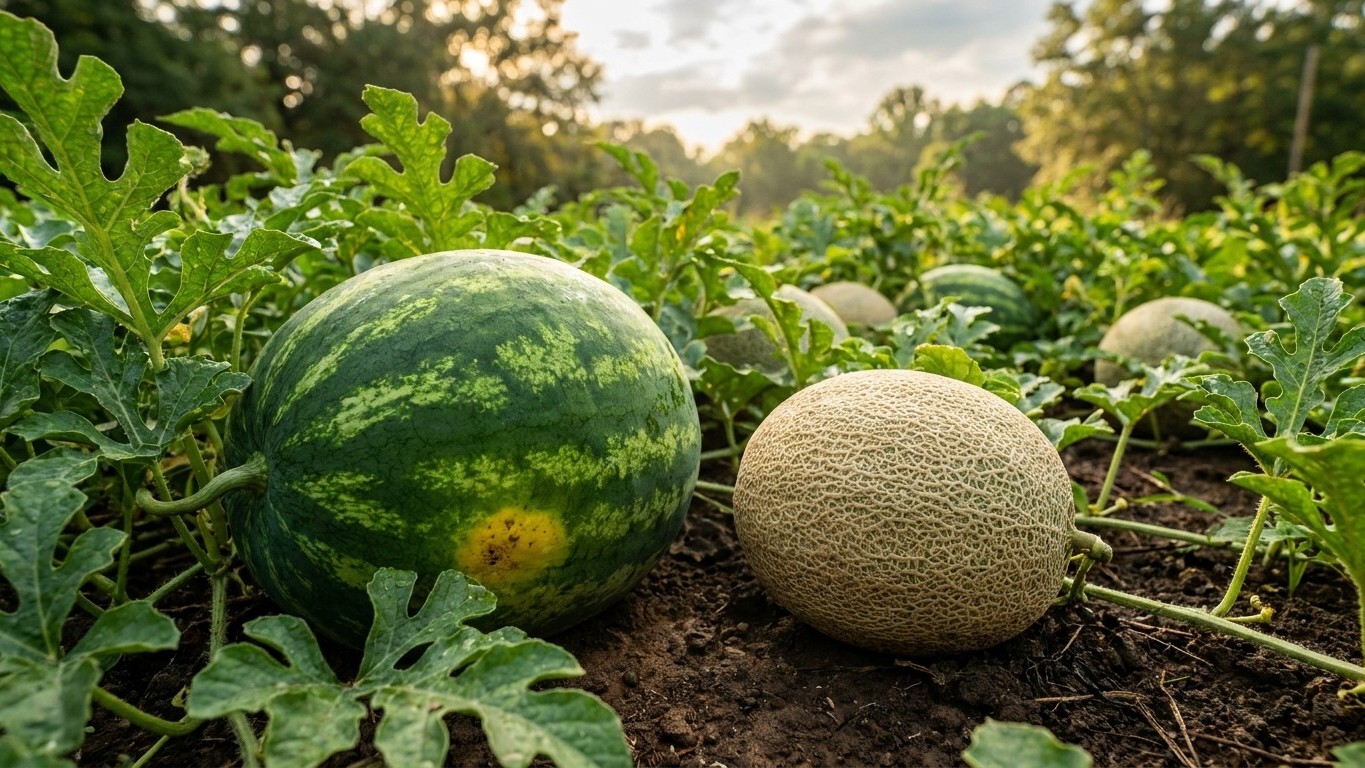

Kentucky’s frost-free season runs long enough, and its summers hot enough, that cantaloupe and full-size watermelon are the safest bets for home gardens across the state. Honeydew and other melons bred for drier air struggle against the humidity that builds through a Kentucky August. The variable that actually decides success isn’t the calendar. It’s the moisture sitting in the air and soil that determines which vine stays healthy long enough to ripen fruit.
The short answer for Kentucky
Start with the numbers. NOAA’s 1991-2020 climate normals put Kentucky’s last spring freeze somewhere between March 24 and April 4, and the first fall freeze between November 2 and November 12. Those are 30-70% probability bands, not fixed dates, but they bracket a frost-free stretch of roughly 212 to 233 days depending on where the actual freeze lands in a given year. That’s a long window. Most melons, including full-size watermelon, need 80 to 100 days from transplant to harvest, so even the cautious end of that range leaves a comfortable cushion.
Heat is the second piece. The reference station averages 37.2 days a year at or above 90°F. That’s real summer heat, the kind that drives sugar development in melon flesh, without tipping into the extreme, dry heat load of the desert Southwest. It’s a heat profile that suits melons bred for a humid, moderately hot summer rather than melons bred for arid, high-desert growing.
Put those two facts together and the decision by type looks like this:
| Melon type | Fit with Kentucky’s season | Fit with Kentucky’s heat | Main risk |
|---|---|---|---|
| Cantaloupe / muskmelon | Strong, matures with days to spare | Good, heat days support sugar development | Foliar disease in wet stretches |
| Full-size watermelon | Adequate if transplanted promptly after last frost | Good | Late-season varieties leave little buffer |
| Icebox/short-season watermelon | Very strong, wide margin | Good | Lower, easier to manage |
| Honeydew | Adequate on paper | Marginal, wants drier heat | Humidity blunts sugar concentration |
Season length and heat load are described at the state level. It doesn’t have county-by-county days-to-maturity data or soil-specific figures, so the honest answer stops at the type level rather than naming a single “best” cultivar. A cantaloupe or a full-size watermelon suited to your county’s actual conditions is the safer framing than any single variety name borrowed from a seed catalog written for a different climate.
What will not work here

The season isn’t what trips up Kentucky melon growers. The humidity is. Summer rainfall averages about 12 inches across June, July and August, with June the wettest at 4.27 inches and August, usually the critical ripening month, still holding at 3.71 inches. That’s not a drought pattern. Combined with 37.2 days a year above 90°F, it produces the classic Ohio Valley combination: warm, wet air that keeps leaf surfaces damp long after a storm has passed. Melons bred for dense vining and tight fruit clusters, the kind that thrive in the drier air of the Mountain West or the high desert, tend to develop powdery mildew and downy mildew here well before harvest.
Honeydew sits at the center of that problem. It wants drier heat to concentrate sugars in the fruit, and Kentucky’s humid air keeps vines and fruit surfaces wet, which favors rot organisms over sweetness. It isn’t impossible to grow, but it’s a harder path here than cantaloupe or watermelon, and the failure usually shows up as bland or split fruit rather than a dead plant.
Watering habits fail just as often as variety choice. The rainfall figures above never read alone. On clay soils, which hold moisture for days, that 4-inch monthly average may be close to sufficient. On sandy or compacted soils, the same rain runs through within a day, and gardeners who assume “we get plenty of rain in summer” and water only when they remember will underwater right through the hottest stretch, when 37.2 annual days above 90°F concentrate demand. A single summer thunderstorm also tends to run off a dry, sun-baked garden bed rather than soak in, so the rain gauge total can be misleading even in a wet month.
Late-maturing, full-size watermelon varieties pushed by a late transplant are the other common failure. If the last frost lands at the late end of its band (April 4) and a gardener waits even another week or two for soil to warm, a 100-day-plus variety can crowd right up against the early end of the fall frost band (November 2). Rural Kentucky gardens should expect that margin to be tighter still: the National Weather Service in Louisville notes that its reference station runs later in spring and earlier in fall than the surrounding rural county, meaning outlying gardens likely see a shorter effective season than the state figures suggest.
What changes across Kentucky
Kentucky spans USDA Hardiness Zone 6a to 7a, using the USDA Plant Hardiness Zone Map system built on average annual extreme minimum winter temperature. That’s not a small spread inside one state, and it means there’s no single planting date or variety choice that fits Paducah the same way it fits a garden near the Virginia line at higher elevation. The zone system measures winter cold, not summer growing conditions, but it’s a useful proxy for how much earlier or later a season starts and ends across the state.
A gardener in the cooler, higher-elevation stretch of the state, closer to zone 6a, should lean toward the shorter end of the season estimate given above and favor icebox watermelon or standard cantaloupe over anything marketed as a long-season specialty melon. A gardener in the warmer, lower-elevation zone 7a stretch has more room to work with; a full-size watermelon that needs the full 100 days has a better cushion there than it does farther north or at altitude.
Heat load likely shifts with that same gradient too, though the 37.2-day figure cited here comes from one reference station and shouldn’t be assumed uniform statewide. Rather than guess at which side of that 6a-7a line applies to a given backyard, the right move is checking the current USDA hardiness zone map directly, since zone boundaries follow elevation and local terrain in ways a state-level summary can’t capture.
Where to check this for your own county
Everything above describes Kentucky at the state level, drawn from one reference weather station. A county recommendation beats a state one every time, because it accounts for local elevation, local soil, and the actual variety trial results from growers nearby.
The University of Kentucky Cooperative Extension Service is the place to get that finer detail. Two things are worth looking for once there. First, the county-specific planting calendar, which will translate the statewide frost-date bands into a tighter window for the actual soil and elevation of a specific county. Second, the variety trial results or recommended-variety lists that county agents publish based on what has actually performed well in local test plots, rather than what a seed catalog claims in general terms.
County extension agents also field direct questions by phone or email, and that channel matters most for the two things a website can’t answer: how a particular season is shaping up in real time, and whether local disease pressure that year favors one type of melon over another. A state-level page, this one included, can describe long-run averages. It can’t tell a reader whether this particular June is running wetter or drier than the 4.27-inch normal, and that gap is exactly what a county office is positioned to fill.
Checking this against your own garden
Every date and average here is a long-run normal, built from 1991-2020 climate data at one reference station. A reader’s own garden outranks all of it, and three simple observations do most of the work of confirming or overriding the numbers above.
Soil warmth by feel is the first check. Melon seed germinates poorly in cold soil regardless of what the calendar says about the last frost date; if the soil still feels cool and damp to the hand a few inches down in mid-spring, waiting another week costs less than a stand of seedlings that rot instead of sprout.
The first flush of male flowers is the second signal. Melon vines produce male flowers days to a couple of weeks before the female flowers that actually set fruit appear, and a vine blooming heavily with only male flowers isn’t behind schedule, it’s following its normal sequence. A vine that reaches full size without producing any flowers at all, though, usually points to excess nitrogen or insufficient heat accumulation for that particular spot.
The first true leaves, the ones that emerge after the initial rounded seed leaves, are the third marker. Slow, pale true-leaf growth in a spot that should be warm enough per the zone and frost data above often means the microclimate, a low spot holding cold air, deep shade from a nearby structure, is running cooler than the state averages suggest, and that single observation is worth more than any date printed on a seed packet.