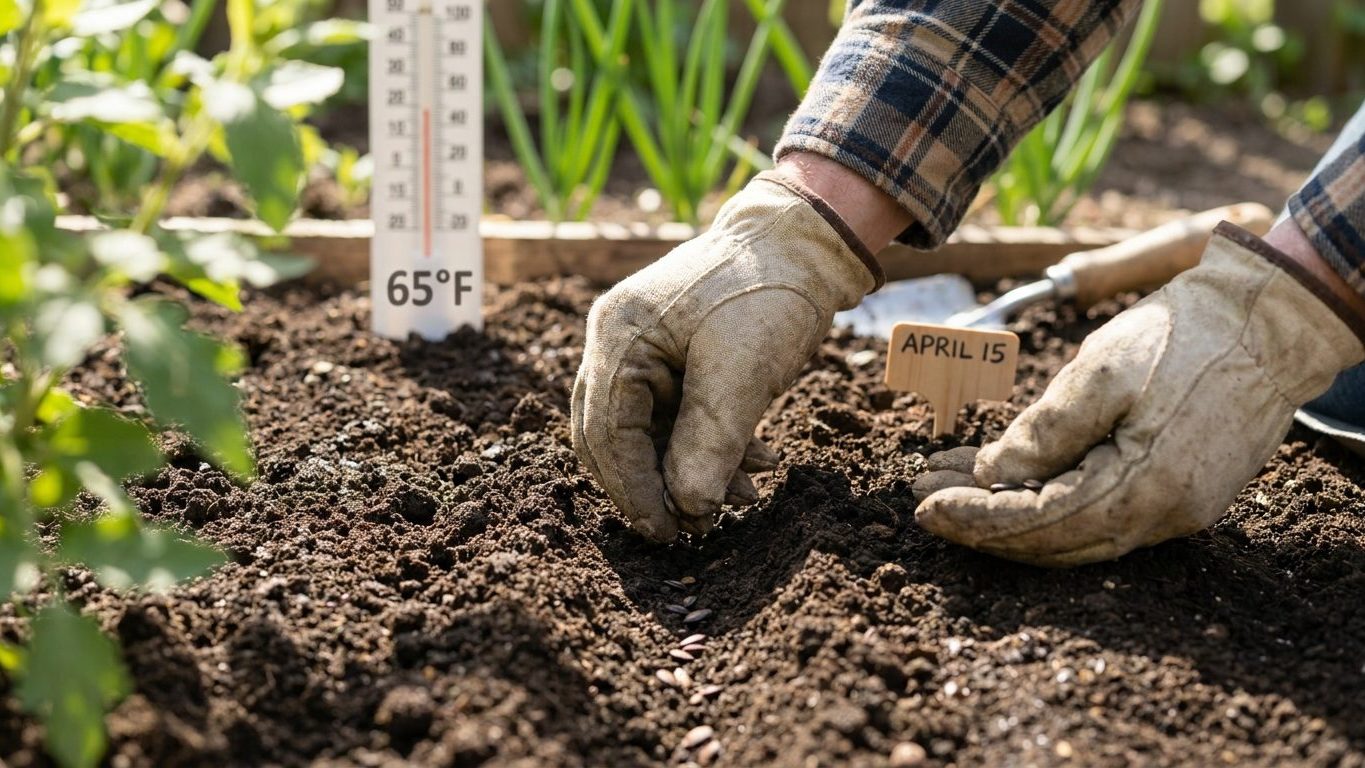

In coastal southern Maine, start melon seeds indoors in early April and move transplants outside between April 22 and May 1, once the last-frost risk has passed. Farther inland or north, push that window later by two to three weeks. Either way, pick a fast-maturing variety and expect to lean on plastic mulch and row cover to make up for a cool, short summer.
The short answer for Maine
Maine’s reference climate station (Portland) puts the last spring frost between April 22 and May 1, and the first fall frost between October 9 and October 21. Those aren’t fixed calendar dates. They’re a 30-to-70 percent probability band from 1991-2020 NOAA climate normals, meaning a frost still has a real chance of showing up on either side of that window. Melons are frost-killed instantly, so the safe move is to transplant after the band closes, not at its earliest edge.
That gives coastal Maine roughly 160 to 180 days between frosts. Sounds generous, but melons don’t ripen on calendar days alone; they ripen on accumulated heat. And Maine’s heat budget is thin: the Portland station averages just 3.8 days a year at or above 90°F. Compare that to a Mid-Atlantic or Southern garden logging weeks of 90-degree days, and it’s clear why a melon variety that shrugs off a cool summer in Virginia can sulk for a whole season in Maine.
Practically, that means starting seed indoors 3 to 4 weeks before the outdoor transplant date, not direct-seeding in open ground. Direct seeding asks the seed to germinate in soil that’s barely warmed by early May, and melons germinate poorly below the mid-60s. Starting indoors in early April, then hardening off and transplanting once the frost-probability window has passed, buys back some of the growing season the climate doesn’t hand out for free.
On the variety side, the short answer is to favor melons bred for 70 to 85 days to maturity from transplant, typically smaller cantaloupe and muskmelon types rather than large watermelons or long-season heirloom melons that expect 90 to 100-plus days of sustained warmth. Black plastic mulch to warm the root zone and floating row cover held over the bed until flowering both help offset the modest heat load. Remove row cover once female flowers appear, since melons need insect pollination and covered plants won’t get visited by bees.
None of this is a guarantee against a late or early frost in any given year. It’s what the probability band and the heat-day average say is the reasonable bet for a typical Maine season, not a promise for this one.
What will not work here
Long-season melons are the first thing to cross off the list. A watermelon variety bred for 95 to 100 days needs sustained heat that Maine’s 3.8 annual days above 90°F simply doesn’t supply. Even with a full 160-to-180-day frost-free window on the coast, most of those days sit in the 65 to 78°F range rather than the high heat melons actually use to push sugar development. The fruit may set, but it often won’t finish ripening before the first fall frost band opens in early October, especially inland where that window closes sooner.
Direct-seeding into bare, unprotected ground is the second failure point. Melon seed wants soil consistently in the mid-60s to germinate reliably. In coastal Maine, soil temperature is still catching up to that range right around the same time the last-frost band is closing, which leaves almost no margin. Skip the indoor head start and a grower is effectively gambling the whole season on a narrow, unreliable soil-warming window.
Watering on autopilot is the third trap. Maine’s summer rainfall averages about 11.2 inches across June, July and August, with July the driest month at 3.43 inches. That’s not a drought figure by Western standards, but it’s also not evenly distributed: a lot of it arrives as thunderstorm bursts that run off rather than soak in, particularly on sloped or sandy ground. A grower who waters once a week on a fixed schedule, assuming the 11-plus inches of summer rain is filling the gaps, can easily under-water melons through a dry stretch in July, right when fruit is sizing up and most sensitive to inconsistent moisture.
Tight spacing is the fourth issue, and it’s counterintuitive given how modest that rainfall total looks on paper. Humidity along the Maine coast and around its many lakes keeps foliage damp longer than the rainfall number alone suggests, which favors powdery mildew and other fungal disease on vines packed close together. Wide spacing and good airflow matter here more than the rainfall total would imply.
What changes across Maine
Maine’s USDA hardiness zone range runs from 3b up to 6a, under the USDA Plant Hardiness Zone Map’s 2023 update, which is built on one variable: the average extreme minimum winter temperature. That’s a wide spread for one state, and it means there is no single melon planting date that applies from Kittery to the Canadian border. The coastal reference station used for the frost dates above sits at the mild end of that range. Inland valleys and the interior north run measurably colder.
What that spread means in practice: a grower well north or at higher elevation should expect the last frost date to land noticeably later than the April 22-May 1 band, and the first fall frost to arrive earlier than October 9. Both ends of the growing season squeeze inward, shortening an already tight melon window. The response isn’t a different melon strategy so much as a more aggressive version of the same one: start seed indoors earlier relative to the local last-frost date, hold row cover on longer, lean harder on black plastic mulch, and pick the shortest-maturity variety available rather than a mid-range one.
A grower at higher elevation anywhere in the state, even in a county that otherwise runs mild, should apply the same adjustment locally: cold air pools in low spots and valley bottoms, so a garden sitting in a hollow can run a full hardiness zone colder than a spot a few hundred feet higher on the same hillside.
None of this points to a single zone number that fits a given reader’s own yard. It only points to a range, and to the direction of adjustment (later start, earlier finish, shorter variety) for anyone gardening away from the mild coastal reference point.
Where to check this for your own county
This page draws on statewide climate normals from one reference station, which makes it useful for a general sense of the season but not a substitute for county-level guidance. The University of Maine Cooperative Extension, reachable at extension.umaine.edu, is the place to check next.
Two things are worth looking for there specifically. First, a local planting calendar tied to the reader’s own county rather than the statewide range cited here; Extension offices often publish or can point to frost-date data pulled from a station much closer to a given garden than the Portland reference used in these figures. Second, variety trial results or recommendation lists for melons that have actually been grown and evaluated in Maine conditions, which matters more for a crop as heat-sensitive as melon than it does for something forgiving like lettuce or kale.
A county-level recommendation will always outperform a state-level one for a simple reason: Maine’s climate varies enough within its own borders, from mild coastal towns to cold interior valleys, that a single statewide answer has to average over real differences. This page is that statewide answer. It’s a reasonable starting point for framing the question, not the final word for a specific address. Extension staff and county-specific bulletins exist precisely to close that gap, and for a crop with as little margin for error as melons in a short Northern season, that gap is worth closing before committing a whole spring’s worth of seed-starting effort to one date.
Checking this against your own garden
Frost-date bands and hardiness zones describe averages. A reader’s own garden will confirm or override them, and three simple observations do that better than any date on a calendar.
Soil warmth by feel is the first. Reach a hand into the planting bed a few inches down; if the soil feels genuinely cool rather than just cool-ish, even on a warm afternoon, it’s telling a grower the ground hasn’t caught up to the air temperature yet, and transplanting now risks stalled, sulky growth rather than an outright freeze. Melon roots barely function in cold soil even when the air above feels transplant-ready.
The first flush of male flowers is the second signal. Melons produce male flowers before female ones, usually by a week or two, and a healthy early flush of males is a sign the plant has settled in and started reproductive growth on schedule for the local microclimate. A long delay in male flowers, well past what the transplant date would suggest, often points to a garden running cooler than the regional average implies.
The appearance of the first true leaves, the serrated leaves that follow the rounder seed leaves, is the third. Their timing and size give a rough read on how much heat the plant has actually banked since transplant, regardless of what the calendar says the date is. Small, slow-to-appear true leaves in a spot expected to be warm suggest a colder microclimate, maybe from shade, wind exposure, or a low spot, than the surrounding neighborhood.
Taken together, these three cues outrank every date in this article, because they come from the actual soil and air a specific plant is sitting in, not from a station average.