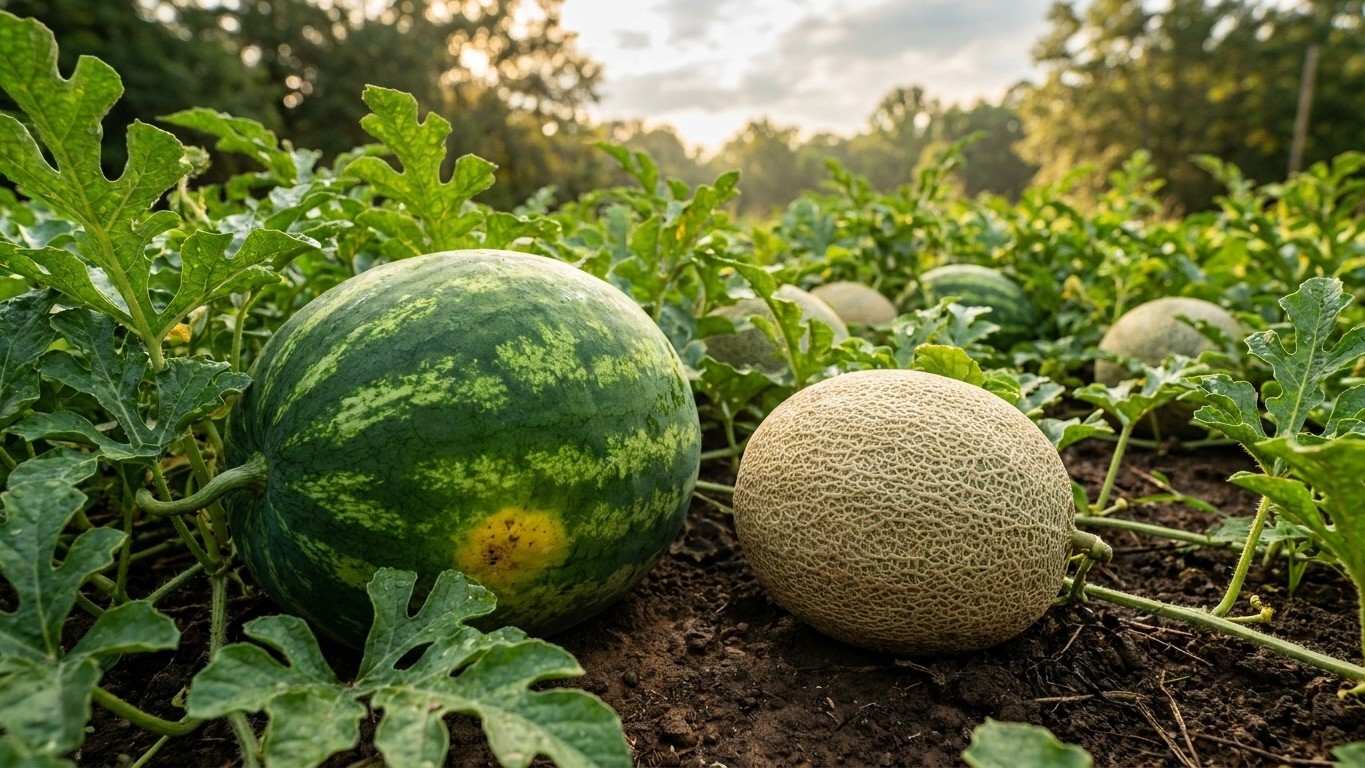

Maine’s best bet is short-season muskmelon and cantaloupe varieties bred to mature in under 80 days, not the long-season watermelons or honeydews that dominate seed catalogs. The state’s cool summers and modest frost-free window rule out anything that needs a long, hot stretch to ripen.
The short answer for Maine
Start with the numbers that actually decide this. Using the conservative end of the frost data for the reference station near Portland, the last spring frost falls between April 22 and May 1, and the first fall frost arrives between October 9 and October 21. Take the tighter, safer pairing (May 1 to October 9) and Maine’s usable growing window runs to roughly 161 days at the mild coastal edge. Inland and northern counties lose real time off both ends, so treat that figure as an upper limit, not a guarantee.
Heat matters just as much as calendar days. The reference station averages only 3.8 days a year at 90F or hotter. Melons are heat-hungry plants that convert warm days into sugar, and Maine simply doesn’t hand out many of those days. That low heat load is the real reason big watermelons and honeydews struggle here even when the season length looks adequate on paper.
Which type actually fits
Put those two constraints together, short season and low heat, and the decision by type becomes straightforward.
| Melon type | Typical days to maturity | Heat requirement | Fit for Maine |
|---|---|---|---|
| Short-season muskmelon/cantaloupe | 68-80 | Moderate | Best fit |
| Icebox-type watermelon (small fruit) | 75-85 | Moderate-high | Workable in a warm, sheltered spot |
| Full-size watermelon | 85-100+ | High | Poor fit outside exceptional microclimates |
| Honeydew | 85-100 | High | Poor fit |
Inside that top row, look for varieties specifically marketed as “early,” “short-season,” or bred for northern gardens, cold frames, or high tunnels. Small-fruited cantaloupe and muskmelon types set fruit faster and ripen on less accumulated heat than the giant slicing melons bred for warmer states. If a variety description leans on words like “reliable in short summers” or lists a maturity date under 80 days, that’s the direction Maine’s numbers point.
What will not work here

Long-season melons are the first casualty. Anything listed at 90 days or more to maturity is racing a clock that, in Maine, often runs out before the fruit finishes sizing and sweetening. Even in a warm year, a melon that needs 95 days from transplant is competing against a frost-free window that, at the conservative estimate, offers about 161 days total, and a good chunk of that gets eaten up by slow early-season soil warming before the plant even starts real growth.
Heat-loving types fail for a separate reason. With an average of just 3.8 days a year above 90F, Maine doesn’t deliver the sustained warmth that honeydews and large watermelons use to convert vine growth into sugar-dense fruit. A gardener can get a watermelon vine to grow beautifully here and still end up with pale, watery fruit that never truly ripens, because the plant never received the heat units it was bred to expect.
The humidity problem nobody mentions
Then there’s the water side of the equation, and it cuts the opposite way from what most gardeners assume. Summer rainfall across June, July, and August averages about 11.2 inches, with July, the driest month, still bringing 3.43 inches. That’s not a drought pattern. It’s enough ambient moisture, especially combined with Maine’s cooler nights, to make powdery mildew and other fungal diseases a real threat to melons planted too close together. A spacing plan borrowed from a hot, dry state, tight rows meant to conserve water, backfires in Maine by trapping humidity around the leaves.
The fix isn’t complicated: wider spacing than the seed packet’s minimum, good airflow, and morning watering at the soil line rather than overhead irrigation in the evening. But skip that adjustment and even a well-chosen short-season variety can lose its leaves to disease before the fruit finishes ripening. Watering on a fixed weekly schedule regardless of rainfall is its own mistake here; a wet July followed by a dry August means the irrigation plan has to change mid-season, not run on autopilot.
What changes across Maine
Maine is not one growing zone, and treating it like one is where a lot of melon plans go wrong. The USDA Plant Hardiness Zone Map, built on average annual extreme minimum winter temperature, places Maine across a spread from 3b to 6a. That’s a wide range for a single state, and it reflects real ground: the difference between a sheltered coastal garden and an inland valley or a spot at elevation is not small.
The frost dates already hint at this. The figures used above (last frost by May 1, first frost by October 9 at the earliest edge) describe the reference station near Portland, which sits at the mild end of Maine’s climate. Inland and northern counties run substantially later in spring and earlier in fall, which compresses the frost-free window well below the 161-day figure used for planning purposes here. A gardener working a 3b pocket is not choosing melon varieties on the same calendar as someone in a 6a coastal microclimate, even though both live in the same state.
Altitude adds another layer on top of latitude. Cold air pools in low-lying inland spots and drains away from hillsides, so two gardens a few miles apart can post noticeably different frost dates. There is no single answer for “when does the season start in Maine,” only a spread, and a reader trying to pin down their own spot needs a finer-grained source than a state-level page can offer. A statewide range can only tell any one garden so much.
Where to check this for your own county
The University of Maine Cooperative Extension is the source built for exactly this gap. Its site, extension.umaine.edu, publishes county-level guidance that narrows the statewide hardiness range and the statewide frost dates down to what actually happens on local ground.
Two things are worth hunting down there specifically. First, the local planting calendar for the reader’s own county, which will reflect the real frost-free window for that spot rather than the coastal Portland figures used as the baseline. Second, the list of melon varieties that extension agents or local trial gardens have actually tested in Maine conditions, since a variety that performs well in a university trial plot a few counties over carries more weight than a general seed catalog description written for a national audience.
A county-level recommendation beats a state-level one every time. It’s built to explain the mechanism, the season length, the heat load, the humidity risk, so the reasoning is clear. But the actual variety list and sowing dates that will perform best in, say, Aroostook County versus Cumberland County are going to differ, and only a county-specific source or a local extension agent can settle that difference with confidence.
Checking this against your own garden
None of the numbers above beat what the garden itself is showing on any given week. Three signs are worth watching, and each one tells the reader something a calendar date can’t.
Soil warmth by feel comes first. Melon seeds and transplants sulk in cold soil regardless of what the calendar says. Pushing a finger a couple of inches into the bed in mid-morning and feeling real warmth, not just the sun’s surface heat, is a better planting signal than any fixed date, especially in a state where microclimates shift so much over short distances.
The first flush of male flowers is the second marker. Melon plants typically open male flowers before female ones, and a healthy early show of male blooms signals the plant has moved past the slow establishment phase and into active growth. If male flowers are late or sparse, it’s often a sign the plant hasn’t had enough accumulated warmth yet, which matters more in a low-heat state like Maine than almost anywhere else.
The first true leaves, the ones that appear after the initial seed leaves, round out the picture. Their size and color say a lot about whether the plant is getting enough light and warmth where it’s actually growing, not where a chart says it should be. Small, pale true leaves point to a spot that runs cooler or shadier than expected, information that’s specific to that garden and that no statewide page, this one included, can hand over in advance.