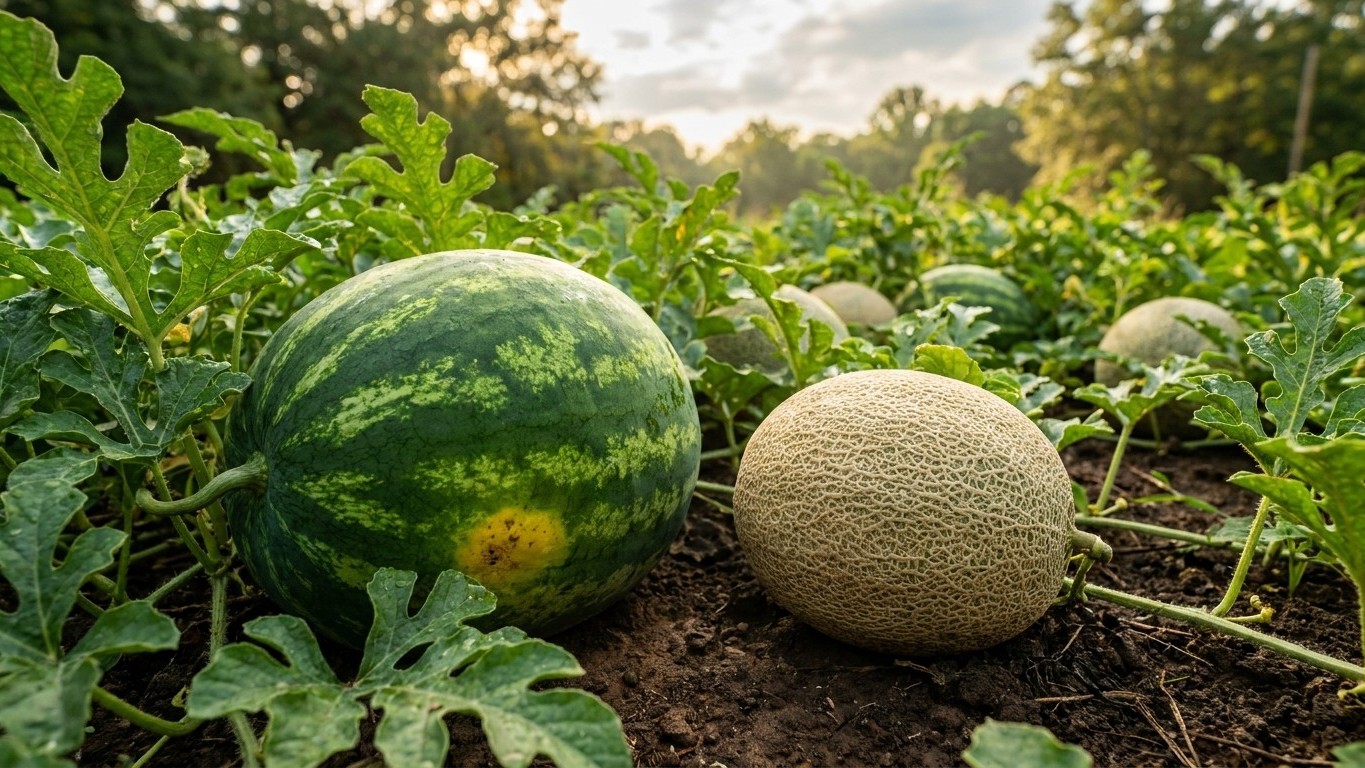

Montana’s frost-free window runs on the short side, and its summer heat arrives in bursts rather than a steady bake. That combination points growers toward fast-finishing melon types: short-season cantaloupe types and compact icebox watermelons, not the full-season watermelons or honeydews that need three-plus months of steady warmth to ripen properly.
The short answer for Montana
Start with the calendar, because it does most of the deciding. The last spring frost at the reference station lands somewhere between April 29 and May 10, and the first fall frost arrives between October 1 and October 14. Stack those two windows against each other and the frost-free stretch runs roughly 144 days in a tight year to about 168 days in a generous one. That is not a long season by melon standards, and it is the single fact that should drive variety selection before anything else.
Add the heat data and the picture sharpens. The reference station averages 28.3 days a year at or above 90 degrees. That is enough heat to ripen a melon, but it does not arrive as a long, even bake the way it does farther south. It comes in stretches, with cooler nights mixed in. Melons that need sustained high heat to sweeten properly are working against the clock twice: once on days-to-maturity, once on heat units actually available.
Put those two facts together and the decision by type becomes fairly clear.
| Melon type | Typical days to maturity | Fit for a 144-168 day window |
|---|---|---|
| Short-season cantaloupe/muskmelon types | roughly 70-85 days | Good, finishes with margin even in a shorter year |
| Icebox/personal watermelon types | roughly 75-85 days | Good, compact vines, quick finish |
| Full-size watermelon types | roughly 85-100 days | Tight, only in the longer years, and only with a head start indoors |
| Honeydew and casaba types | roughly 100-120 days | Poor, routinely runs out of season and heat both |
The practical takeaway: lean toward the fastest-maturing cantaloupe and icebox watermelon types, treat full-size watermelons as a stretch goal that needs transplants rather than direct seed, and set honeydew and casaba types aside unless you’re growing under cover.
What will not work here

The clearest failure mode is arithmetic. A melon that needs 100 days from transplant, started outdoors after the last frost around early May, is still growing when the first fall frost shows up in early October. That’s not a marginal miss, that’s a plant caught mid-ripening with fruit that never finishes sweetening. Honeydew and casaba types, which commonly run 100 to 120 days and want steady heat the whole way, are fighting both the calendar and the heat budget at once. They’re a poor bet without a greenhouse, high tunnel, or serious head start indoors.
The second failure mode is water, and it runs the opposite direction from what people expect. Summer rainfall across June, July, and August totals about 4.3 inches, with August, the exact stretch when melons are sizing fruit, delivering just 0.87 inches. A watering routine built around once-a-week soakings, which works fine in a wetter region, leaves melon roots short on moisture right when fruit is filling out and the 28.3 annual days above 90 are pulling water out of the soil fastest. The fix isn’t more water necessarily, it’s more frequent, shallower checks on soil moisture through peak fruit-set, especially on sandy soil that drains fast.
A third failure mode is treating the whole state as one growing zone. Montana’s hardiness range spans 3a to 6a under the USDA system, an enormous spread built on one variable, the average annual extreme minimum temperature. A melon plan built around the milder end of that range and then planted in a colder pocket is starting from the wrong frost dates entirely.
Finally, mountain valleys elsewhere in the state can frost in any month, a caution worth taking seriously rather than skimming past. A variety chosen for a 150-day season does nothing for a garden that might see a frost in July.
What changes across Montana
The reference figures used above come from one of Montana’s milder valley locations. The state’s hardiness range runs 3a to 6a, and that spread is wide enough that there is no single melon answer for “Montana” as a whole. A 3a garden and a 6a garden are not variations on a theme, they’re different growing problems.
At the colder end of that range, the frost-free window shrinks further than the 144-to-168-day figure already discussed, and the margin for a full-size watermelon or anything in the honeydew category disappears almost entirely. Growers there are better served leaning hard into the fastest cantaloupe and icebox types, starting transplants indoors, and using black plastic mulch or row cover to bank extra soil heat in spring, since cool soil delays germination and slows early root growth regardless of the seed packet’s promises.
Altitude compounds the effect independent of latitude. A valley floor and a bench a few hundred feet higher in the same county can carry meaningfully different frost dates, and the caution already noted, that mountain valleys can frost in any month, applies more to the higher and more northern parts of the state than to the milder reference valley used for the figures above.
None of this can be resolved from a state-level page, and it shouldn’t be. The right move is checking the USDA Plant Hardiness Zone Map for the specific location in question rather than assuming either end of the 3a-6a range applies.
Where to check this for your own county
Montana State University Extension is the state’s land-grant extension service, and it’s the right next stop for anyone trying to move from a statewide range down to a single county.
Two things are worth looking for once there. First, a county-level planting calendar, if one exists for the area in question, since it will translate the statewide frost-date range into a narrower, locally-observed window rather than the 144-to-168-day estimate built from a single reference station. Second, any variety trial data specific to the region, particularly for melons and other warm-season crops that sit near the edge of what the local season can support. Extension trials exist precisely to answer which specific types have actually finished ripening, in real seasons, in that particular county.
A county recommendation will beat a state one every time, because it’s built on local frost records and, often, on multiple seasons of trial results from growers working the same soil and elevation. The statewide picture rests on a single reference station’s climate normals. That’s useful for understanding the shape of the problem, the season length, the heat load, the rainfall pattern, but it isn’t a substitute for what a county extension office already knows about which melons actually finish there.
If no melon-specific county calendar exists, a general vegetable planting guide from the same extension office will still carry local frost-date estimates more precise than the statewide range used here, which is the single most useful number for deciding when to start seed or set transplants.
Checking this against your own garden
Every date here is a normal, an average built from 1991-2020 records at one reference station. A gardener’s own soil and plants will say more about what’s actually happening this year than any calendar can.
Soil warmth by feel is the first check. Melon seed germinates poorly in cold soil, no matter what the calendar says about the last frost having passed. Pressing a hand into the top few inches of bed soil and finding it consistently warm, not just warm at midday, is a better germination signal than a fixed date.
The first flush of male flowers is the second thing to watch. Melon vines produce male flowers before female ones, and a healthy run of them signals the plant has moved past establishment and into active growth, a sign the local season is treating that variety well.
The first true leaves, the leaves that appear after the initial seed leaves and actually look like the plant’s mature foliage, mark the point where a seedling has shifted from living off stored seed energy to functioning on its own roots. Slow, pale, or stalled true-leaf development in a spot that should be warm enough often points to a specific microclimate issue, a cold pocket, heavy shade, or compacted soil, that no regional planting date can account for.