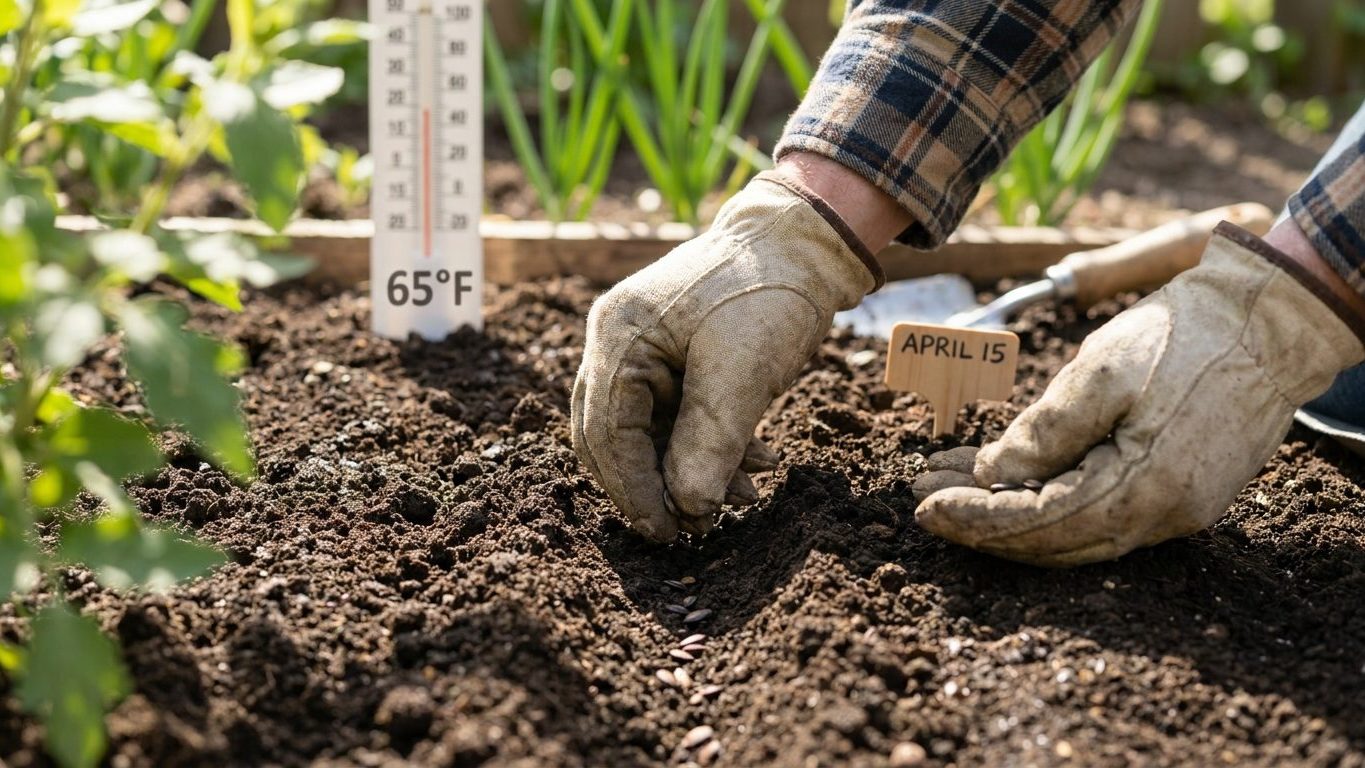

Melons need warm soil and a long stretch of frost-free days to ripen, so the safe window for New York runs from late April into May at the earliest, and only after the soil itself has warmed, not just the air. The exact date depends on where in the state you garden, because New York’s frost calendar is not one calendar at all.
The short answer for New York
At the reference weather station for New York City, the last spring freeze falls somewhere between March 23 and April 3, and the first fall freeze arrives between November 14 and November 27. Those are NOAA’s 1991-2020 climate normals, and they describe a probability band, not a promise: the actual freeze in any given year can land earlier or later than that window a meaningful share of the time. Melons don’t care about the calendar date so much as the soil temperature, and that’s the piece the frost dates only hint at.
Melon seed germinates poorly below roughly 65°F soil temperature, and the vines sulk in anything cooler even after they sprout. Air temperature at the reference station typically clears the last-frost band by early April, but soil at 3 to 4 inches deep usually needs another two to four weeks of sun to catch up, especially after a wet spring. That pushes the realistic direct-seeding window for the New York City area to roughly the first week of May through the third week of May, with transplants (started indoors three to four weeks earlier) going into the ground on the same schedule once the risk of a late freeze has dropped.
Working backward from the fall side confirms the window is workable but not generous. A frost around November 14, the earlier end of the fall band, gives melons planted in early May something on the order of 190 days before the first freeze risk. Most melon varieties need 70 to 100 days from transplant to harvest, so the New York City area has real margin, at least on paper. That margin shrinks fast the further you move from the reference station, which is the point of the next section.
This page can only answer for the state’s reference conditions. It cannot tell an individual reader in Buffalo, the Southern Tier, or the Adirondacks what their own last frost date is, because that figure was never measured at those sites in the facts behind this page. What it can say is that the same logic, soil warmth before seed, fall frost minus days-to-maturity after transplant, applies everywhere in the state. Only the two dates change.
What will not work here
The biggest trap in New York is treating the whole state like the New York City figures describe it. A 100-day melon variety that comfortably ripens with a first-week-of-May planting near the coast can run out of season entirely in a shorter-season county, where the frost-free stretch is nowhere near the 190-plus days the city reference station enjoys. New York’s hardiness zones span 3b to 7b across the state, and that gap in winter cold typically tracks with a gap in growing-season length too: a long-season melon planted on the same May calendar date in a short-season county simply hasn’t got the days left to finish before the first hard freeze shuts it down.
Direct-seeding too early is the second common failure, and it’s a soil problem more than a frost problem. Melon seed sitting in soil that hasn’t cleared 65°F doesn’t just germinate slowly, it often rots outright, especially with the moisture New York summers deliver. The reference station’s own numbers show June averaging 4.54 inches of rain, the driest of the three summer months, with July and August running slightly wetter at 4.6 and 4.56 inches. That’s roughly 13.7 inches across the whole summer, enough that a cool, damp early-June planting sits in wet, under-warmed soil for days at a stretch. Gardeners who jump the gun by two or three weeks often end up reseeding in late May anyway, having lost nothing but time and seed.
Humidity, not drought, is the other quiet failure mode here. New York’s summer heat load, averaging 12.2 days a year at or above 90°F, is moderate compared to the deep South or the Plains, so this isn’t a state where melons typically fail from underwatering. But that same rainfall pattern, arriving as a fairly even 4.5-plus inches a month rather than one dry stretch, keeps foliage damp longer after storms. Melon vines planted at tight spacing, or grown up against a fence or wall with poor airflow, hold that moisture on their leaves and are more prone to powdery mildew and other fungal disease as the season goes on. Wider spacing and a spot with some air movement do more good here than an extra watering can.
What changes across New York
New York’s USDA hardiness zone range, 3b to 7b under the current USDA Plant Hardiness Zone Map, is one of the widest spreads a single state can claim, and it’s built on one number: the average extreme minimum winter temperature. That’s a cold-hardiness measure, not a growing-season measure directly, but the two usually move together. A 7b reading, closer to what the New York City reference station experiences, generally sits alongside a long, frost-free stretch. A 3b reading, found in colder interior pockets and higher elevations upstate, generally comes with a much shorter one.
What that means in practice: a gardener working land at the colder end of that range should expect their last spring frost noticeably later than the March 23 to April 3 window cited here, and their first fall frost noticeably earlier than November 14 to 27. Both dates are specific to the New York City station and explicitly do not describe upstate New York or the Adirondacks, where colder air pools in valleys and higher ground cools faster. Melons in those areas need every shortcut available: starting seed indoors rather than direct-sowing, warming the soil ahead of transplant with black plastic mulch, and leaning toward the shorter end of the maturity range, varieties finishing in 70 to 80 days rather than 90 to 100.
There is no single planting date for New York, and this page shouldn’t pretend otherwise. The honest version of the answer is: use the New York City window as the earliest realistic case, and shift later, sometimes by three to four weeks, the further you are from that reference station in elevation or distance from the coast. How far exactly is a question for the next section, not for a statewide estimate.
Where to check this for your own county
Looking at this paragraph, I need to move the organization name onto the link and remove the URL text.
The reference station behind these numbers sits in New York City. If you’re gardening upstate, in the Finger Lakes, the North Country, or anywhere at meaningfully higher elevation, that station’s frost dates are a starting point for the logic, not a number to copy onto your own calendar. The fix is Cornell Cooperative Extension, the land-grant extension service for New York State.
Extension offices work at the county level for a reason: frost dates, soil types, and even which melon varieties reliably ripen before the county’s own first fall freeze all get recorded locally, county by county, in a way a single statewide figure never can. Look specifically for two things when you get there: the local planting calendar for your county (it will give you actual frost-date estimates for stations near you, not the New York City figures used on this page), and any variety trial results or recommended-variety lists Cornell’s regional programs have published for melons in your part of the state.
A county recommendation beats a state one every time, because it was measured closer to your own soil. This page works from statewide and New York City reference data precisely so it can explain the mechanism, why soil temperature matters more than air temperature, why fall frost timing sets your maturity-length ceiling, why humidity changes spacing decisions. The county office fills in the numbers that actually apply to your address. Treat this page as the reasoning and the extension office as the data.
Checking this against your own garden
Every date on this page is a normal, an average built from thirty years of weather at one station. Your own garden will run early or late compared to that average almost every year, and three simple checks will tell you which way, and by how much, without needing anything more than your hands and your eyes.
- Soil warmth by feel: push a finger a few inches into the planting bed in the morning. If it still feels cool and slightly damp-cold rather than merely moist, the soil hasn’t cleared the roughly 65°F melons want, whatever the calendar says. Sandy, south-facing beds warm noticeably faster than shaded clay ones just a few yards away.
- The first flush of male flowers: melon vines produce male flowers well before the female flowers that actually set fruit. Their appearance signals the plant has settled into active growth, a good sign the local heat and day length have caught up to what the vine needs, whether or not that lines up with the reference station’s average.
- The first true leaves: the rounded seed leaves that emerge first don’t tell you much, but the first jagged, vine-shaped true leaves that follow are the plant’s own signal that conditions are good enough to keep growing rather than stall. A slow gap between seed leaves and true leaves usually means the soil is still colder than the plant would like.
None of these replace a frost date. But they catch what an average never can, the particular warmth, drainage, and exposure of the one bed you’re actually planting in, which is the only garden this page was never going to be able to measure for you.