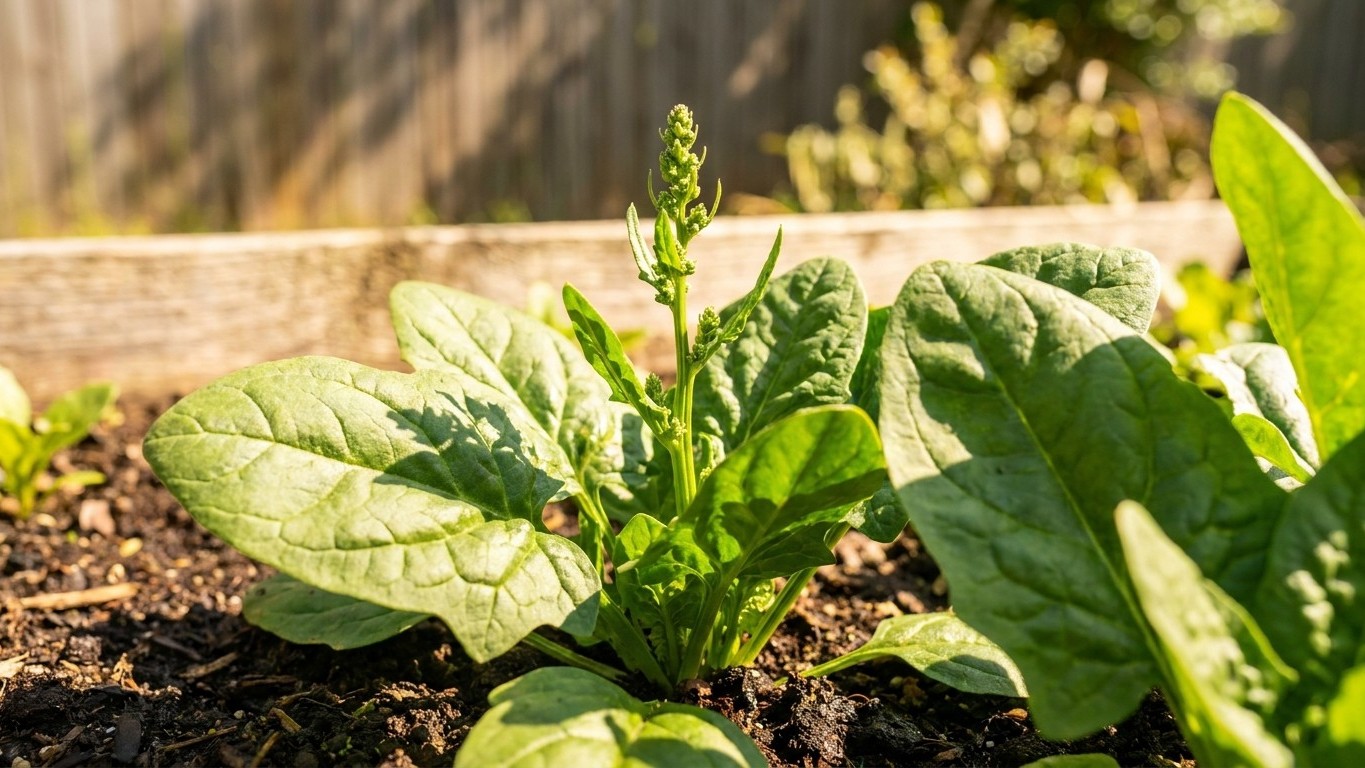

Two insects from Purdue Extension Entomology’s documented list actually feed on spinach in Indiana: the cabbage looper and the seedcorn maggot. Everything else on that list targets beans, cucurbits, potatoes, or asparagus. The looper shows up as a leaf feeder once foliage is established; the maggot attacks earlier, going after seeds and seedlings before a plant even breaks the surface.
Which pests attack spinach in Indiana
Purdue Extension Entomology documents ten insects for gardens in this territory: Asparagus beetle, Brown marmorated stink bug, Cabbage looper, Colorado potato beetle, Mexican bean beetle, Seedcorn maggot, Spotted cucumber beetle, Squash bug, Squash vine borer, and Striped cucumber beetle. That’s the full list this service tracks here, and it’s worth naming in full because most of it has nothing to do with a spinach bed.
Asparagus beetle stays on asparagus, full stop. Colorado potato beetle needs a nightshade, potato, eggplant, tomato, and spinach isn’t one. Mexican bean beetle wants legumes. The squash bug, squash vine borer, and both cucumber beetles are cucurbit specialists that will strip a zucchini plant and walk right past a spinach row without stopping. Brown marmorated stink bug is a generalist, but it favors fruiting structures, pods, tomatoes, peppers, tree fruit, over flat leafy greens with nothing to pierce and suck. That leaves two.
The two that actually matter
The cabbage looper is a caterpillar that feeds on foliage across a wide range of leafy vegetables, spinach among them, chewing irregular holes and skeletonizing tissue as it grows. The seedcorn maggot works underground and earlier: it’s the larva of a small fly that lays eggs in cool, moist, organic-matter-rich soil, and the maggot feeds on the seed itself or on the emerging root and stem before a seedling even gets going.
| Pest | Typical host | Attacks spinach? |
|---|---|---|
| Cabbage looper | Leafy vegetables, brassicas | Yes, foliage feeder |
| Seedcorn maggot | Seeds and seedlings of many crops | Yes, at germination |
| Asparagus beetle | Asparagus | No |
| Brown marmorated stink bug | Fruits, pods, tree fruit | Rarely, not a leafy-green pest |
| Colorado potato beetle | Nightshade family | No |
| Mexican bean beetle | Beans | No |
| Spotted & striped cucumber beetle, squash bug, squash vine borer | Cucurbits | No |
The extension service documents ten insects for this territory, and only two have any real business in a spinach row. That’s a short list, and it’s short on purpose, not because there’s more to add.
When each one shows up, and what it does first
Spinach in Indiana goes in the ground early, well ahead of the last spring frost window of April 9 to April 21, because the crop tolerates cold better than heat. That early, cool, often-wet soil is exactly the environment the seedcorn maggot’s parent fly prefers for laying eggs. The first sign isn’t a chewed leaf at all, it’s a gap: seeds that never come up, or seedlings that emerge, then wilt and collapse within days for no visible reason above ground.
The cabbage looper arrives later, once there’s actual foliage to eat, and it shows up as small, irregular holes in the leaf that get bigger and more ragged as the caterpillar grows. Look for pale green droppings, frass, caught in the leaf folds before you ever spot the caterpillar itself, since loopers are colored close to the leaf and easy to miss at a glance.
Where the calendar actually pinches
Spinach grows best below a 75 F ceiling, and the reference city’s longest day runs 14 hours 49 minutes, long enough on its own to push the plant toward bolting once temperatures climb with it. That combination, long days plus heat, closes the spring window fast. With an average of 14.6 days a year reaching 90 F or higher at the reference station, the spring crop is usually finished, one way or another, before that heat load fully arrives. Cabbage looper pressure on a spring planting is real but often runs out of foliage to work on before it runs out of season.
A fall crop changes the order. Soil has to drop back below the 80 F mark where germination stalls before seed goes in, which happens later than most gardeners expect in a state that racks up real summer heat. Once that fall seeding is up and growing into cooler, shorter days, foliage feeding from cabbage looper becomes the more likely problem of the two, simply because there’s more leaf mass around for a longer stretch before the first fall frost, which lands October 21 to October 30 at the reference station.
Telling the damage apart from everything else
Not every gap in a spinach row is an insect’s doing, and spinach in particular gets blamed for pest damage that’s actually heat, day length, or plain bad luck with water.
| Symptom | Likely cause | What tells it apart |
|---|---|---|
| Seeds never emerge, or seedlings collapse right after emerging | Seedcorn maggot, or damping-off disease, or simple drought stress | Dig up the seed or seedling; a maggot feeding inside the seed points to the insect, a soft rotted stem points to disease, dry soil around an intact seed points to moisture |
| Ragged holes, skeletonized leaf tissue, pale green droppings in leaf folds | Cabbage looper feeding | Frass and an actual caterpillar are the tell; slug damage instead leaves slime trails and feeds mostly at night and along leaf edges |
| Leaves yellowing with no holes at all | Nutrient deficiency, or the plant bolting under heat and long days | Check for a central seed stalk forming, that’s bolting, not a pest and not a deficiency |
| Leaves turning bitter | Not insect damage | The 75 F ceiling is also the bitterness threshold; crossing it changes flavor with no visible feeding marks anywhere |
A gardener who assumes every hole means an insect ends up treating a soil or timing problem with a pest solution, which fixes nothing. If the damage pattern doesn’t match either of the two documented pests cleanly, a photo and a description of exactly where and when it appeared is worth more than a guess, and that’s a job for the local extension office, not a garden forum.
What actually works here, and what is a waste of time
For seedcorn maggot, timing beats any product. Sowing into soil that’s already workable rather than cold and sodden shortens germination time, and a faster-emerging seedling spends less time exposed to the stage where the maggot does its damage. Fresh, undecomposed organic matter or manure worked in right before sowing draws egg-laying females in, so that amendment belongs in the soil weeks ahead, not the day of planting. A lightweight floating row cover laid down at sowing and left on through emergence keeps the adult fly from laying eggs there in the first place, and it costs nothing to remove once seedlings are established.
For cabbage looper on a fall crop, insect netting or row cover over the bed excludes the egg-laying adult moth before caterpillars ever get started, which is far more reliable than trying to catch them once they’re already inside the leaf tissue. Hand-picking works on a small bed if checked every few days, since a looper population builds slowly enough that early removal keeps it from ever becoming a real problem.
What doesn’t work: watching for wilted seedlings and reacting after the fact. Seedcorn maggot damage happens underground before any symptom shows above ground, so by the time a gap in the row is obvious, the window to do anything about that particular seeding has already closed. Waiting until a spinach leaf looks skeletonized to act on cabbage looper is similarly late, since the caterpillar causing the visible damage has usually been feeding for days already. Whether any specific control product is appropriate, and what’s legally labeled for use on spinach in this state, is a question for the local Purdue Extension office, not something to guess at from a bag on a shelf.
Where to check this for your own county
Everything here comes from Purdue Extension Entomology, and it’s documented at the state level. A county in the far north and a county near the Ohio River don’t necessarily carry the same pest pressure, the same soil temperatures, or the same practical planting dates, even though they share the same state-level pest list. The published frost window, April 9 to April 21 for the last spring freeze and October 21 to October 30 for the first fall freeze, is anchored to the Indianapolis station; a garden two weeks south or north of that reference point runs on a different clock entirely.
The four spinach varieties mentioned in extension guidance for this region, Bloomsdale, Melody, Teton, and Olympia, don’t come with published days-to-maturity or resistance ratings in that same guidance, so there’s no data here to compare them on beyond the name. That’s a gap worth knowing about rather than filling in with a guess.
A county extension office can confirm whether either of these two pests has actually been reported nearby this season, and can look at a photo of real damage in a real bed. That’s the next step, not another search: call the Purdue Extension office for the county where the garden sits, and bring a specific symptom, not a general question.
Common questions
Do rabbits or deer eat spinach in Indiana?
Purdue Extension Entomology’s list covers insects, not mammals, and neither is included in the facts documented here. A local extension office can speak to wildlife pressure separately from insect pests.
Can spinach recover after seedcorn maggot damage?
A seedling killed at germination doesn’t recover; the practical response is reseeding into a warmer, faster-draining spot rather than waiting on the original row.
Is bolting the same thing as pest damage?
No. Bolting is triggered by long days combined with warmth, not by an insect, and it shows up as a central seed stalk with no chewing marks anywhere on the leaves.
When is the safest window to plant a fall spinach crop here?
The source gives a rule rather than a date: sow 50 to 75 days before the target harvest, once soil has cooled back down from the summer highs that block germination above 80 F.