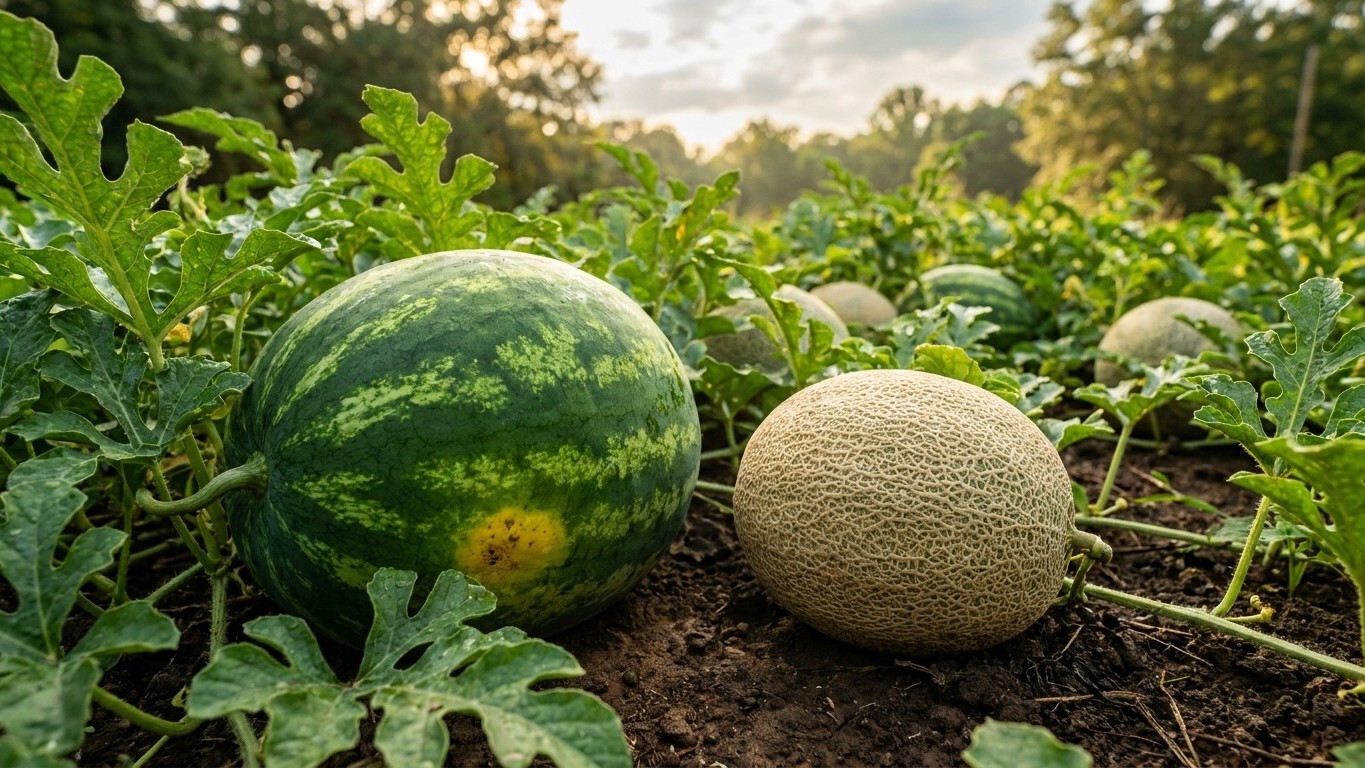

Short-season muskmelons and compact icebox watermelons are the realistic picks for North Dakota gardens. The state’s frost-free window runs roughly 133 to 154 days at the reference station, with barely a dozen days a year hot enough to push 90F, so anything bred for a long, hot summer is fighting the calendar before it even sprouts.
The short answer for North Dakota
Start with the two numbers that actually decide this. Last spring frost at the reference station (Fargo, station USW00014914) falls between May 4 and May 15. First fall frost arrives between September 25 and October 5. Stack those against each other and the frost-free season runs somewhere between 133 and 154 days, depending on where in that probability band your particular spring and fall land. That’s the whole growing season, start to finish, for anything you plant outdoors.
Now the heat side of the equation, because melons don’t just need frost-free days, they need warm ones. NOAA’s 1991-2020 normals put the average at just 11.7 days a year reaching 90F or higher at this same station. That’s a low heat load by any national standard. Melons build sugar and size through accumulated warmth, not just through calendar days, so a short list of 90-degree afternoons matters as much as the frost dates.
Put those two facts together and the decision by type gets simple. Muskmelons (the cantaloupe-type melons) bred specifically for short, cool northern seasons are the safer bet, because they’re selected to size and ripen without depending on a long stretch of blistering heat. Compact or icebox-type watermelons, the ones bred to finish quickly and stay small, fit the same window better than the large, vining watermelon types that expect a Southern or Mid-Atlantic summer to fully sweeten. Honeydew and other late, heat-hungry melon types are the ones to skip entirely here, not because the plants won’t grow, but because the fruit won’t finish before the numbers above run out.
None of this comes from a general rule about “northern gardens.” It comes specifically from this reference station’s frost dates and heat-day count. If your own county runs colder or warmer than Fargo, and much of North Dakota does, that changes the math, which is exactly what the next two sections work through.
What will not work here
The clearest failure mode is a variety mismatch with the season length itself. With a frost-free window that can run as short as 133 days at the tight end of the probability band, any melon that needs a long, leisurely summer to mature is starting from behind. Large slicing watermelons bred for regions with 180-plus frost-free days and long stretches of 90-degree heat are the obvious casualty. They may vine vigorously all summer and still be sizing fruit when the first fall frost, which can arrive as early as September 25, ends the conversation.
Heat load is the second failure point, and it’s a subtler one because the plants often look fine right up until harvest. With only 11.7 days a year reaching 90F, North Dakota simply doesn’t bank the heat units that push sugar content up in the final weeks before ripening. A melon variety that depends on sustained heat to finish sweetening, rather than one bred to ripen adequately on moderate warmth, will come off the vine bland or half-ripe even if the vine itself looked healthy all season.
Watering mistakes that compound the problem
Summer rainfall here totals about 10.0 inches across June, July, and August, but it isn’t spread evenly. June brings 4.29 inches, July drops to 3.07, and August, the exact stretch when melon fruit is sizing and ripening, falls to just 2.6 inches, the driest month of the growing season. A gardener watering on a fixed weekly schedule through that stretch is guessing at exactly the moment the plant needs the most consistent moisture. Combine a dry August with the modest but real evaporation from those 90-degree days, and a once-a-week watering routine can leave fruit stressed during sizing, right when it matters most.
Direct-seeding melons outdoors is the other common misstep in this climate. Every day spent waiting for a direct-sown seed to germinate and establish is a day pulled out of an already tight 133-to-154-day window. Starting transplants indoors and moving them out after the last frost risk has passed uses that limited season far more efficiently than sowing seed straight into cold spring soil.
What changes across North Dakota
North Dakota isn’t one garden, and the USDA Plant Hardiness Zone Map makes that obvious: the state spans zone 3a to zone 4b. That’s a real spread, built on the USDA system’s one variable, average annual extreme minimum winter temperature, and it means there’s no single “North Dakota answer” to when the season opens and closes. A garden at the 4b end of that range is working with meaningfully milder winter extremes than one at 3a, and that difference tends to show up in how early spring soil warms and how late fall frost holds off.
The frost dates and heat-day figures used above come from one specific station, the Fargo airport. That’s a legitimate reference point, but it’s a single location within a state that stretches across two full hardiness zones. Gardens elsewhere in the state, particularly farther north or west, or at higher elevation, commonly see their last spring frost arrive later and their first fall frost arrive earlier than this reference station shows, sometimes by one to two weeks. That shrinks an already tight frost-free window even further.
The practical shift for a reader gardening toward the colder end of that 3a-4b spread is to lean harder into the earliest-maturing melon types available, start transplants indoors rather than direct-seeding, and consider row cover or plastic mulch to bank a little extra soil warmth in spring. None of this page tells you which zone your own property sits in, because a state-level page can’t know that. What it can tell you is that the spread is wide enough to matter, and that the USDA hardiness zone map itself, not a guess based on your county’s name or its distance from Fargo, is the tool that settles it.
Where to check this for your own county
This page describes North Dakota. Your county is not North Dakota, it’s one piece of it, and the gap between a state-level page and a county-level recommendation is exactly the gap that matters for a crop working with a season this tight. The place to close that gap is North Dakota State University’s Extension service.
Once there, two things are worth searching out specifically. The first is a local or regional planting calendar, which will reflect frost dates and season length for your actual area rather than the single airport station cited throughout this page. The second is any list of melon varieties that NDSU or a county extension office has actually trialed in North Dakota conditions. Extension trial data carries more weight than a general description of “short-season melons,” because it reflects real plants grown in real North Dakota soil and weather over multiple seasons, not just a theoretical match between a variety’s catalog description and the state’s climate normals.
A county recommendation beats a state one every time, for the simple reason that it’s built on conditions closer to your own garden. This page works from statewide and single-station figures because that’s what a page covering the whole state can responsibly offer. Extension staff working at the county level can go further, and for a crop as sensitive to local frost timing and heat accumulation as melons are, that extra layer of specificity is worth the extra search.
Checking this against your own garden
Every date and figure above is a normal, an average built from thirty years of station data. Your own garden this year is not an average, and three things you can check by hand outrank any calendar date on this page.
Soil warmth by feel comes first. Melon roots stall in cold soil regardless of what the air temperature or the calendar says, so before transplanting outside, dig a few inches down and feel the soil rather than relying on the last-frost window alone. Cool, clammy soil that feels colder than the air temperature suggests your particular spot, maybe a low corner of the yard or a spot with heavier shade, is running behind the general pattern.
The first flush of male flowers is the second signal. Melon plants typically open a run of male flowers before the female flowers, the ones with a small swelling behind the petals that will become fruit, appear. Watching for that first male flush tells you the plant has moved out of pure vegetative growth and is gearing up to set fruit, which is useful information no planting calendar can give you directly.
First true leaves, the leaves that emerge after the initial seed leaves and actually look like melon foliage, are the third marker. Their timing and vigor tell you how your particular soil, sun exposure, and this year’s specific spring weather are treating the plant, information that’s more current and more local than any thirty-year normal. Watching all three, together, over a season or two, builds a working sense of your own garden’s microclimate that a state page, however specific, can’t fully replace.