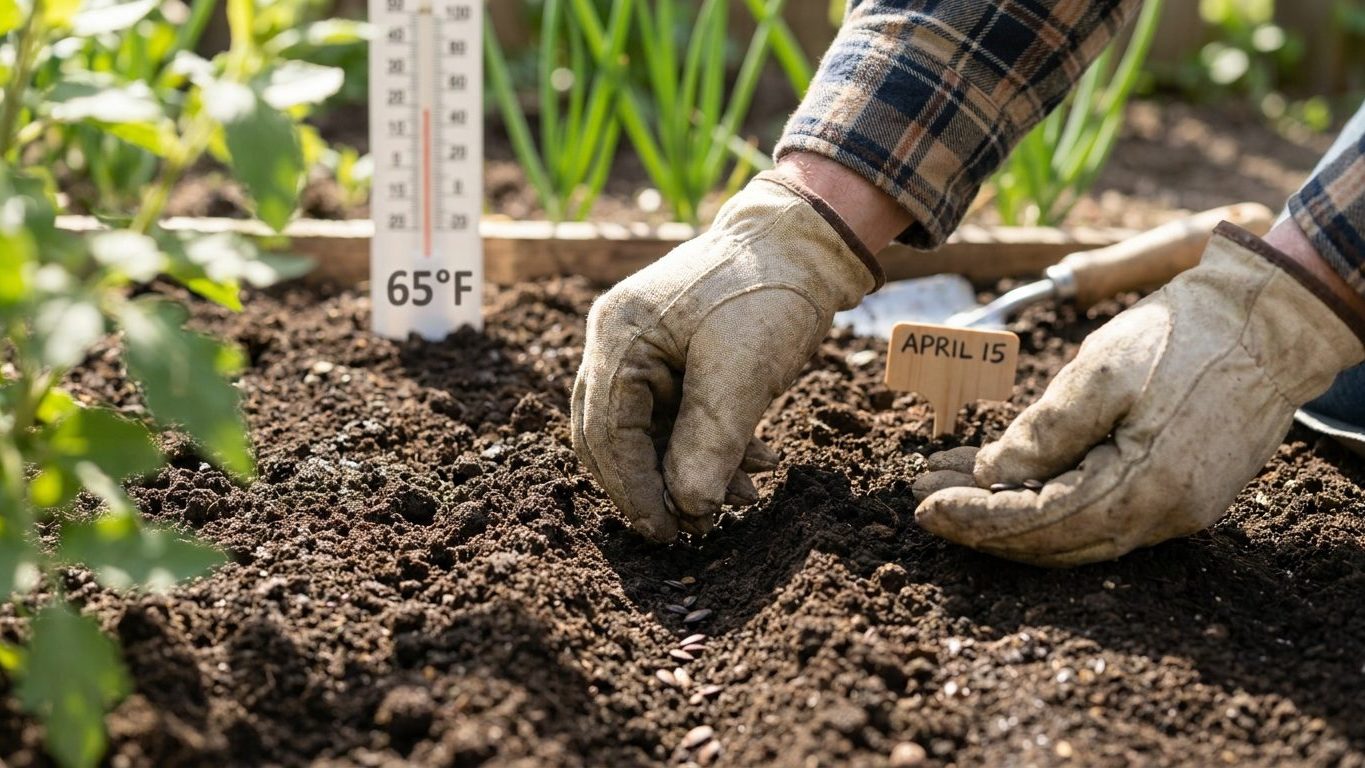

In North Dakota, direct-seeded melons go into the ground roughly one to two weeks after the last spring frost, once soil has warmed past the cold, wet stage that rots seed. Transplants can go out right at frost-out date if covered. Either way, the real limit isn’t the calendar day, it’s whether enough frost-free days remain before fall cold arrives to finish the fruit.
The short answer for North Dakota
The reference station for this state, Fargo (USW00014914), sees its last spring frost land somewhere between May 4 and May 15, and its first fall frost between September 25 and October 5. Those aren’t fixed dates. NOAA builds them from the 30-70% probability band for a 32F freeze, which means on May 4 there’s still roughly a 70% chance of frost in a typical year, and by May 15 that risk has dropped to around 30%. Neither date is a guarantee. It’s a bet, and the odds shift by about a week in either direction depending on the year.
Run the math on what sits between those two windows and you get the actual growing season: as short as 133 days (May 15 to September 25) in a late-spring, early-fall year, or as long as 154 days (May 4 to October 5) in a kinder one. That 21-day swing matters more for melons than almost any other garden crop, because melons don’t just need to survive the season, they need enough accumulated heat to actually ripen sugars before the vines get cut down by cold.
Direct seeding works best once soil temperature has held above roughly 65-70F for several days running, which in this climate typically lands seed in the ground in the back half of May or the first week of June, not right at the frost-out date itself. Transplants started indoors four to five weeks earlier buy back that lost time, and under row cover or black plastic they can go into the garden right at the last-frost window instead of waiting for the soil to catch up on its own.
Either path, the fall side of the calendar deserves equal attention. Counting backward from the earliest realistic frost date (September 25), a melon needing 85 days from transplant to harvest needs to be in the ground, as a transplant, no later than roughly the first days of July, with margin lost if it was direct-seeded instead. That’s the real short answer here: pick the planting method and the variety maturity by working backward from fall frost, not just forward from spring.
What will not work here

Long-season melons are the first casualty of this state’s calendar. Varieties bred for a 100-plus day maturity, common in the muskmelon and large watermelon categories grown further south, run out of runway in a short-season year here. Even in the generous 154-day scenario, a 100-day melon leaves barely 50 days of margin for a slow spring, a cool stretch in July, or a transplant that sulks for two weeks after setting out. In the 133-day scenario, that margin disappears entirely.
Heat load is the second problem, and it’s a subtler one. Fargo averages just 11.7 days a year at or above 90F. That’s a modest heat budget, and melons ripen on accumulated warmth as much as on calendar days. A vine can hit its “days to maturity” number on the calendar and still produce pale, underripe fruit if the accumulated heat units behind those days were thin. This is exactly what happens when a gardener plants a variety selected for Georgia or Texas summers into a Fargo backyard: the days pass, the fruit doesn’t finish. Short-season, heat-efficient varieties bred for northern climates are doing real work here, not just splitting hairs on a seed catalog label.
Water management fails in a specific, predictable way too. Summer rainfall averages about 10 inches across June, July, and August, but it isn’t spread evenly: June brings 4.29 inches, July drops to 3.07, and August, right when melon vines are sizing fruit and most vulnerable to stress, falls to just 2.6 inches. A watering schedule set once in June and left alone through August will under-deliver right when the plant needs the most consistent moisture. On sandy soil that August gap shows up within days as wilting; on clay it’s masked longer, then hits all at once when the profile finally dries out. Either way, a “water once a week” habit that worked fine in a wetter June turns into a stress event by late summer.
Close spacing isn’t the state’s biggest risk (humidity here is moderate, not the fungal-disease driver it is in the Southeast), but it still compounds the short season by shading soil that needs every degree of warmth it can get. Vines packed tight stay cooler at the root zone and slower to fruit, which is the opposite of what a short-season garden can afford.
What changes across North Dakota
The USDA Plant Hardiness Zone Map puts the state across a 3a to 4b range, built entirely from average annual extreme minimum winter temperature. That’s not a season-length measurement on its own, but it tracks closely with the latitude and elevation differences that also drive frost timing, so it’s a reasonable proxy for how much the picture shifts between the coldest and warmest corners of the state.
| Zone | What it measures | Practical shift from the Fargo reference dates |
|---|---|---|
| 3a | Colder extreme minimum winter temperature | Expect a later last-frost and earlier first-frost than Fargo; add a week or two of cushion on both ends |
| 4b | Milder extreme minimum winter temperature | Closest to the Fargo reference window itself; least adjustment needed |
A gardener working land in the colder end of that range shouldn’t assume the Fargo dates apply directly. The caution built into those NOAA figures already flags that suburban and rural sites typically see later spring frosts and earlier fall frosts than an airport weather station by one to two weeks, and that gap widens further at elevation or in a zone 3a pocket. Practically, that means leaning harder on transplants over direct seed, choosing the shortest-maturity varieties available rather than mid-range ones, and treating row cover or plastic mulch as standard practice rather than insurance.
None of this adds up to a single statewide planting day, because the state doesn’t have one. A 3a garden and a 4b garden in the same state can be working with a two-to-three-week difference in usable season, which for a crop as season-sensitive as melons is the difference between a variety that finishes comfortably and one that never gets there. Readers should check the USDA hardiness zone map for their own address rather than assume either end of the state’s range applies to them.
Where to check this for your own county
North Dakota State University Extension is the source that knows the difference between a garden near Fargo and one near Williston or Bottineau. This page has worked from a single reference station’s frost data and a statewide hardiness zone range, because that’s what a state-level page can responsibly give. A county extension office works from local trial plots, local frost records, and years of feedback from growers in that specific soil and microclimate.
Two things are worth asking NDSU Extension or the county office directly. First, the local planting calendar: many county offices publish a version adjusted for their own average frost dates, which can run a week or more different from the Fargo figures used here, especially in the western or northern parts of the state. Second, the variety list: extension services often maintain a short list of melon varieties actually trialled and proven in that county’s conditions, which matters more than any seed catalog description written for a national audience.
A county recommendation beats a state one every time, for the simple reason that it’s built from data closer to the actual garden. This page is the state-level view: useful for understanding the mechanism (frost probability, season length, heat load) but not a substitute for the local numbers. Calling or checking the county extension office before committing to a planting date, especially in a year that’s running unusually early or late, costs little and removes most of the guesswork this page can’t resolve on its own.
Checking this against your own garden
Every date and probability band in this article describes an average built from thirty years of data at one weather station. It doesn’t know what’s happening in a specific backyard this particular spring, and that’s exactly where a gardener’s own observation takes over.
Soil warmth by feel is the first and most reliable check. Melon seed sitting in cold, damp soil doesn’t germinate faster for having been planted on the “right” date, it just sits there and often rots. Pushing a bare hand a few inches into the bed, if it feels cool and clammy rather than warm and dry-ish at the surface, the soil isn’t ready regardless of what the frost-date window suggests.
The first flush of male flowers is the second signal, and it’s one that confuses a lot of first-time melon growers. Male flowers typically show up a week or two before the female flowers (the ones with a tiny swollen bulge at the base) start opening. Seeing plenty of male blooms with no fruit-set yet isn’t a failure, it’s the plant’s normal sequence, and it’s a decent sign the vine has settled into its spot and started reproductive growth on schedule for that particular garden’s conditions.
The first true leaves, the ones that appear after the rounded seed leaves and actually look like miniature melon foliage, mark the point where a transplant has recovered from the shock of being moved outside. If they’re slow to appear or look pale and stunted well past the first week or two outdoors, that’s a more useful warning than any calendar date: it’s telling the gardener their specific microclimate is running colder or slower than the regional average this particular year, and that the countdown to fall frost should be treated as tighter than the reference numbers suggest.