
Melons in Ohio go into the ground once the soil has warmed past the frost line, typically between late May and the first week of June across most of the state. That window sits inside the frost-date range Ohio State University Extension tracks for zone 6a: last spring frost May 5 to May 15, first fall frost October 5 to October 15. Everything else on this page explains how much room that actually gives you.
The short answer for Ohio
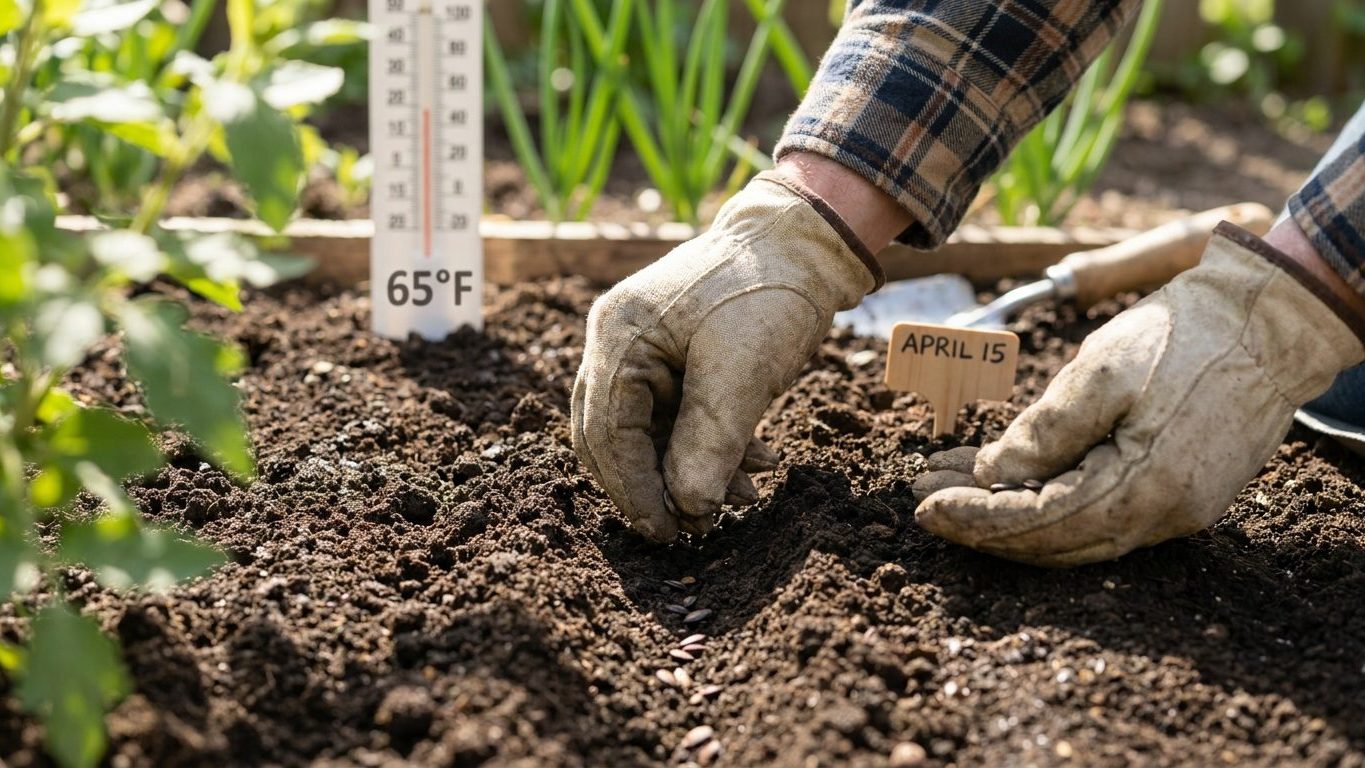
Plant Melons in Ohio after the last spring frost date has passed for your area, which OSU Extension puts at May 5 to May 15 for zone 6a. Wait another week to ten days beyond that if you’re direct-seeding, since melon seed barely germinates in soil below 65°F and a frost-free date doesn’t mean warm soil. Transplants started indoors three to four weeks earlier can go out right at the tail end of that frost window, especially under a cloche or black plastic that gets the root zone moving faster than open air will.
That frost-date range isn’t a guarantee, it’s a probability threshold. OSU Extension’s Ohio Gardening Calendar builds these dates from decades of weather records, and they mark the point where the odds of another freeze drop low enough that most gardeners are willing to risk a transplant. Planting on May 5 in a year that runs cold still carries real frost risk; planting on May 15 in a warm spring means you’ve left a week or ten days of growing season on the table. The safer play for a tender crop like melon is to lean toward the later end of that window rather than the earlier one, unless you’re prepared to cover plants on a cold night.
On the back end, the first fall frost arrives October 5 to October 15. Counting from a mid-May transplant to an early-October frost gives roughly 145 to 150 days of frost-free growing, which covers the maturity window of nearly every melon variety sold for home gardens, from 65-day icebox watermelons to 85-day cantaloupes. The tighter question is heat, not time. Columbus averages just 15.3 days a year at or above 90°F, according to NOAA’s 1991-2020 climate normals. That’s a moderate heat load, enough to ripen most muskmelons and short-season watermelons reliably, but not the kind of sustained heat that pushes sugar content in a 100-day heirloom watermelon the way a longer, hotter season would. Choose varieties rated for a season with modest heat accumulation rather than assuming Ohio summers behave like a Deep South garden.
What will not work here

Long-season melons are the first casualty. A watermelon variety bred for 95 to 100 days to maturity needs both time and heat to finish sweet, and Ohio’s 15.3 average days above 90°F simply doesn’t deliver the heat units those varieties expect in states farther south. The fruit can still ripen in terms of days on the calendar, but the sugar content lags, and gardeners who’ve grown the same seed packet in a hotter zone often report a flatter-tasting melon here. Sticking to varieties rated 65 to 85 days gives the crop a real shot at finishing before the heat backs off in September.
Planting too early is the second failure mode, and it’s a common one because the frost date feels like a green light. Melon seed sitting in soil below 65°F doesn’t germinate, it rots, and a transplant set out the day after the last frost into cool, wet ground often sulks for two or three weeks rather than growing. Since the last frost window runs from May 5 to May 15, and average soil temperatures lag air temperatures by a week or more in spring, direct-seeded melons do better pushed into late May.
Watering on a fixed weekly schedule fails here too, because Ohio’s summer rainfall isn’t evenly distributed. June and July average 4.33 and 4.67 inches, but August drops to 3.74 inches, the driest month of the growing season and exactly when melon plants are sizing fruit and need water most consistently. A once-a-week schedule that worked in July can leave an August melon patch stressed and dropping blossoms, especially on sandy soil where an inch of rain drains through in a day rather than holding for a week the way clay does.
Tight spacing is the fourth trap. Ohio’s summer humidity, riding on top of that same rainfall pattern, creates ideal conditions for powdery and downy mildew on melon foliage. Vines crowded together with poor airflow show disease pressure earlier and lose leaf cover before the fruit finishes ripening, which matters more here than in a drier climate where the same spacing would cause no trouble at all.
What changes across Ohio
Ohio isn’t one growing zone, it’s a spread. The USDA Plant Hardiness Zone Map places the state across zone 5b to zone 6b, and that range is built on a single measure, the average annual extreme minimum temperature, not on spring or fall frost timing directly. Still, the two track closely enough that a gardener at the cold end of that spread should expect a shorter frost-free season than the May 5 to October 15 range cited above, which reflects the zone 6a reference used in OSU’s calendar, roughly the Columbus area.
Higher ground in the northeast and southeast hill country tends to sit at the 5b end of that range, where a later last frost and an earlier first frost are both plausible, tightening the growing window by a couple of weeks on each side compared to central Ohio. The Lake Erie shoreline behaves differently again: the lake moderates temperature swings, which can delay the spring warm-up even as it pushes the first fall frost later, stretching the season in a way that doesn’t match either the coldest or warmest parts of the state.
There’s no single planting date that covers a gardener in Ashtabula County and one in Hocking County equally well. Rather than guess which end of the 5b-6b spread applies to a given yard, check the USDA Plant Hardiness Zone Map directly for the specific location, and treat the May 5 to October 15 frost window in this article as the central Ohio reference point, shifting a week or two earlier on both ends if the map places that yard in the colder band.
Where to check this for your own county
Ohio State University Extension maintains the state’s land-grant extension service, and its site at extension.osu.edu is the right next stop for anyone planting melons in a specific county rather than the state as a whole. County-level extension offices publish their own planting calendars and often carry results from local variety trials, which reflect actual soil, elevation and microclimate conditions in a way a statewide date range can’t.
Look specifically for two things on the county extension pages: a localized planting calendar that adjusts the frost-date range for that county’s elevation and position relative to Lake Erie or the Ohio River, and any variety trial results for melons, since county extension offices sometimes test cultivars under local conditions and report which ones actually produced well that season. A county office in the Appalachian foothills may recommend pushing transplant dates a week later than what’s listed here; one near the lake shoreline may say the opposite.
This page gives the state-level answer, built from OSU’s statewide gardening calendar and the NOAA climate normals for the Columbus reference station. A county recommendation, built from local trial data and a narrower set of weather records, will always beat a state-level average for a specific piece of ground. Treat this article as the starting point for understanding the mechanics, and the county extension office as the place that fine-tunes the actual date.
Checking this against your own garden
No calendar date beats what the plant and the soil are actually telling a gardener standing in the yard. Three signals matter more than any frost-date range.
- Soil warmth by feel: push a bare hand into the planting bed a few inches down. If the soil feels cool and damp rather than mild, melon seed will sit and rot rather than germinate, regardless of what the calendar says about the last frost being past.
- The first flush of male flowers: melon vines produce male blossoms before female ones, usually a week or two ahead. Seeing male flowers open confirms the plant has settled in and is building toward fruit set, a sign the transplant timing worked for that particular spot.
- The first true leaves: the rounded seed leaves that emerge first don’t tell you much, but the jagged true leaves that follow show the plant is actively growing rather than stalled. Slow true-leaf development after transplant usually points to soil that’s still colder than it looks.
A yard tucked against a south-facing wall or sitting in a low frost pocket can run a full week or two warmer or colder than the county average, and these three signs will show that difference well before a soil thermometer would, and long before another frost date on a calendar confirms it.
Some gardeners also time melons by the Moon: when to plant watermelon and cantaloupe by the moon, as almanac tradition rather than fact.