
Melons need warm soil and a long stretch of frost-free heat, so the window in Oklahoma runs from mid-April through early May for direct seeding, once the last spring frost has passed. That frost date itself is not a fixed line but a probability, and understanding what it actually measures changes how early a gardener should really risk it.
The short answer for Oklahoma
At the reference weather station used for Oklahoma’s climate normals, the last spring frost falls somewhere between March 28 and April 10. That is not one date but a band: NOAA’s 1991-2020 climate normals define it as the window during which the odds of a 32°F freeze occurring after that point drop from 30% down to 70% avoided, meaning early in the band (late March) there is still a meaningful frost risk, and by the end of the band (April 10) the odds of frost have fallen substantially. Melon seedlings die outright at 32°F, and even a light frost sets back a young vine badly, so this band is the floor, not the target date.
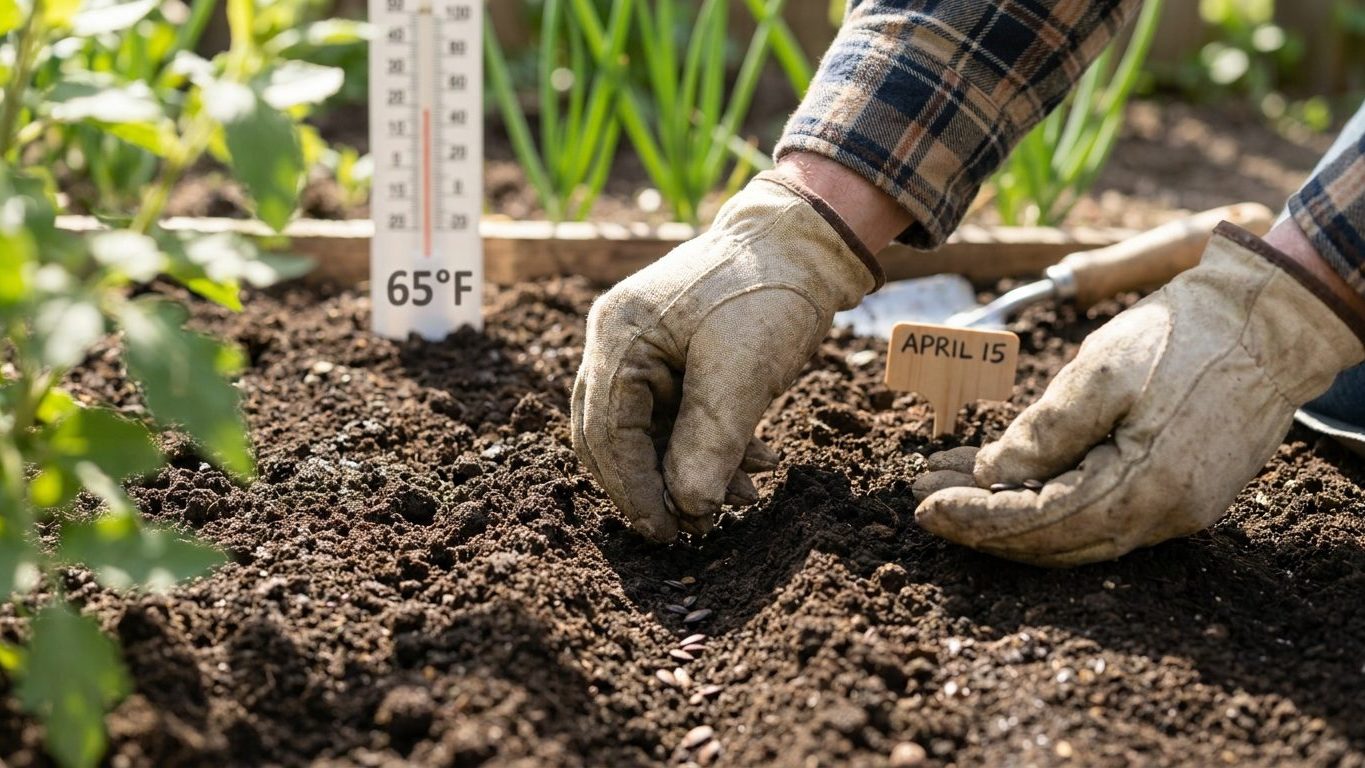
Melon seed also refuses to germinate well in cold soil. Even once the air stops threatening frost, soil temperature needs to sit consistently in the mid-60s to 70°F range before seeds sprout reliably. In practice, that pushes direct-sowing outdoors to somewhere in the third week of April through the first week of May across most of the state, a few weeks after the last-frost band closes, once the ground itself has caught up with the air.
Gardeners who want a head start can start seed indoors three to four weeks before their expected last frost and transplant out once that risk has passed, which is standard practice for melons because they resent root disturbance less than squash but still benefit from a jump on the short window before summer heat turns punishing. On the other end of the season, the first fall frost at the same reference station arrives between October 29 and November 8. That gives a frost-free stretch of roughly 200 days from the earliest edge of spring frost risk to the earliest edge of fall frost risk, which is more than enough time for even a slow 100-plus-day melon variety planted on schedule.
One caution matters here: these dates come from a single airport weather station, not from every backyard in the state. Suburban and rural gardens, especially those away from urban heat and in low-lying spots where cold air pools, often see their own last frost land later and their first fall frost arrive earlier than the reference station, sometimes by one to two weeks. Treat the dates above as the state’s baseline, not a guarantee for any particular yard.
What will not work here
A short season is not what defeats melons in Oklahoma. With roughly 200 frost-free days on the books, there’s plenty of runway even for the slower long-season varieties. What actually causes failure here is heat load and water timing, and the numbers back that up plainly.
The reference station averages 70.7 days a year at or above 90°F. That is not a handful of hot afternoons, it is more than ten weeks of the growing season spent under stress-level heat. Melon vines can tolerate genuine heat better than most vegetables, but extended stretches above 90°F during flowering push blossom drop and poor fruit set, especially when nighttime temperatures stay elevated too and pollinators slow their activity in the hottest part of the day. A vine that looks lush in July can still set almost no fruit if the heat runs long enough without a break.
Watering on a fixed weekly schedule is the second common failure, and it comes straight out of the rainfall numbers. Summer rainfall averages about 11.7 inches across June, July and August, but it is not spread evenly: June brings 4.49 inches, July drops to just 3.59 inches, and August recovers slightly to 3.6 inches. July, the month when melon vines are often sizing fruit and demanding the most water, is also the driest and the hottest. A once-a-week watering habit that worked fine in a cooler, wetter month leaves vines short on moisture exactly when the fruit needs it most, and inconsistent watering during fruit development is a classic cause of cracked or misshapen melons.
Close spacing is a third trap, particularly in the more humid eastern part of the state where summer air holds more moisture near the ground. Melon foliage packed too tightly traps humidity around the leaves overnight, and that stagnant moisture is exactly what fungal diseases like powdery mildew and downy mildew need to take hold. Wide spacing with good airflow between vines matters more here than in a drier climate, because the disease pressure from trapped humidity compounds the stress the vines are already under from the heat.
What changes across Oklahoma
Oklahoma is not one growing climate, and the USDA Plant Hardiness Zone Map makes that obvious: the state spans zone 6a to zone 8a, based on average annual extreme minimum winter temperature. That is a wide spread for one state, and it means there is no single melon-planting date that applies evenly from the Panhandle to the Red River.
A zone 6a area, generally the colder pockets and higher-elevation stretches in the western and northern parts of the state, runs a shorter frost-free season than the reference station’s numbers suggest. Gardeners there should expect their own last spring frost to land later than the March 28 to April 10 band cited above, and their first fall frost to arrive earlier than the October 29 to November 8 window. That compresses the safe planting calendar from both ends and argues for leaning toward shorter-season melon varieties or starting transplants indoors rather than counting on direct seeding.
A zone 8a area, generally the warmer southern tier, can often push planting a little earlier in spring and stretch harvest a little later in fall, since both frost risks arrive on a friendlier schedule than the statewide reference figures show. Elevation plays into this too: higher ground cools faster at night even within the same rough latitude, so two towns at similar latitude but different elevation can see noticeably different frost timing.
None of this tells any individual reader which zone covers their own yard, and this page won’t guess. The USDA’s official Plant Hardiness Zone Map lets a gardener enter a ZIP code and get the specific zone for that location, which is the right next step before locking in a planting date based on the state-wide range alone.
Where to check this for your own county
Everything on this page describes Oklahoma as a whole, built from one reference weather station and a statewide hardiness range. That is useful for understanding the pattern, but it is not a substitute for a county-level recommendation, and a county recommendation will beat this page every time.
Oklahoma State University runs the state’s Cooperative Extension Service, and it is the right place to look for local numbers. The service’s main portal sits at extension.okstate.edu. From there, look specifically for two things: the local planting calendar for the reader’s own county office, which adjusts for frost timing more precise than the single-station normals cited here, and any variety trial results for melons grown in that county or region, since OSU’s horticulture programs periodically test cantaloupe and watermelon varieties for performance under the state’s heat and disease pressure.
County extension educators also field direct questions about local soil temperature readings, recent frost history for that specific area, and which melon varieties have performed well in nearby demonstration gardens. That kind of hyper-local feedback is exactly what a statewide article, including this one, cannot offer. Treat the dates and ranges above as the framework for understanding why timing matters, then use the county office to fill in the specific answer for the actual plot of ground being planted.
Some gardeners also time melons by the Moon: when to plant watermelon and cantaloupe by the moon, as almanac tradition rather than fact.
Checking this against your own garden
Every date on this page is a normal, an average built from thirty years of weather records at one airport station. A gardener’s own eyes and hands, checked against their own soil on their own morning, outrank all of it. Three simple observations settle the question better than any calendar.
First, soil warmth by feel. Push a bare finger a couple inches into the planting bed in mid-morning. If the soil feels cool and slightly damp in a way that raises goosebumps, it is still too cold for melon seed no matter what the calendar says. Soil that feels closer to room temperature, with a dry, crumbly surface, is closer to ready.
Second, watch for the first flush of male flowers on any melon vines already growing, whether transplanted or from an earlier direct-sown batch. Male flowers, usually smaller and appearing on thinner stems than the female flowers that follow, tend to show up once a vine has settled into steady warm-weather growth. Their appearance signals the plant has moved past the shock of transplanting or germination and into its main growing phase, which is a sign the local conditions have turned genuinely favorable.
Third, track how fast true leaves appear after the initial seed leaves (cotyledons) unfold. Quick, vigorous true-leaf growth within a week or so points to soil and air temperatures that suit the plant. Sluggish growth that drags on for two weeks or more, even with adequate water, often means the soil is still running cooler than the vine wants, regardless of what the regional frost dates suggest for that particular week.