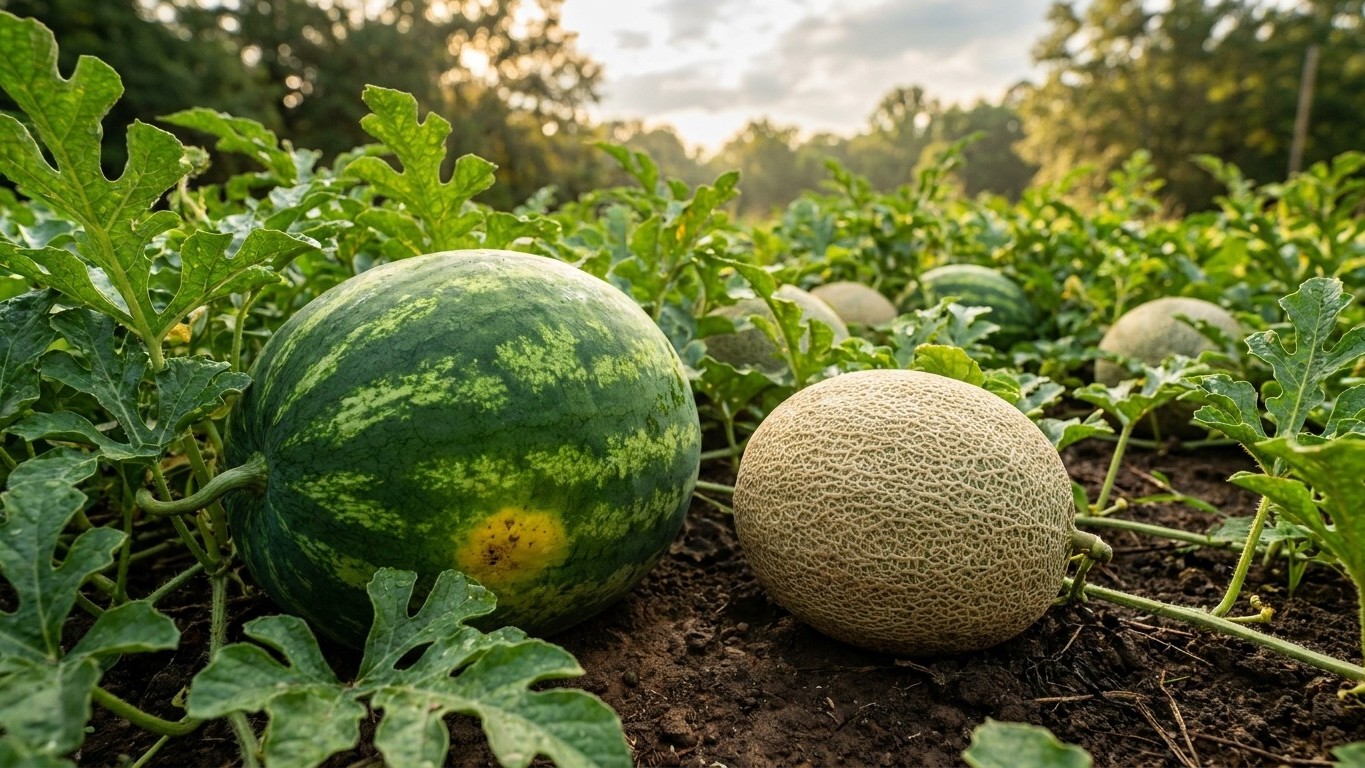

Western Washington’s cool, maritime summers make cantaloupe and muskmelon types the realistic pick for most home gardens here, chosen for short days-to-maturity rather than sheer size. Watermelon and honeydew need more cumulative heat than the Puget Sound region reliably delivers, so they’re a gamble unless the season gets an artificial boost.
The short answer for Washington
Start with the heat load, because that’s what actually ripens a melon, not the calendar. At the Seattle reference station, the year averages only 3.0 days that reach 90F. That’s an extraordinarily low heat count for a fruit that evolved in hot, dry regions and depends on sustained warm days to convert starch into sugar.
That single number should drive the variety decision more than anything printed on a seed packet. Short-season cantaloupe and muskmelon types, the kind bred to finish in roughly 65 to 80 days from transplant and to set fruit under moderate rather than blazing heat, are the closest thing to a safe bet on this side of the Cascades. They don’t need a string of 95F afternoons to sweeten up; they just need consistent warmth and enough daylight hours, which a normal Puget Sound summer can usually supply if the plants go in as transplants rather than direct-sown seed.
Watermelon sits at the other end of the spectrum. Most types are bred around longer maturity windows and higher cumulative heat, which is exactly what this region’s 3-day count doesn’t offer. Honeydew is worse for this climate: it’s often even more heat-hungry than watermelon and less forgiving of a cool, damp spring. Neither is impossible here, but both usually need help: black plastic mulch to warm the root zone, floating row cover to trap daytime heat, or a low tunnel to buy back the degree-days the open sky won’t provide.
Here’s where this page has to stop rather than guess: eastern Washington, beyond the Cascades, is high desert with a completely different heat and frost profile than the Seattle station these facts are built on. That’s a real, separate growing reality, not a rounding error, and this page doesn’t have the station data to make a dated recommendation for Yakima, the Tri-Cities, or Spokane. If that’s the county in question, the type calculus flips: with far more heat days than 3 per year, watermelon and honeydew become the practical choices, and the extra step is checking the local frost dates rather than borrowing Seattle’s.
For the maritime side of the state, though, the short answer holds: lead with cantaloupe or muskmelon, treat watermelon and honeydew as projects that need extra infrastructure, and don’t expect a “slicing” giant watermelon to behave the same way it would in a hot inland climate.
| Melon type | Typical maturity habit | Heat need | Western WA fit |
|---|---|---|---|
| Cantaloupe / muskmelon (short-season) | Shorter, roughly 65-80 days | Moderate | Best realistic choice |
| Watermelon | Longer | High | Needs plastic mulch or row cover |
| Honeydew | Longer | Highest | Riskiest without season extension |
What will not work here
Direct-seeding melons into the garden in spring is one of the more common failure points west of the Cascades. The frost dates themselves look generous on paper: last spring frost falls somewhere between February 27 and March 18, first fall frost between November 13 and November 30, which reads like a long frost-free season. But that window is a probability of freezing temperatures, not a signal that the soil or the light is ready for a heat-loving crop. Cold, wet soil and low spring light hold melons back for weeks after the last frost has technically passed. Seed dropped straight into that ground in March or even April often just sits and rots rather than germinating, because melon seed wants warm soil, not merely frost-free soil.
Long-season, high-heat varieties
Any variety bred around a long, hot growing season, the kind of watermelon or honeydew that assumes weeks of 90-degree-plus days, is fighting the region’s own climate data. With only 3.0 days a year reaching 90F at the reference station, there simply isn’t enough banked heat for those types to reliably finish before fall’s shortening days and cooling nights shut fruit development down. The plant can grow plenty of vine here; the failure shows up later, in fruit that never fully sweetens or ripens before the season runs out.
Weekly watering on the assumption of a dry desert summer
Summer rainfall across June, July and August totals only about 3.0 inches, with July the driest month at just 0.6 inches. That sounds like classic melon-growing dryness, and in some ways it is. But treating it like a hot desert climate and watering on a once-a-week schedule misreads the other half of the equation. Because the heat load is so low, evaporation demand isn’t nearly what it would be in an actual desert; a shallow, infrequent watering routine built for a hot, high-evaporation climate can leave roots swinging between soggy and parched in a cooler, slower-drying garden. The fix isn’t more water on a fixed schedule, it’s checking the soil itself rather than importing a watering rule from a hotter state.
The other quiet failure mode in a cool maritime spring is disease pressure on plants set out too early into cold, damp soil, or crowded too close together for what little airflow and light is available. Melons pushed into the ground ahead of real soil warmth, or spaced as if this were a hot, fast-drying climate, tend to sulk, yellow, or develop fungal trouble before they ever get to the fruiting stage.
What changes across Washington
Washington’s USDA hardiness zone range runs from 4a to 9a, under the USDA Plant Hardiness Zone Map system, which is built on one measurement: the average annual extreme minimum temperature. A spread from 4a to 9a is enormous, five full zones, and it means there is no single “Washington answer” to when the ground is safe to trust with a melon transplant. A 4a reading describes conditions closer to interior Montana; a 9a reading sits closer to coastal Northern California. Those are not variations on a theme, they’re two different growing climates sharing one state border.
The frost and heat numbers cited earlier for the short answer come specifically from the Seattle-area reference station, representing the mild, maritime side of the state. A reader gardening at higher elevation, in the Cascades or in the colder valleys and highlands further east, is very likely sitting in a meaningfully colder zone than that reference point, with a shorter effective season and less banked heat even than the modest 3.0 days-above-90F already described. For that kind of location, the practical shift is toward the very shortest-maturity melon types available, paired with black plastic and row cover almost as a default rather than an option.
A reader further south, in the milder Puget Sound lowlands or near the Columbia River, is more likely on the warmer end of the western Washington spread, closer to that 9a boundary, with a bit more cushion on both ends of the frost calendar. That doesn’t erase the low heat-day count, which is a regional climate feature rather than a zone feature, but it does mean slightly earlier transplanting and slightly more forgiving fall finish dates are realistic.
None of this should be read as a personal zone assignment. The spread across Washington is too wide, and the difference between the maritime west and the desert east too large, for a state-level page to tell an individual reader which zone applies to their own yard. That call belongs to the USDA hardiness zone map itself, checked at the address level.
Where to check this for your own county
This page describes Washington at the state level, built mostly around one reference station’s climate normals. That’s useful for understanding the broad pattern, cool maritime summers with very little extreme heat, a wide statewide hardiness range, a dry but not scorching summer, but it is not a substitute for what your own county’s extension office has on file. The relevant resource is Washington State University Extension.
Two things are worth pulling from a county-level visit there. First, the local planting calendar for melons and other warm-season vegetables, which will reflect actual county frost dates and soil-warming patterns rather than the Seattle-area normals used throughout this page. A county in the Columbia Basin, in the rain shadow east of the Cascades, is going to have a planting calendar that looks almost nothing like one built around Puget Sound data, and that difference matters more than anything a state-level page can average out.
Second, look for varieties actually trialled by that county’s extension office or master gardener program. Local trials account for microclimate effects, soil types, and pest pressure that a statewide climate normal simply can’t capture. A cantaloupe type that performs well in a WSU trial plot in one county carries more weight for a gardener in that county than any general type-level guidance offered here.
A county recommendation beats a state one, plainly. This page is the state one: a starting framework built on regional climate data, useful for narrowing the field to cantaloupe and muskmelon types over watermelon and honeydew in the maritime west, but not a replacement for what the local extension office says about a specific ZIP code’s frost dates and locally proven varieties.
Checking this against your own garden
Every date and average in this article is a regional pattern, not a promise about one particular yard. The garden itself outranks all of it, and three simple observations will say more about a specific plot than any climate normal.
Soil warmth by feel is the first and most direct check. Cold, clammy soil that feels chilly to the bare hand in spring is soil that will stall melon roots regardless of what the frost calendar says has already passed. Warm, dry, crumbly soil that feels closer to room temperature is the signal that transplants, not seed, are ready to go in.
The first flush of male flowers is the second marker. Melons typically produce a wave of male blossoms before the female flowers, the ones with the small swelling behind the petals that will become fruit, show up. Seeing plenty of male flowers with no females yet isn’t a failure, it’s a normal early stage, but a long stretch of male-only flowering with cool nights afterward is a sign the plant is waiting on more heat before it commits to fruiting.
The first true leaves, the ones that emerge after the two rounded seed leaves and actually look like miniature melon foliage, mark the point where the plant has moved past its most fragile stage. Slow, pale, or stalled true-leaf growth in a spot that gets full sun is often a soil-temperature or drainage problem specific to that bed, not a sign the variety itself was wrong. Watching for these three things over a season builds a far more accurate read of a garden’s own microclimate than any state or county average ever will.