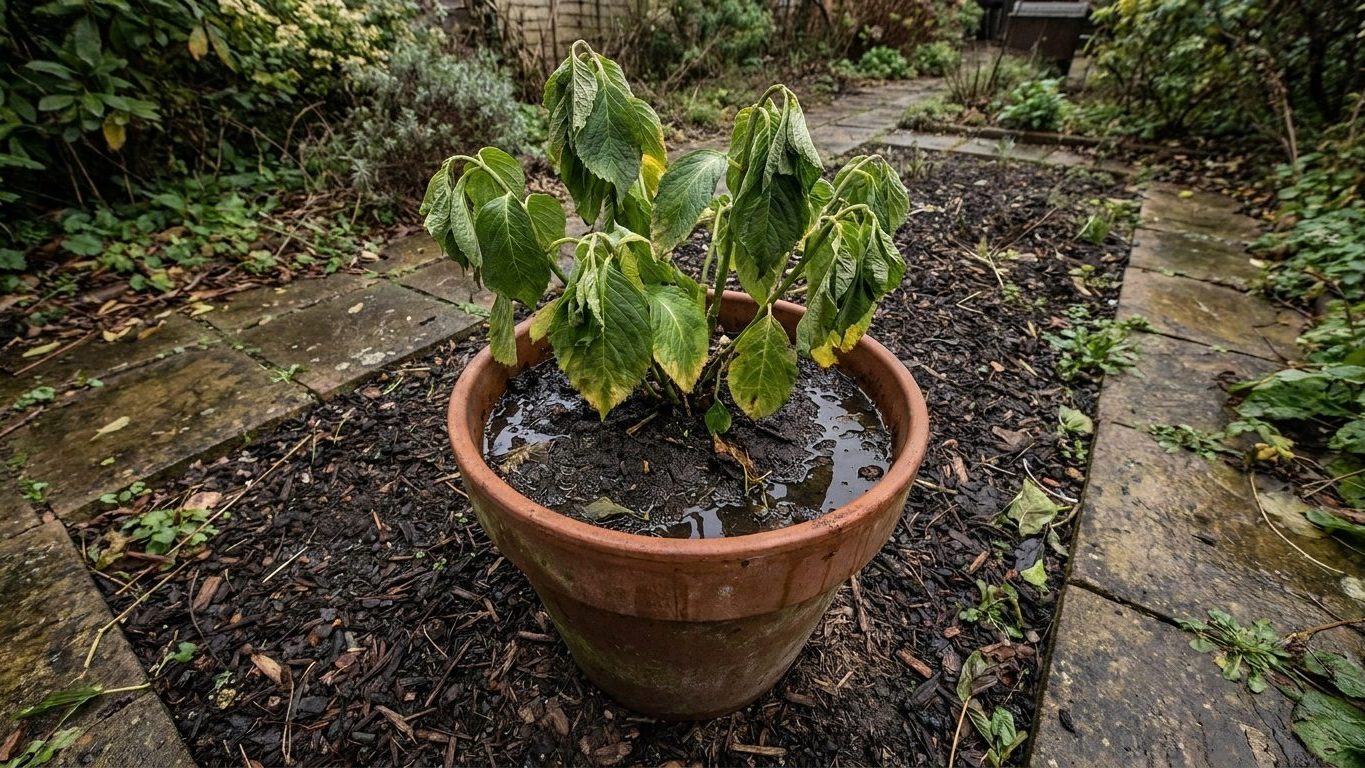

A hydrangea with drooping leaves standing in soaked soil is not thirsty. It’s suffocating. The roots are sitting in water instead of air, and that’s usually a drainage problem you can fix in the next few days, not a plant you’ve already lost. Whether it recovers depends on how long the roots have been submerged.
What you are looking at
The giveaway is the mismatch: leaves droop and go dull as if the plant needed water, but the soil around the base is dark, heavy, and clearly wet, sometimes with standing water visible after rain or a heavy watering. On bigleaf and panicle hydrangeas, the wilting often starts on the lower or older leaves first, then spreads upward as the problem worsens. In early stages, leaves may droop in the afternoon heat and look almost normal again by morning, a false reassurance that fools a lot of gardeners into waiting.
As the condition advances, the wilt stops recovering overnight. Leaf margins turn yellow, then brown and papery, and leaves drop while still partly green, not after the crisp, curled browning you’d see from drought stress. In severe cases, the stem at soil level darkens, softens, or turns black, and the whole branch or the entire plant collapses. Pull gently on a wilted stem near the base: if it comes away with mushy, brown or black roots that smell sour, that section is already dead tissue, not a plant that’s merely stressed.
Don’t confuse this with normal midday drooping. Mop-head and lacecap hydrangeas (H. macrophylla) are notorious for flagging in full afternoon sun even when soil moisture is fine, then perking back up by evening, that’s a leaf-size and heat response, not root damage. Also don’t confuse it with drought wilt, where the soil is dry and crumbly, leaf edges crisp up rather than yellow, and watering brings a fast recovery within a day. Wet-soil wilt is the opposite picture: the water is there, the plant just can’t use it.
What actually causes it
Roots don’t just absorb water passively, they need oxygen to respire and actively pull water and nutrients up into the plant. When soil stays saturated, water fills the air pockets between soil particles that would normally hold oxygen. Root cells starved of oxygen stop functioning within days, and the root tissue begins to break down. Weakened, oxygen-deprived roots then become an easy target for soil fungi and bacteria that cause root rot, which finishes the job. A hydrangea wilting in wet soil is showing you a root system that has partly or fully stopped working, even though the surrounding soil is full of water it cannot deliver upward.
The common mistake is treating the wilt as a thirst signal and adding more water. That’s exactly backwards: more water means less oxygen in the root zone and faster rot. The plant is drowning, not dry.
Several situations produce this same wet-soil wilt, and telling them apart matters for what you do next: heavy clay soil that drains poorly after rain, a low spot in the yard where water pools, a container without adequate drainage holes, a plant set too deep at planting time so the crown sits below grade, or simply a stretch of daily watering during a wet week that never let the topsoil dry. The source also names bacterial wilt as a disease affecting hydrangeas separately from waterlogging; it can produce a similar drooping appearance by damaging the plant’s internal water-conducting tissue, even in soil that isn’t excessively wet. If you’ve checked drainage and the soil genuinely isn’t saturated, a disease cause is worth ruling out rather than assuming poor drainage every time.
Both bigleaf hydrangea (H. macrophylla) and panicle hydrangea (H. paniculata) are shallow-rooted, which means their root systems sit close to the surface where waterlogging hits fastest and hardest. That shallow root habit is also why both benefit from a mulch layer, which buffers soil moisture swings, but mulch piled against the stem holds moisture right where you don’t want it.
| Type | Flowers on | Root habit (per source) | Drainage sensitivity |
|---|---|---|---|
| Bigleaf / mop-head / lacecap (H. macrophylla) | Last year’s wood | Shallow-rooted | High, benefits from mulch |
| Panicle / peegee (H. paniculata) | Current season’s growth | Shallow-rooted | High, benefits from mulch |
| Smooth (H. arborescens) | New wood | Not specified in source | Not specified in source |
| Oakleaf (H. quercifolia) | Old wood | Not specified in source | Not specified in source |
| Mountain (H. serrata) | Old wood | Not specified in source | Not specified in source |
| Climbing (H. petiolaris) | Old wood | Not specified in source | Not specified in source |
What to do now
Stop watering immediately, even if the leaves look thirsty. That instinct is the one thing guaranteed to make it worse. Check the soil by hand a few inches down: if it’s saturated or mucky, the priority is getting excess water away from the roots, not adding more.
For a container plant, that means moving it somewhere the pot can actually drain, checking that the drainage holes aren’t blocked, and emptying any saucer that’s holding standing water. For an in-ground plant, that can mean digging a shallow trench to redirect runoff away from the root zone, or, if the spot is chronically wet, accepting that this location isn’t right for the long term. Gently dig around the crown to check for mushy, dark, foul-smelling roots. Trim away anything clearly rotted with clean shears; firm, pale roots that remain are worth saving the plant for.
Be honest about what’s already lost. A stem that’s collapsed and blackened at the soil line will not recover, and pruning it back to healthy wood won’t reverse dead tissue below. If the crown itself is rotted through, the plant is gone, and no amount of drainage fixing after the fact will bring it back. What you’re Protecting from here is the rest of the root system and whatever growth still comes from healthy tissue.
Whether this year’s flowers are salvageable depends on the type. A hydrangea that flowers on new wood can still push fresh growth and bloom later in the season if enough healthy root remains. One that flowers on last year’s wood, like bigleaf, oakleaf, mountain, or climbing hydrangea, has already set this year’s buds on old growth, so root damage now threatens next year’s flowers more than this year’s. Pruning timing and zone-specific recovery windows differ by type and region; check the guide for your hydrangea type and state for that detail rather than applying a one-size answer here.
What does not work
Watering more because the leaves are drooping is the single most common mistake, and it directly worsens oxygen starvation in already-struggling roots. The leaves look thirsty; the roots are drowning. Adding water here treats the visible symptom and ignores the actual cause.
Fertilizing to “perk up” a wilting plant doesn’t help either. Damaged roots can’t take up nutrients efficiently, and the added fertilizer salts sit in already-saturated soil, adding a second stress to a root system that’s struggling to function at all.
Misting the leaves or spraying them with water does nothing for a problem that starts underground. The leaves aren’t dehydrated at the cellular level from lack of humidity, they’re wilting because the roots below can’t move water up the stem. Cosmetic surface fixes don’t touch the actual point of failure.
Moving a wilting hydrangea into full sun to “dry the soil out faster” backfires for most types. Bigleaf hydrangea needs dappled or partial shade and protection from afternoon sun regardless of soil moisture, and full sun adds heat stress on top of an already compromised root system. Only panicle hydrangea tolerates full sun well, so this move helps at most one type and actively harms the others.
Trimming off every wilted leaf at the first sign of trouble also doesn’t solve anything by itself. It’s a cosmetic step, not a fix, unless it’s paired with correcting the actual drainage problem underneath.
Preventing it next time
Site selection matters more than anything else you’ll do afterward. A hydrangea planted where water naturally drains, rather than a low spot that collects runoff after every rain, avoids this problem before it starts. If you’re stuck with heavy clay or a soggy corner of the yard, amending the planting hole with organic matter or building a raised bed changes the odds far more than any watering habit will.
Beyond site, watering schedule is the next lever. Water only when the top few inches of soil have dried out, rather than on a fixed daily routine that ignores rainfall. The source notes hydrangea soil should have good drainage, with occasional wetness being acceptable, not chronic saturation.
Mulch helps regulate that moisture swing for the shallow-rooted types, bigleaf and panicle hydrangea especially, but keep it a few inches back from the stem itself so it isn’t holding constant moisture against the crown, which recreates the same rot risk it’s meant to prevent.
Matching the type to the site also pays off long term. Panicle hydrangea tolerates a wider range of conditions, including full sun, and the source describes it as a solid substitute for bigleaf hydrangea in spots where that species doesn’t thrive. If a planting spot has struggled with drainage before, choosing a type suited to that reality beats fighting the site every season.
Common questions
Can a wilted hydrangea recover if I stop overwatering?
Often yes, if the roots aren’t fully rotted. Improve drainage, stop watering until the top few inches of soil dry, and check for new growth over the following weeks. If the crown and main stem are already black and mushy, recovery isn’t possible.
How do I tell overwatering wilt from underwatering wilt?
Check the soil, not just the leaves. Wet, dark, heavy soil with drooping but yellowing leaves points to waterlogging. Dry, crumbly soil with crisp, curled brown leaf edges points to drought, and that kind usually perks up within a day of a good watering.
Is wilting in wet soil the same as bacterial wilt disease?
Not necessarily. Waterlogged soil causing root rot is the more common cause. Bacterial wilt is a separate disease named for hydrangea that can also cause wilting by damaging the plant’s internal water transport, even without excess soil moisture, so it’s worth considering if drainage genuinely isn’t the issue.
Should I move a wilting hydrangea to a sunnier spot to dry it out faster?
No, for most types. Bigleaf hydrangea needs shade or dappled light and will suffer more in full sun regardless of soil moisture. Panicle hydrangea is the exception that tolerates full sun well.