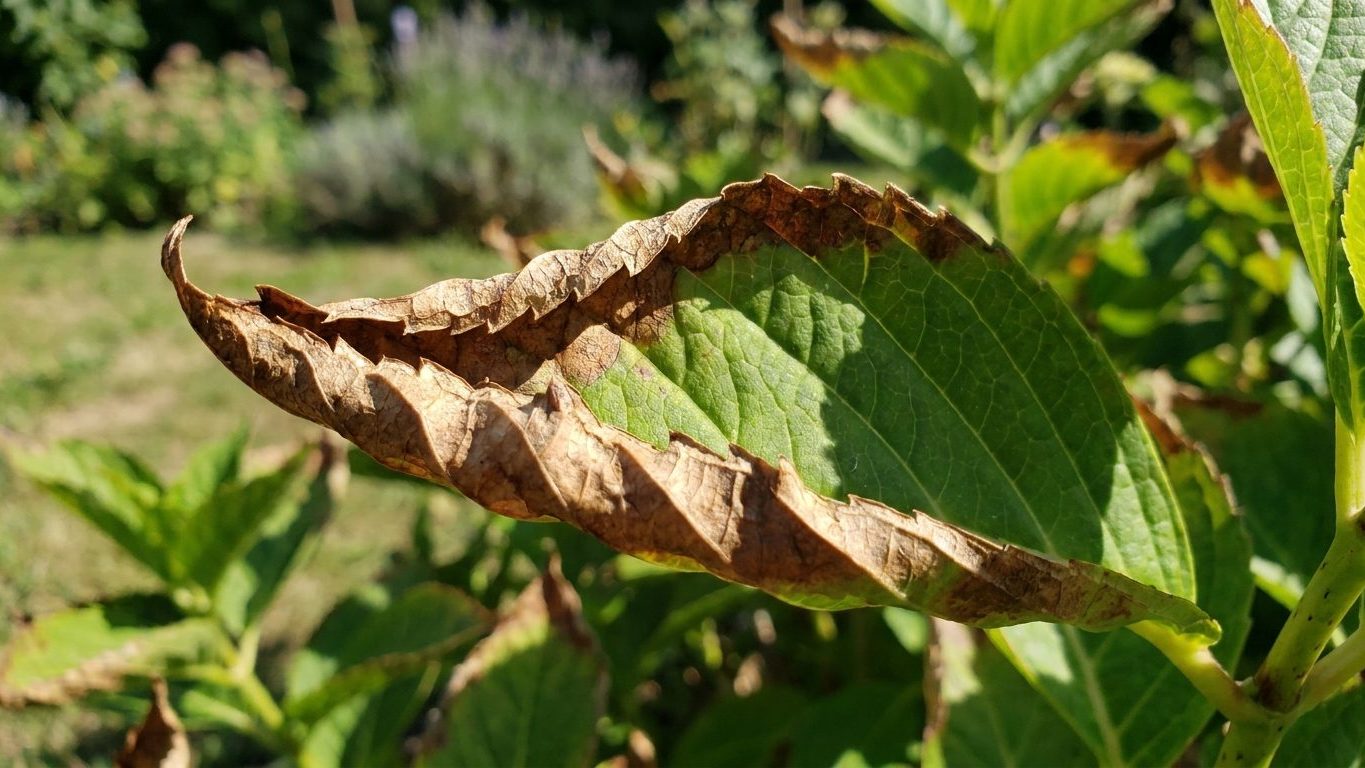

Brown, crisp edges on hydrangea leaves are almost always scorch, not disease — a sign the leaf is losing water faster than the roots can resupply it. It’s rarely fatal on its own, but it does weaken the plant and can cut into next season’s blooms if it happens over and over. What’s driving it depends on your zone, your hydrangea type, and the last week of weather.
What you are looking at
Scorch starts at the outer margin of the leaf, not in the middle. The tip and edges turn tan, then dark brown, and the tissue goes papery and crisp to the touch, sometimes curling upward or inward as it dries. It usually shows up first on the newest fully expanded leaves and on whichever side of the plant catches the most sun or wind. The green tissue closer to the veins often stays healthy even while the margin is dead, which is the single clearest sign you’re dealing with scorch and not a pathogen.
That distinction matters, because two other problems get mistaken for it constantly. Leaf spot, one of the diseases named by NC State Extension for this genus, produces round or angular spots scattered across the whole leaf surface, often with a darker ring around each spot, rather than damage confined to the edge. Bacterial wilt looks different again: whole leaves or whole stems collapse and blacken, often within days, instead of the slow tan-to-brown progression of scorch. Powdery mildew coats the leaf in a visible white or gray film before any browning starts. If what you’re seeing is edge-in, dry, and crisp rather than spotted, mushy, or coated, you’re looking at scorch.
Scorch can appear on any hydrangea, but it shows up fastest on the two types with shallow root systems: bigleaf (mop-head or lacecap) hydrangea and panicle hydrangea. Both pull water from a relatively thin layer of soil, so anything that dries that layer out, heat, wind, a few skipped waterings, shows up on the leaves within days rather than weeks.
What actually causes it
The mechanism is simple plumbing. On a hot, dry, or windy day, the leaf loses water through its surface faster than the roots can pull replacement water up through the stem. The tissue farthest from the vein, the outer margin, runs out first and dies while the rest of the leaf is still being supplied. That’s physiological damage from a water deficit, not an infection, which is why fungicide has nothing to act on here.
A common mistake is assuming brown, dry leaf edges automatically mean disease and reaching for a spray. It’s the wrong tool: there’s no fungus or bacterium to kill, and no amount of fungicide restores water flow to a leaf margin.
Several unrelated situations end in the same symptom, so it’s worth checking which one matches your last two weeks:
- Weather-driven scorch: appears within a day or two of a hot, dry, or windy stretch, especially on plants getting more afternoon sun than they should.
- Underwatering or transplant shock: soil feels dry a couple of inches down, and the plant was recently moved or divided.
- Salt or fertilizer burn: shows up after a feeding, and often looks uniform along every leaf edge rather than worse on one side of the plant.
- Root disturbance or waterlogging: leaves scorch even though the soil is wet, because damaged or oxygen-starved roots can’t move the water that’s actually there.
- Leaf spot disease: spots scattered mid-leaf with defined margins, not confined to the edge.
Bigleaf hydrangea is the type most sensitive to sun exposure specifically, since it wants dappled or partial shade and needs protection from direct afternoon sun. Panicle hydrangea is the outlier that tolerates full sun well, so scorch on a panicle plant is more often a watering or fertilizer issue than a sun-exposure one.
What to do now
The dead margin on a scorched leaf will not turn green again. That tissue is gone for the season, and there’s no treatment that reverses it. But the plant itself is very rarely in danger from leaf scorch alone, and the green portion of a partially damaged leaf keeps photosynthesizing, so there’s no need to strip the plant.
Remove a leaf only if it’s almost entirely crisp and contributing nothing. Otherwise leave it in place. Water deeply and less frequently rather than a light daily splash, since shallow-rooted types like bigleaf and panicle hydrangea need moisture available in that upper layer of soil, and a 2 to 3 inch mulch ring helps hold it there and buffers soil temperature swings. If fertilizer or salt is the likely cause, flush the root zone with plain water over a few days to move excess salts past the roots.
What you can’t fix this season is exposure. If the damage traces back to afternoon sun on a bigleaf hydrangea, no amount of watering undoes that, and the fix is repositioning for next year, not a mid-summer rescue. Flower buds already set are similarly out of reach: bigleaf, mountain, oakleaf, and climbing hydrangea all flower on last year’s wood, so buds for this year were formed months ago and scorched foliage doesn’t change what’s already set, for better or worse. Panicle and smooth hydrangea flower on the current season’s new growth, so a plant recovering well from scorch still has a real shot at a normal bloom this year. Either way, the priority now is keeping the plant hydrated so it can ripen good wood for next season, not trying to reverse damage that’s already done.
What does not work
Fungicide is the most common wasted step, since there’s no pathogen involved in ordinary leaf scorch, and spraying a chemical meant to kill fungus does nothing to restore water movement into a leaf margin. It’s a treatment for the wrong problem.
Misting the foliage in the heat of the day is another instinct that backfires. It feels like it should cool the plant, but it evaporates within minutes in full sun and does nothing to address the actual deficit, which is at the root, not on the leaf surface.
Adding more fertilizer to “green the plant back up” is worse than doing nothing if salt burn or over-feeding caused the scorch in the first place, since it pushes more salts into a root zone that’s already stressed. And moving or repotting a scorched plant mid-summer, while it’s fully leafed out, adds transplant shock on top of an existing water deficit rather than solving it; that kind of move belongs in the dormant season, not now.
Stripping off every damaged leaf at once, hoping to force fresh growth, removes photosynthetic tissue the plant needs to recover and adds stress rather than relieving it. Partial leaves left in place do more good than a bare stem.
Preventing it next time
The single change that matters most is matching the hydrangea’s sun exposure to its type. Bigleaf hydrangea needs dappled sun or partial to deep shade and protection from afternoon sun specifically; panicle hydrangea is the one type in the genus that genuinely takes full sun. Getting that placement right does more to prevent recurring scorch than any watering schedule can, because it removes the daily stress that watering is otherwise fighting against.
After exposure, consistent moisture is the next lever. Because bigleaf and panicle hydrangea are both shallow-rooted, they dry out faster than deeper-rooted shrubs, and a 2 to 3 inch mulch layer kept clear of the stem buffers both soil moisture and temperature swings through hot stretches.
Go easy on fertilizer, especially anything high in nitrogen applied during a heat wave, since it raises the risk of salt burn at exactly the moment the plant is least able to handle it. And if you’re planting new, choose the type suited to the site rather than fighting the site to suit the plant: the exact hardiness zone, pruning window, and planting depth for your area depend on which of the six hydrangea types you have, which is worth checking on a type-specific guide before you plant rather than after scorch shows up.
Common questions
Will scorched hydrangea leaves turn green again?
No. The dead, crisp margin is permanent damage. The plant can still produce healthy new leaves once the underlying water stress is corrected, but the existing brown tissue won’t recover.
Is brown, crisp leaf edging a sign of disease?
No, it’s physiological scorch from a water deficit, not an infection. Leaf spot, one of the diseases documented for this genus, looks different: round or angular spots scattered across the leaf rather than damage confined to the outer edge.
Should I cut off every brown leaf?
Only remove leaves that are almost entirely crisp. A leaf with a damaged edge but a healthy green center is still doing useful work for the plant and is better left in place.
Does scorched foliage affect this year’s flowers?
It depends on the type. Bigleaf, mountain, oakleaf, and climbing hydrangea flower on wood formed the previous year, so buds already set aren’t changed by current leaf damage. Panicle and smooth hydrangea flower on new growth made this season, so keeping the plant well watered now still helps this year’s bloom. And a separate note worth knowing if pets are around: only bigleaf hydrangea is documented as toxic, and only if a large quantity of leaves, flowers, bark, or stems is eaten, with symptoms limited to nausea, stomach pain, vomiting, and sweating.