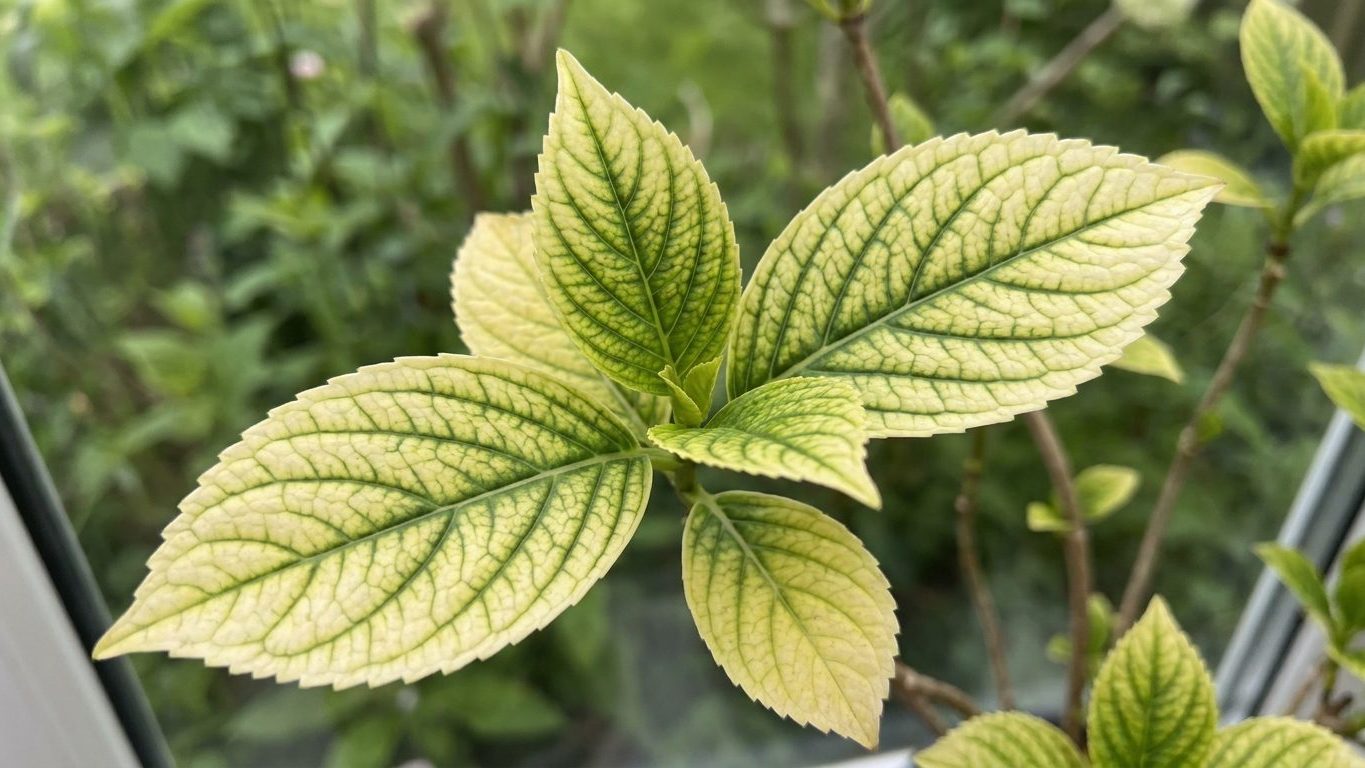

Yellow leaves with the veins still green is interveinal chlorosis, and on a hydrangea it almost always points to a nutrient the plant cannot pull out of the soil, not a nutrient that is missing. It looks alarming but it is rarely fatal, and it is usually fixable within a season or two once you address what is blocking uptake at the root.
What you are looking at
The pattern is specific: the tissue between the veins fades to pale yellow or almost white, while the veins themselves stay a clear, defined green, so the leaf looks like a green net laid over a yellow background. On most hydrangeas this shows up first on the newest growth at the branch tips, because young leaves demand the most of whatever nutrient is in short supply, and it spreads toward older leaves only if the underlying cause goes uncorrected.
Look closely at where the yellowing sits before you settle on a diagnosis. If the whole leaf, veins included, has turned a uniform pale yellow starting with the oldest leaves near the base of the plant, that is a different problem, most often a straightforward nitrogen shortage, and it does not need the same fix. If you see actual spots, lesions, or a powdery white coating rather than a clean interveinal pattern, you are likely dealing with leaf spot or powdery mildew, both of which the extension literature lists as diseases affecting hydrangea, and neither responds to a soil correction.
Wilting combined with yellowing, especially if it comes on fast and the stems look discolored at the base, points toward bacterial wilt rather than a nutrient issue. And if the plant is otherwise vigorous with good color but the leaves show fine stippling or a dusty look on the underside, mites are a more likely culprit than anything happening in the soil.
True interveinal chlorosis, by contrast, comes on gradually, stays confined to the leaf tissue between veins, and does not come with spots, wilting, or a powdery film. The plant itself usually keeps growing and flowering normally while this happens, which is one of the clearest signs the problem is nutrient availability rather than disease or pest damage.
What actually causes it
The common explanation gardeners reach for first is a straight-up deficiency, so the instinct is to feed the plant more of everything. That instinct is usually wrong. In the great majority of cases the soil already contains enough iron and manganese; what is missing is the plant’s ability to absorb them, and that ability is governed by soil pH.
The extension source that documents hydrangea soil needs lists a workable pH range from acid (below 6.0) through neutral (6.0 to 8.0) up to alkaline (above 8.0). As soil pH climbs into that alkaline range, iron and manganese shift into chemical forms that plant roots struggle to take up, even though the raw minerals are sitting right there in the ground. That is the mechanism worth remembering: the nutrient is present, the plant just cannot reach it. Adding more iron or manganese to soil that is already too alkaline does not solve the access problem, it just adds more nutrient the plant still cannot absorb.
This is a different mechanism from the one that changes flower color on bigleaf and mountain hydrangeas, where pH governs how much aluminum is available for the plant to move into the flower bracts. Leaf chlorosis runs on iron and manganese availability; flower color runs on aluminum availability. They both respond to the same soil pH lever, which is why people conflate them, but fixing one does not automatically fix the other, and a plant can show yellow leaves while its flowers stay whatever color they already are.
Other, less common causes produce a similar look and are worth ruling out. Waterlogged, poorly drained soil suffocates roots and blocks nutrient uptake the same way alkaline pH does, which matters because both bigleaf and panicle hydrangeas are shallow-rooted and sensitive to soggy ground. Nematodes, listed among the pests that affect hydrangea, damage roots directly and can produce patchy yellowing that looks similar from a distance but tends to show up alongside stunted or uneven growth rather than the clean, uniform interveinal pattern.
What to do now
The leaves that are already yellow will not turn green again this season. That tissue has lost its chlorophyll and it does not recover, so there is no spray or feed that reverses existing yellowing on those specific leaves. The realistic goal is not to fix what has already happened but to change conditions so the next flush of growth comes in green.
Start by checking drainage around the root zone, since both bigleaf and panicle hydrangeas are shallow-rooted and sit close to the surface where waterlogging and pH swings both do their damage. If the ground stays wet for long stretches after rain, that alone can be enough to choke off nutrient uptake regardless of what the soil test says about pH.
A layer of mulch over the root zone does double duty here: it buffers the soil against rapid pH and moisture swings, and the extension source specifically recommends it for shallow-rooted types like macrophylla and paniculata. This is a low-effort step with a real payoff, and it is one of the few fixes that helps almost regardless of which exact mechanism is behind the chlorosis.
Hold off on any fertilizer decision until you know your actual soil pH. Feeding blind, especially with anything that pushes pH higher, adds to the same lockup that caused the problem in the first place. If a soil test comes back solidly alkaline, that is the number to work against directly rather than guessing at a supplement to add on top.
Watch the next round of new growth rather than the leaves you already have. If new leaves at the tips come in a clean, even green once drainage and mulch are addressed, the correction is working. If they come in yellow again, the pH is still the blocking factor and needs a more direct fix than mulch alone provides.
What does not work
Extra nitrogen fertilizer is the first thing most people reach for, since yellowing reads as a feeding problem. It does not touch interveinal chlorosis, because the pattern here is not a nitrogen shortage: nitrogen deficiency yellows the whole leaf including the veins and hits the oldest leaves first. Pushing nitrogen on a plant already struggling with iron and manganese uptake can actually make things look worse, since it drives fast new growth that demands more of the very nutrients the roots cannot access.
Foliar iron sprays applied straight to the yellow leaves will often green up that specific tissue for a few weeks, which feels like progress. But the fix is cosmetic. The roots underneath are still sitting in soil where iron is chemically locked up, so the next flush of new growth comes in yellow again, and the spray has to be repeated indefinitely instead of solving anything.
Adding lime “to green things up” is the opposite of what alkaline-soil chlorosis needs. Lime raises soil pH further, which locks iron and manganese down harder rather than freeing them. This is the same lever the source describes for flower color, where lime pushes pH toward pink territory in bigleaf and mountain types, and applying it here for leaf color moves the soil in exactly the wrong direction.
Epsom salt gets tried too, on the assumption that any yellowing responds to a mineral supplement. It addresses magnesium, and magnesium deficiency does produce its own yellowing pattern, but it is a different symptom set and does not correct iron or manganese lockup. None of these fixes the actual mechanism, which is availability at the root, not the presence of the nutrient in the bag.
Preventing it next time
The single change that matters most is knowing your soil pH before you add anything to it. Everything else on this list is secondary to that one number, because pH is the lever controlling whether iron and manganese are available in the first place. A gardener who tests first and amends deliberately avoids the whole problem far more reliably than one who reacts to yellow leaves after the fact.
After that, avoid alkaline inputs you do not need. Lime has a legitimate use for raising pH on genuinely acid soil, but applying it out of habit, or because a neighbor’s soil needed it, pushes a hydrangea that was fine toward the alkaline range where chlorosis starts. The same caution applies to any product marketed for turning flowers blue or pink: aluminum sulfate acidifies soil and lime makes it more alkaline, and using either without a reason drifts your soil pH in ways that show up later as leaf color, not just flower color.
Keep mulch in place year-round on shallow-rooted types. It is a small, ongoing habit rather than a one-time fix, and it buffers both moisture and pH swings at the root zone where the real work happens.
Finally, match the hydrangea type to the site rather than fighting the site to suit the plant. A macrophylla struggling in full sun or heavy, poorly draining soil is under more stress across the board, and stressed plants show nutrient problems faster and more severely than healthy ones growing in conditions that suit them.
Common questions
Will the yellow leaves eventually turn green again?
No. Once chlorophyll is lost from that tissue it does not return. The realistic marker of progress is new growth coming in green, not the existing yellow leaves recovering.
Does this mean my flower color will change too?
Not necessarily. Leaf chlorosis runs on iron and manganese availability while flower color on bigleaf and mountain hydrangeas runs on aluminum availability, both governed by soil pH but through separate mechanisms. Fixing one does not automatically move the other, and this color mechanism does not apply at all to panicle, smooth, oakleaf, or climbing hydrangeas.
Is a hydrangea with yellow leaves dangerous to pets or kids?
Only bigleaf hydrangea is documented as toxic, and only in large quantities, causing nausea, stomach pain, vomiting, and sweating in people, dogs, cats, and horses. Yellowing itself does not change that risk one way or the other.
Does it matter which type of hydrangea I have?
Yes. Soil pH, drainage tolerance, and root depth all differ across bigleaf, panicle, smooth, oakleaf, mountain, and climbing hydrangeas, and the right fix depends on which one you are growing and what USDA zone you are in. A pruning date or hardiness answer that works for one type is often wrong for another.