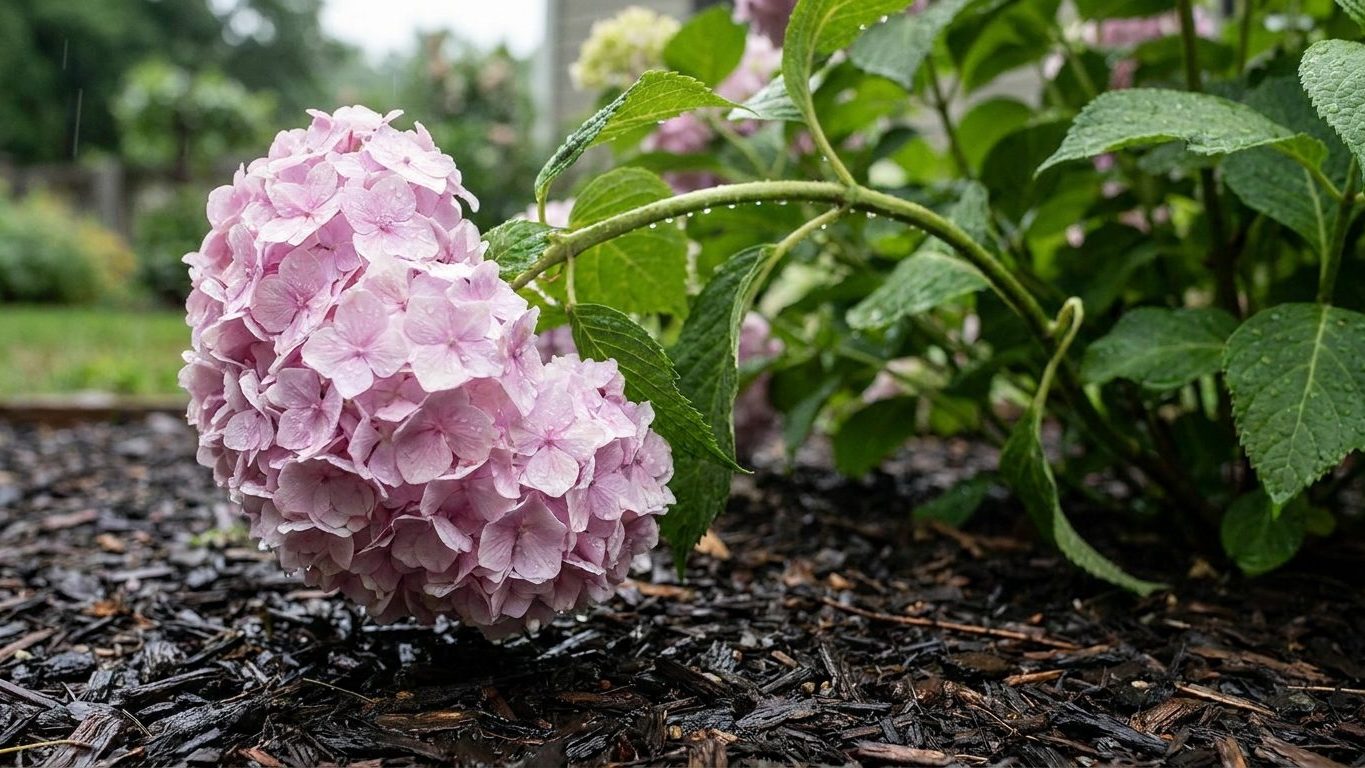

Flopped stems after rain are almost always a weight problem, not a disease. Rain-soaked flower heads, especially on bigleaf hydrangea (mophead and lacecap types) and on Annabelle-type smooth hydrangea, get heavy enough to bend the soft stem below them right to the ground. It looks alarming but it is rarely fatal to the plant.
What you are looking at
The stem itself usually stays green and intact. What gives way is the point just below the flower head, where new growth is still soft and hasn’t built up woody strength yet. After a heavy rain, or sometimes just heavy overhead watering, the whole truss tips sideways or face-plants into the mulch, and the stem stays bent there instead of springing back.
This shows up most on mophead and lacecap bigleaf hydrangea (H. macrophylla) and on smooth hydrangea (H. arborescens, the Annabelle type), both of which push out rapid, soft new growth topped with a disproportionately large flower ball. Mountain hydrangea (H. serrata) has lighter, flatter lacecap flowers and flops less. Panicle hydrangea (H. paniculata) has a more upright, branching habit and cone-shaped flower clusters that shed water differently, so it is less prone to the classic flat-out flop, though very heavy or top-heavy cultivars can still lean.
What this is not: if the stem is soft, dark, or mushy at the base, and the leaves are wilting even on dry days, that points to bacterial wilt or root rot from waterlogged soil, not a simple weight collapse. If leaves show spotting or a powdery white coating along with the drooping, that’s leaf spot or powdery mildew, both named as issues on this genus, and neither one is solved by staking the stem.
A true weight-flop plant otherwise looks healthy: green leaves, firm stems everywhere except the bend, and the problem appears suddenly after a rain event rather than developing gradually over a week.
What actually causes it
The common explanation, that the plant is “weak” or lacking some nutrient, misses the actual physics. A hydrangea flower head is made of dozens to hundreds of individual florets, and both the florets and the surrounding leaves absorb and hold rainwater on their surfaces. That water weight lands on a stem that, especially in a plant putting on rapid growth, hasn’t finished lignifying, meaning it hasn’t built the woody, rigid cell walls that come with a few more weeks of maturity.
Two things make this worse. First, both bigleaf and panicle hydrangea are shallow-rooted, so the whole root system offers less anchoring leverage than a deep-rooted shrub would, and a top-heavy flower can rock the base slightly with each gust or downpour. Second, too much shade pushes stems to stretch toward available light, producing longer, thinner, weaker growth that flops under far less weight than a stem grown in the dappled or partial sun this genus generally prefers.
Excess nitrogen is a separate but related trigger. Lawn fertilizer runoff or overfeeding pushes out lush, leafy, water-heavy growth at the expense of stem density, so a hydrangea sitting near a heavily fed lawn often flops sooner and more often than one in leaner soil.
To tell these apart: if the flop happens right after a storm and the plant is otherwise vigorous, it’s the weight-and-softness mechanism above. If stems are noticeably longer and thinner than normal with wide leaf spacing, look at light levels first. If the whole shrub looks leggy and over-lush with dark green oversized leaves, suspect nitrogen. If the flop is accompanied by yellowing, blackened stem bases, or a foul smell at the soil line, that’s a drainage or bacterial wilt issue, and it needs a different fix entirely.
What to do now
A bent stem with an intact flower can be gently lifted and supported; it will not straighten fully on its own, but a stake, a peony ring, or even a loosely tied loop to a nearby support will hold it up for the rest of the season. If the stem has actually cracked or snapped, that particular flower truss is lost, and the honest move is to cut it back cleanly just above a healthy leaf node rather than let it hang and rot.
Don’t try to force a bent stem straight by tying it tightly in one spot. A tight tie concentrates pressure and often finishes the crack that the rain started. Support the stem in two loose points instead, one lower down and one just under the flower head, so the weight is distributed.
Once a flower head has flopped and dried out, it’s lighter and less likely to re-flop with the next rain, so many gardeners just prop it once and leave it. If several stems went down at once and the whole shrub looks lopsided, resist any urge to do a hard mid-season cut on bigleaf, mountain, oakleaf, or climbing hydrangea, since those bloom on the previous year’s wood and a poorly timed cut removes next year’s flowers along with this year’s mess. Panicle and smooth hydrangea, which bloom on the current season’s growth, tolerate a corrective trim now with far less risk to future blooms. Exact pruning timing depends on your hydrangea type and your USDA zone, which is worth checking on the type-specific and state-specific pages in this guide before you cut anything back hard.
What does not work
Crushed eggshells worked into the soil, foliar calcium sprays, and extra lime are all remedies gardeners reach for when a plant looks structurally weak, on the theory that more calcium builds sturdier cell walls. For hydrangea stem flop, none of it addresses the actual problem. The soil almost never lacks calcium in the first place, and even where it’s marginal, the flop is a mechanical failure from sudden water weight on immature tissue, not a slow nutritional deficiency playing out over the stem’s growth. Calcium builds structure over weeks; it does nothing for a stem that bent under last night’s storm.
Adding lime carries a real cost for bigleaf and mountain hydrangea specifically: it raises soil pH, and above roughly pH 6.5 those two types shift from blue toward pink. So a gardener trying to “strengthen” stems with lime can end up changing flower color they never meant to touch, with zero benefit to stem rigidity. Panicle, smooth, oakleaf, and climbing hydrangea don’t respond to soil pH with color changes at all, so lime does nothing decorative for them either, good or bad.
Pruning hard mid-season “to force stronger regrowth” backfires the same way on old-wood bloomers: it trades this year’s flop for next year’s missing flowers. And propping a flopped stem back up after it’s already cracked doesn’t heal the crack. It just delays the stem breaking off entirely, usually at the next windy day.
Preventing it next time
The single change with the biggest effect is staking or caging before the flower heads open, not after. A simple grow-through support installed in spring gives the stem something to lean on the moment it starts carrying weight, rather than trying to correct a bend that’s already happened.
After that, light exposure matters more than most people expect. Bigleaf and mountain hydrangea want dappled sun or partial to deep shade with protection from afternoon sun; too much shade stretches stems thin, and too much hot afternoon sun stresses the plant in a different way. Panicle hydrangea is the one type in this genus that genuinely handles full sun well, so it needs less babying on placement.
Watch nitrogen inputs, especially from nearby lawn fertilizer, since lush overfed growth is consistently softer and floppier than growth on leaner feeding. Mulch around the base helps both bigleaf and panicle hydrangea, whose shallow roots benefit from steady moisture and cooler soil, which in turn supports steadier, less erratic growth than a plant swinging between drought stress and sudden soaking.
Finally, match the plant’s mature size to its spot. An 8-to-25-foot panicle hydrangea or a 15-foot climbing hydrangea planted somewhere too tight will always look top-heavy and prone to leaning, no matter how well it’s fed or watered.
Common questions
Will the flopped stem straighten on its own once the flower dries out?
Not fully. The bend in the stem tissue tends to stay even after the extra rainwater weight is gone, though a lighter, dried flower head is far less likely to cause a second flop. Propping it once with a stake usually holds the shape for the rest of the season.
Is this the same thing as bacterial wilt?
No. A weight-flop plant stays green and firm everywhere except the bend and usually happens right after rain. Bacterial wilt, one of the diseases named for this genus, causes wilting and stem softening that develops on its own, often with darkened or mushy stem bases, and it doesn’t clear up once the water weight is gone.
Do panicle Hydrangeas flop the same way as bigleaf?
Less often. Panicle hydrangea has a more upright, branching structure and cone-shaped flower clusters, and it’s the only type in the genus that takes full sun well, which tends to produce sturdier growth. It’s not immune, especially on very top-heavy cultivars, but it’s less prone to the classic flat flop than bigleaf or Annabelle-type smooth hydrangea.
Should I cut back a hydrangea that’s flopped over the lawn?
Only cut what’s actually cracked or broken. For old-wood bloomers (bigleaf, mountain, oakleaf, climbing) an untimely hard cut removes next year’s flower buds. Panicle and smooth hydrangea, which bloom on new wood, tolerate a corrective trim with much less risk. Check the pruning timing for your specific type and zone before cutting anything beyond the obviously damaged stems.