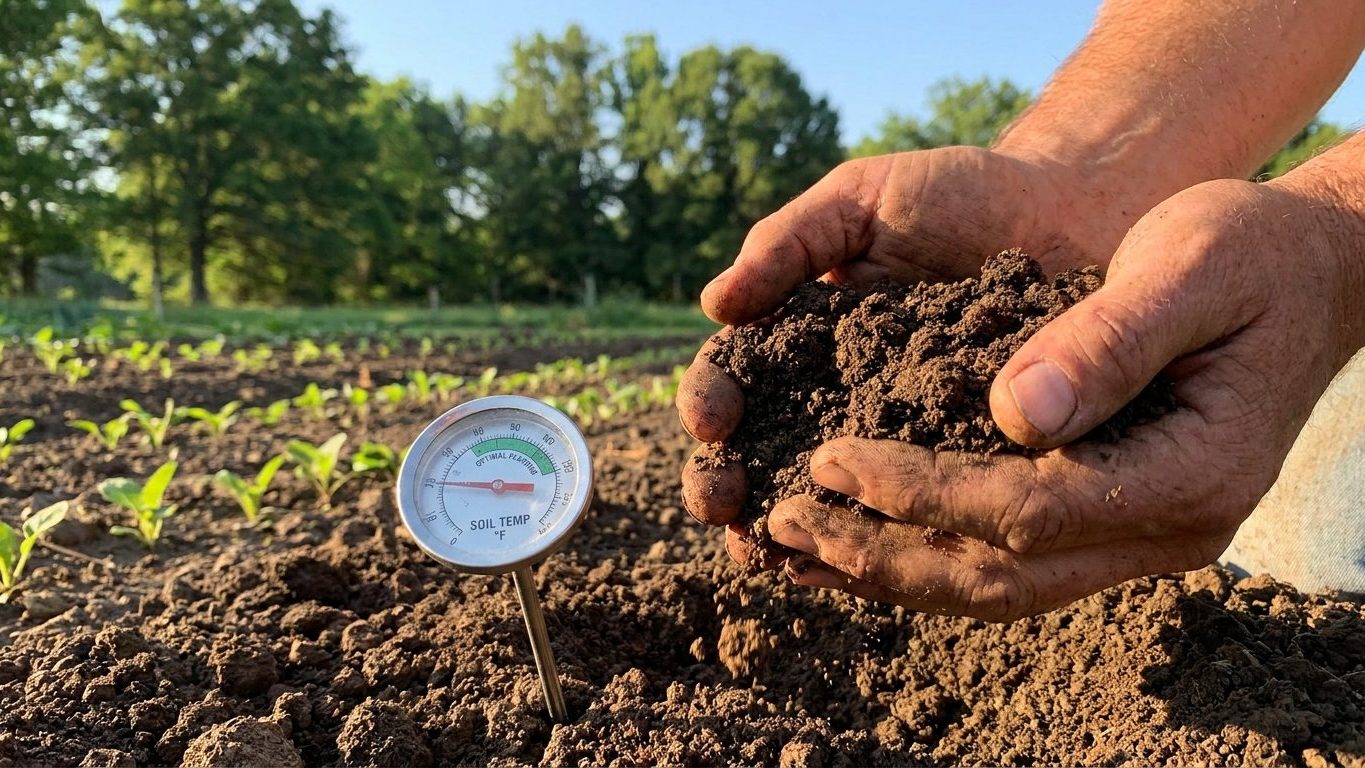

Winter squash goes into Illinois soil once soil temperatures hold above roughly 60°F, which typically follows the region’s last spring frost window in mid-to-late April. The frost-free season that follows runs long enough for full-season types to mature and cure before fall frost, though summer heat and rainfall are moderate rather than generous. Which type does best, and how you manage water, depends on exactly where in the state you’re planting.
When the soil is warm enough in Illinois

The reference figure for this region, drawn from NOAA’s 1991-2020 Climate Normals for station USW00094846, puts the last spring frost between April 11 and April 22. That’s the 30-70% probability band, meaning frost has roughly a three-in-ten to seven-in-ten chance of occurring on any given day in that window. It is not a guarantee that frost stops on a specific date, and it is not a promise that planting the day after is safe. It’s a statistical range built from three decades of airport weather data, nothing more.
That distinction matters more for winter squash than for almost any other crop in the garden, because the frost date itself isn’t really what you’re waiting on. Winter squash seed rots in cold, wet ground, and transplants sulk or stall when soil temperature sits below the mid-50s. The frost date is a rough proxy for when the ground has warmed enough, but soil lags behind air temperature by days, sometimes by two weeks in a cool, cloudy spring. A gardener who plants on the calendar date rather than checking the dirt is gambling on both fronts: the fading chance of a late frost and the very real chance the soil simply hasn’t caught up yet.
There’s also a gap between the reference station’s numbers and what happens in an actual backyard. Airport stations like the one behind these normals tend to run warmer than surrounding suburban and rural ground, partly because of pavement and partly because of site exposure. Gardens outside the immediate metro area typically see their last spring frost arrive later, sometimes by a week or two, and more if the property sits in a low spot or at higher elevation where cold air pools overnight. Treat April 11 to April 22 as the city’s number, not your county’s, and confirm timing against your own past frost history or a local extension bulletin before committing seed to the ground.
Once soil has warmed, direct-seeding is the simpler route for winter squash, since the crop resents root disturbance more than most vine crops. If you start indoors to gain a few weeks, keep the root ball small and transplant before roots begin circling the container. For pest pressure in early establishment, floating row cover over young plants is the standard practice worth knowing, removed once flowering begins so pollinators can reach the blossoms. Your state extension service, linked below, publishes the planting-date guidance calibrated to their own trial data, and that’s the number worth following once you’ve confirmed your local frost pattern.
How long the season lasts here
Pairing both ends of the frost record gives a real answer to how much growing time Illinois offers. The first fall frost, per the same NOAA station, falls between October 24 and November 3. Stack that against the spring window of April 11 to April 22, and the frost-free season runs somewhere between about 185 days, if spring arrives late and fall arrives early, and roughly 206 days, if the year breaks favorably on both ends. That’s a six-and-a-half to nearly seven-month window, generous by national standards and enough to carry a full-season winter squash from seed to cured fruit with room to spare.
| Boundary | Earliest scenario | Latest scenario |
|---|---|---|
| Last spring frost | April 11 | April 22 |
| First fall frost | October 24 | November 3 |
| Resulting season length | ~185 days | ~206 days |
A window that long changes the math on succession sowing. In a state where the frost-free stretch barely clears five months, growers have one shot: whatever goes in the ground first is the only crop they’ll get. Illinois’s margin is wider, which opens the door to a second sowing of a quicker-maturing type in early summer, aimed at extending harvest into fall rather than replacing a failed first planting. That’s worth planning deliberately rather than leaving to chance, and the site’s succession sowing guide walks through how to stagger sowing dates so the second planting still has time to mature before frost closes the window.
The extra weeks also make transplanting a more reasonable option here than in shorter-season territories, where every day saved by starting indoors matters. In Illinois, the choice between direct-seeding and transplanting comes down more to convenience and pest timing than to a hard need to squeeze out extra growing days. That said, the root-disturbance risk with transplants doesn’t disappear just because the calendar is forgiving, so the small-root-ball rule from the previous section still applies regardless of how much slack the season offers.
Heat and water in Illinois

The reference station near Chicago logs an average of 14.0 days a year at or above 90°F. That’s a modest heat load, not a punishing one. It’s enough to push water demand up during a hot stretch in July or August, but it’s nowhere near the heat totals that force gardeners further south to prioritize shade cloth and root-zone cooling for their squash vines. In Illinois, heat is a factor to manage, not a threat to survival.
Rainfall tells a more complicated story. Summer totals about 12.1 inches of rain across June, July and August, spread as 4.1 inches in June, 3.71 in July, the driest month, and 4.25 in August. That’s a decent baseline, and on paper it looks like enough to carry winter squash through its fruit-filling stage without much supplemental watering. But rain that falls as scattered thunderstorms, which is the typical summer pattern across the Midwest, tends to run off rather than soak deep into the root zone, especially on compacted or clay-heavy ground. A sandy garden bed can drain that same inch of rain within a day, needing another drink soon after; a clay bed holds it for a week but can also stay waterlogged long enough to stress roots after a heavy storm.
Because Illinois sits in that middle ground, neither hot and dry enough to make irrigation a daily requirement, nor cool and damp enough to invite constant mildew pressure, the practical approach is to treat the 12.1-inch summer figure as a baseline that needs checking against your own soil and your own rain gauge, not as a number that lets you skip watering altogether. July, the driest month on record, is the stretch most likely to require a hose. Watering at the base of the plant rather than overhead also cuts down on foliar disease, which matters more in a humid August than the heat count alone would suggest. Winter squash is unforgiving about incomplete maturity: a fruit that hasn’t fully ripened on the vine before frost won’t finish curing in storage, so keeping vines healthy and hydrated through the fruit-fill window in late summer is what protects the harvest, more than any single technique applied earlier in the season.
Which winter squash suit Illinois
Illinois’s frost-free window, running roughly six to nearly seven months, gives room to grow types across the full range of maturity lengths, from quicker-maturing kinds suited to a second sowing to longer-season types that need most of the summer to fill out and cure properly. The state’s USDA Plant Hardiness range spans zones 5a to 7b, a reminder that a garden in the far south of the state faces a milder winter and often a longer effective growing season than one near the northern border, even though both share the same statewide frost-date normals cited above.
With moderate heat and uneven summer rainfall, the type that suits a given garden depends more on local soil drainage and disease pressure than on the state’s climate broadly. Gardens on heavier, slower-draining soil in a humid August benefit from types bred with stronger resistance to powdery mildew and vine borers, since foliage stays damp longer after a storm. Gardens with excellent drainage and full sun exposure have more flexibility, since heat stress and drought are the smaller risks here compared to disease.
Cultivar performance shifts from county to county based on local disease pressure, soil type and even which seed lots a university trial happened to test that year. A name dropped into an article without that local trial data behind it is a guess dressed up as advice, and it’s the kind of error an experienced gardener spots immediately. The variety recommendations that actually mean something come from University of Illinois Extension, which runs its own regional trials and publishes results calibrated to conditions gardeners in this state actually face. Starting there, with your county’s soil and microclimate in mind, is a more reliable path to a full harvest than any generic list could offer.