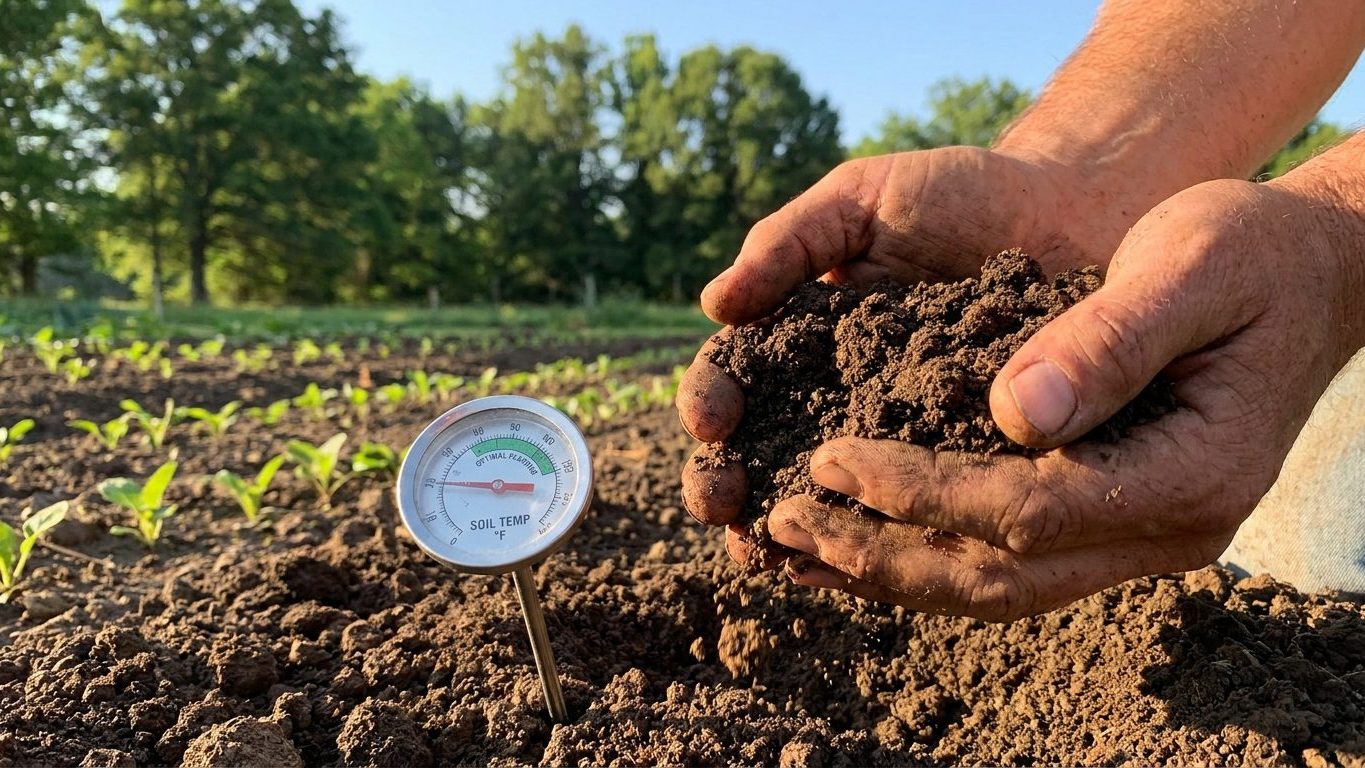

Mississippi gardeners can plant winter squash once soil temperatures climb reliably past the mid-60s, typically after mid-to-late March in most of the state, and expect to harvest mature fruit well before the first fall frost arrives in November. The state’s long, hot growing season favors winter squash more than almost any other crop in the garden, but heat, humidity, and disease pressure all shape which type does best and when to get seed in the ground.
When the soil is warm enough in Mississippi
The question every gardener asks first is “when do I plant?” But the honest answer starts with a correction: the date that matters is not the frost date, it’s the soil temperature underneath your feet. Winter squash seed rots in cold, wet ground long before a young plant would actually be killed by frost. So the last spring frost is a proxy, a rough marker that tells you when the soil is likely warming, not the actual trigger for planting.
At the reference station used for Mississippi’s climate normals, the last spring freeze falls somewhere between March 6 and March 22, according to NOAA’s 1991-2020 Climate Normals for 32°F freeze probabilities. That’s a 30-70% probability band, meaning frost still has a real chance of showing up on either side of it. It is not a guarantee, and it should never be treated as one.
That figure also comes from an airport weather station, which tends to run warmer than surrounding suburbs and rural low spots. Gardens outside town, especially in valleys or shaded low ground, often see frost linger a week or two past what the station reports. If you garden in one of those spots, wait for the soil itself, not the calendar, to tell you it’s ready. A simple soil thermometer pushed a few inches down works better than any date on a seed packet.
Once nighttime lows stay consistently above the mid-50s and soil temperature holds near 65°F or warmer, winter squash seed germinates quickly and seedlings avoid the stunting that cold snaps cause. In much of Mississippi that window opens in early-to-mid April for direct seeding, a few weeks after the frost-risk period from the NOAA data has mostly passed. Gardeners who want a head start sometimes transplant young squash instead of direct-seeding, but winter squash roots resent disturbance, so any transplants should be young, in individual pots, and moved with minimal root disruption.
For fungicide or pest treatments during this early stage, focus on cultural practice rather than any specific product: crop rotation, spacing for airflow, and removing volunteer squash plants that can carry over pests and disease from the previous season. Your county extension office through Mississippi State University Extension can confirm local soil-warming timing and pest pressure for your specific area.
How long the season lasts here
Mississippi’s growing season, bookended by the last spring frost (March 6 to March 22) and the first fall frost (November 7 to November 22), runs somewhere between roughly 230 and 260 days at the reference station. That is a long window by national standards, and it changes the strategy for winter squash more than almost any other single factor.
A short growing season forces a gardener into a single sowing and makes every week of delay costly. Mississippi’s situation is the opposite. With seven-plus months between frost dates, there’s enough time for an early planting in April, harvested by late summer, followed by a second sowing in June or early July that still has time to mature before the November frost window closes. That second window matters because winter squash needs its full maturation period on the vine; fruit picked green or under-ripe won’t cure properly and won’t store through winter the way a fully mature squash will.
This length also changes the transplanting calculus mentioned above. Where a short season makes every day of head-start valuable enough to risk transplant shock, Mississippi’s long window means direct seeding is often the safer, simpler choice; there’s enough time for a direct-seeded crop to catch up and still finish well ahead of frost. Transplants remain useful mainly for gardeners squeezing in that second, later sowing, since starting seedlings indoors in early June before setting them out shortens the time those plants occupy garden space outdoors during the hottest weeks.
Gardeners interested in stretching the harvest window or hedging against a bad first planting should look at the site’s succession sowing guide for a fuller breakdown of staggered planting dates and spacing strategies suited to a long season like Mississippi’s.
The caution about the reference station applies here too: rural and suburban gardens often see frost arrive earlier in fall and linger later in spring than the airport data suggests, which can trim actual usable growing days by a week or two on each end. That’s still plenty of room for two sowings in most of the state, but it’s worth checking your own county’s frost history rather than assuming the airport numbers apply exactly to your yard.
Heat and water in Mississippi
Winter squash is unusual among garden crops in that season length decides almost everything. The fruit has to mature fully on the vine before frost arrives; there’s no ripening on the counter for a winter squash the way there is for a tomato. An immature squash won’t cure into a hard, storable rind, and it won’t keep. In a territory with a short season, that reality pushes gardeners toward the earliest-maturing types available. Mississippi’s long window removes that constraint almost entirely, which shifts the real challenge from time to heat and moisture management.
At the Jackson reference station, the average year sees 71.1 days at or above 90°F, according to NOAA’s 1991-2020 Climate Normals. That’s a heavy heat load, more than two months’ worth of 90-degree-plus days spread mostly across June through September. Squash plants tolerate heat reasonably well once established, but that much sustained heat drives serious water demand and stresses flowering, sometimes causing blossom drop or poor fruit set during the hottest stretches of July and August.
Summer rainfall doesn’t fully offset that heat load. The reference station records about 14.1 inches of rain across June, July, and August, with June the driest month at 4.43 inches, July at 5.02 inches, and August at 4.69 inches. That’s a moderate amount of rain, but it rarely falls evenly. Mississippi summer rain tends to arrive as thunderstorms, dumping an inch or two at once and running off rather than soaking deep into the root zone, especially on compacted or sandy soils. Combined with 71 days of 90-degree heat driving evaporation, that pattern means irrigation is often what carries winter squash fruit through its filling stage, not rainfall alone.
A rain gauge on your own plot, checked weekly through the growing season, tells you more than any regional average. Where soil holds clay, rain lingers longer between waterings; on sandy soil, the same storm drains within a day and irrigation needs to fill the gap more often. Either way, deep, infrequent watering aimed at the root zone works better for winter squash than frequent light watering, which encourages shallow roots poorly suited to Mississippi’s heat.
Which winter squash suit Mississippi
With season length rarely the limiting factor here, the choice comes down to heat tolerance, disease resistance, and how a type handles Mississippi’s humid summers. This page won’t name specific varieties, and that’s a deliberate choice, not an oversight: the varieties trialled and recommended by Mississippi State University Extension reflect actual field performance in the state’s soils and climate, tested against local pest and disease pressure that changes from one growing season to the next. A variety name plucked from a seed catalog without that local trial history is a guess dressed up as a recommendation.
What can be said by type: Mississippi’s combination of long season, heavy summer heat, and meaningful humidity puts disease resistance near the top of the list of priorities, ahead of days-to-maturity concerns that dominate shorter-season states. Powdery mildew and other fungal pressures build through a long, humid summer, and a type bred with resistance to those pressures tends to outperform one chosen purely for size or storage qualities.
Types that produce well with good airflow around the vine and some afternoon shade at the root zone tend to handle the 71-plus days of 90-degree heat better than those that sprawl densely without space between plants. Spacing generously and training vines where possible reduces the humid, still air around foliage that fungal disease thrives in.
Because Mississippi spans hardiness zones 7b to 9a under the USDA Plant Hardiness Zone Map (based on 1991-2020 averages of extreme minimum winter temperatures), conditions differ meaningfully between the Delta, the hill country, and the Gulf Coast. That zone range describes winter cold extremes, not summer growing conditions, but it’s a reminder that a variety performing well near the coast may not be the same one thriving in the northern hill counties. Local extension trial data accounts for that variation in a way a general guide cannot, which is exactly why the recommendation here is to ask, not guess.