
Winter squash grows well across South Carolina, from the Upstate hills to the Lowcountry coast, as long as it goes into the ground after the soil itself has warmed rather than the moment the calendar clears the last frost. The state’s hardiness range spans zones 7a to 9a, wide enough that a planting date that works in Charleston can still be weeks too early in Greenville. What actually decides success is soil temperature, the length of the frost-free window, and how summer heat and rain land on the vine.
When the soil is warm enough in South Carolina
The question every gardener asks first is simple: what’s the date? For South Carolina, NOAA’s 1991-2020 Climate Normals put the last spring frost, measured as the 30-70% probability band for a 32F freeze at station USW00013880, between February 28 and March 17. That’s a wide window on its own, and it’s worth sitting with for a second before jumping to a planting date.
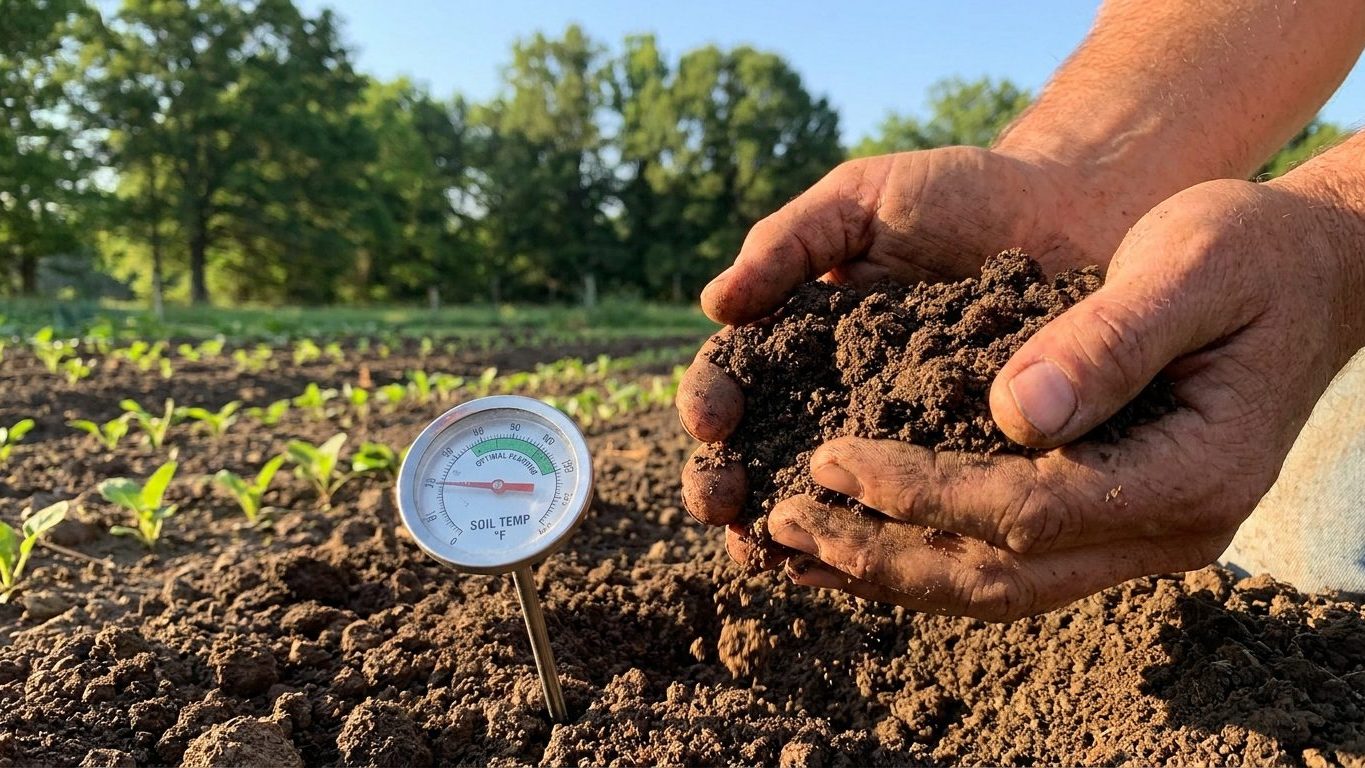
Frost is a proxy, not the real target. Winter squash seed doesn’t germinate reliably in cold ground, and transplants sulk or rot at the root when soil temperature lags behind air temperature. The frost date tells you when the freezing risk has mostly passed. It does not tell you when the top few inches of soil have actually warmed enough for squash roots to get moving, which in South Carolina’s clay-heavy soils can trail the last frost by a couple of weeks.
That February 28 to March 17 range itself hides real variation. Peninsular Charleston, moderated by tidal water and urban heat, tends to run milder than the airport station the normals are drawn from. The Upstate, sitting at higher elevation with colder air pooling in valleys, runs several weeks tighter at both ends of the frost calendar. A gardener in Aiken or Columbia is working with a different clock than one in Beaufort, even though both fall inside the same statewide zone range of 7a to 9a.
Treat the frost date as a probability, not a promise. A 30-70% band means exactly what it says: there’s real chance of a freeze on either side of it, some years more than others. The safer read for a gardener is to wait past the top end of the local window and confirm soil warmth by feel or with a simple soil thermometer before setting out squash, rather than pushing sowing dates against the earliest possible frost-free day.
For the actual types of winter squash that perform reliably in local trials, this page won’t put a name to a variety. Those trial results live with Clemson Cooperative Extension, and the recommendations they publish are tied to conditions this page can’t verify plot by plot. Naming a cultivar without that backing is the fastest way to steer a reader wrong, so the honest answer here is: check the frost-and-soil timing above, then let the extension service point you to what’s actually been tested in your county.
How long the season lasts here
Put the two frost dates together and the season stretches further than most gardeners expect. The first fall frost at the same reference station, USW00013880, falls between November 20 and December 5, again as a 30-70% probability band for a 32F freeze. Paired with the spring window of February 28 to March 17, the frost-free season runs somewhere between roughly 248 days, if the last frost lands late and the first fall frost lands early, and as many as 280 days, if the last frost is early and the first fall frost holds off until December. That’s a range of about eight to nine and a half months with no frost at all, which is a long runway by national standards.
A window that long changes the math on how you plant, not just when. In a short-season territory, the first sowing is usually the only sowing, and every week lost to a bad transplant or a slow germination narrows an already tight margin. South Carolina doesn’t have that problem. With close to nine months of frost-free ground on the long end of the range, there’s often room for a second sowing of winter squash later in the season, timed so the fruit still has enough weeks to mature and cure before the fall frost band arrives.
That’s also where transplanting versus direct seeding becomes a real decision rather than a forced one. In a short window, transplants buy time you can’t afford to lose to direct-seed germination delays, even with the root disturbance squash dislike. In South Carolina’s longer window, direct seeding is often the simpler, lower-risk choice, since there’s enough season length to absorb a slower start without pushing fruit maturity into frost risk.
The practical way to use this extra length is a staggered planting plan rather than one big sowing date. This site’s guide to succession sowing lays out how to space multiple plantings through a long season like South Carolina’s, so the harvest doesn’t all land at once and a failed first sowing isn’t the only shot at a crop.
Heat and water in South Carolina
Winter squash lives or dies by one rule: the fruit has to mature fully on the vine before frost, because an immature squash won’t cure and won’t store. Everything about heat and water in a given territory either helps that fruit reach full size and a hardened rind in time, or gets in the way.
South Carolina’s summers run hot. The reference station at Charleston logs an average of 55.1 days a year at or above 90F, per NOAA’s 1991-2020 Climate Normals. That’s a heavy heat load concentrated in the growing season, and it drives both faster water loss from soil and leaf, and real stress on the plant during fruit set. A count like this describes the reference station specifically, and inland or upstate spots can run hotter still on summer afternoons.
What’s notable here is that South Carolina isn’t a hot, dry territory in the way parts of the Southwest are. Summer rainfall at the same station averages about 19.8 inches across June, July, and August, out of 52.5 inches for the year. Broken down by month, the pattern looks like this:
| Month | Average rainfall |
|---|---|
| June | 6.21 inches |
| July | 6.6 inches |
| August | 6.97 inches |
That’s a lot of rain landing during the hottest stretch of the year, which sounds like good news for a thirsty squash vine, and it can be. But heat plus humidity plus regular rain is the exact combination that favors fungal disease, powdery and downy mildew especially, more than it favors simple drought stress. A vine that’s never short on water can still lose its leaves to mildew weeks before the fruit is ready, which is the bigger risk in South Carolina than dry soil.
The number that never reads alone is rainfall against soil type. On sandy Coastal Plain soils, that near-7-inch August rainfall drains through fast and a garden can still need supplemental watering between storms, especially with 90-plus-degree days pulling moisture out of the top inches. On heavier Piedmont clay, the same rain sits longer, which helps in a dry stretch but adds to the disease pressure already coming from summer humidity. A rain gauge on the actual plot, not the regional average, is what settles which situation applies.
Which winter squash suit South Carolina
None of this points to a single winning variety, and that’s a deliberate gap rather than an oversight. The types that make sense for South Carolina follow directly from the facts above, without needing a brand name attached.
Given a season that can run close to nine months frost-free, earliness isn’t the constraint it would be further north. That opens the door to longer-maturing types alongside quicker ones, and makes a second, staggered sowing worth planning for rather than a luxury. Given 55.1 days a year above 90F at the reference station, types and training methods that keep leaves off hot soil and allow airflow around the crown matter more than they would in a milder climate, since good air movement is one of the few practical defenses against the mildew that hot, humid air encourages. And given nearly 20 inches of rain landing in the three hottest months, disease resistance becomes the first thing to look for in a variety description, ahead of size or shape, because a resistant type has a real shot at keeping its leaves through August in a way a susceptible one won’t.
Vining growth habits versus more compact, bush-type plants matter here too, mostly through airflow. A sprawling vine planted too densely in a wet, hot summer traps humidity right where mildew spores need it. Spacing for air movement, whatever the growth habit, does more real work in this climate than almost any other single decision at planting time.
This page stops short of naming which specific squash to plant, and that’s the right call rather than a missing detail. Clemson Cooperative Extension runs the variety trials that actually test winter squash types against South Carolina’s heat, humidity, and disease pressure, county by county, and their published results reflect real field performance in ways a general page never can. Their extension directory is available at clemson.edu/extension, and it’s the resource that turns everything above, the frost dates, the season length, the heat and rain, into an actual variety list worth planting.