
Start winter squash transplants indoors in Anchorage around mid-April, then move them outside only after the last frost window closes, May 3 to May 12. Plan to have fruit set and skins hardening well before the first fall frost, September 22 to October 1, because winter squash rarely finishes from a direct-sown seed in this climate.
The short answer for Anchorage
Those two frost dates aren’t guarantees. They come from NOAA’s 1991-2020 Climate Normals for station USW00026451, and they mark the window where the probability of a 32F freeze sits between 30% and 70%. In plain terms: mid-way through that band, a freeze is roughly a coin flip. Transplanting on May 3 still carries real frost risk; waiting until May 12 cuts it, but not to zero.
Between those two dates sits about 143 frost-free days. That number matters more for winter squash than for almost any other vegetable in the garden, because most winter squash varieties need 75 to 100 days from transplant to a fully cured, storage-ready fruit, and that clock doesn’t start until the plant is already several weeks old. Sow seed directly into Anchorage soil on May 10 and you’re often asking a 90-day squash to finish inside a season that only gives it 90-something usable days after germination, with no room for a cold snap, a slow August, or a late-set fruit that needs another two weeks to harden its rind.
That’s why the workable calendar here isn’t “direct seed after frost.” It’s start seed indoors three to four weeks before the last frost date, harden off transplants in the days leading up to May 3-12, and set them out only once that window is realistically past. Anything that shortens the gap between transplant and first fall frost is doing the reader’s work for them here.
One more figure worth separating out: Alaska’s USDA hardiness zone range spans 1a to 8a. That’s a measure of the average annual extreme minimum winter temperature, useful for deciding whether a perennial survives the winter, not for deciding when to plant an annual vegetable in spring. It doesn’t set the sowing calendar. The frost dates do. Treat the two facts as answering different questions, because conflating them is the most common way a home gardener miscalculates.
What will not work here
Direct seeding into the ground is the first thing that fails. With roughly 143 frost-free days total, and winter squash needing 75-100 of those days just from the transplant stage onward, seed sown straight into cold May soil loses two to three weeks it can’t get back. That’s often the difference between a hard-shelled, storable squash in late September and a soft-rind fruit still ripening when the first fall frost, September 22 to October 1, ends the season for good.
Long-season winter squash varieties are the second failure point. Some pumpkin and banana squash types are bred for 100-plus day seasons in warmer climates. Anchorage’s zero average days above 90F tells the rest of the story: there’s essentially no heat load pushing fruit development along in a hot stretch of July. Growers in warmer states can lean on a run of 90-degree days to accelerate ripening when a squash is running behind. Anchorage growers can’t count on that at all, the season either finishes on schedule or it doesn’t finish.
Skipping season-extension tools is the third failure. Cold soil in May and June slows root establishment even after transplant. Black plastic mulch, row cover, or cloches aren’t optional extras in this climate; they’re often what closes the gap between a squash that sets fruit in early July and one that’s still flowering when the days start shortening in August.
Ignoring the rain pattern is a smaller but real issue. Summer rainfall averages about 5.8 inches across June, July and August, with June the driest month at 1.02 inches. That’s enough to keep soil workable without heavy irrigation in most years, but it also means growers can’t assume a hot, dry stretch will force them to water on a strict schedule the way a grower in a drier, hotter state would. Watering by a fixed weekly routine, rather than by checking the soil, either drowns cool wet soil in a rainy stretch or lets it dry out unnoticed during the driest month.
What changes across Alaska
Alaska’s hardiness zone range runs from 1a to 8a. That’s not a narrow spread, it’s one of the widest ranges of any state, built entirely on the average annual extreme minimum temperature, and it means there is no single answer to “when should I plant” that covers the whole territory. Anchorage’s frost dates and 143 frost-free days already describe one of the milder, more forgiving corners of the state.
A grower in the Interior, further from the moderating effect of Cook Inlet, typically works with a shorter frost-free window and colder soil later into spring, even though long summer daylight hours partly offset the compressed season. A grower at higher elevation or further north again faces a narrower gap between last spring frost and first fall frost, which squeezes an already tight winter squash timeline even further.
The practical shift for anyone outside the Anchorage area is to treat the dates on this page as a starting reference, not a local forecast. If the local frost-free season runs shorter than 143 days, the response isn’t to plant earlier and gamble on frost, it’s to lean harder on starting seed indoors well ahead of transplant, choosing the shortest-season squash varieties available, and using row cover or plastic mulch to buy back the days a colder location doesn’t have.
Rather than guess which zone applies to a specific yard, check the USDA Plant Hardiness Zone Map directly for the exact location. The map is built for precisely this kind of address-level lookup, and it’s a more reliable starting point than assuming a nearby town shares the same zone.
Where to check this for your own county
This page describes Anchorage’s frost dates and season length because that’s what the climate data actually measures. It is not a substitute for a county-level recommendation, and Alaska’s spread from zone 1a to zone 8a is exactly why that distinction matters here more than in most states.
The University of Alaska Fairbanks Cooperative Extension Service is the state’s land-grant extension office, and it’s the right next stop for anyone planting outside Anchorage or wanting a finer-grained answer than a statewide climate normal can give. Two things are worth looking for specifically once there: a local planting calendar built around the district office nearest the reader’s own community, and any variety trial results for winter squash conducted in that district.
Variety trials matter more here than in longer-season states, because the margin for error is so thin. A squash variety that performs well in a 100-day trial plot in one part of the state may still fall short in a shorter-season district, and extension trial data usually says so directly rather than leaving it to guesswork.
A county-level recommendation from a local extension office will beat this page every time, because it’s built from conditions in that specific district rather than a single reference station’s 30-year average. This page gives the state-level picture: the frost dates, the season length, the general failure points. Local extension staff can translate that into a planting date and a variety list built for one particular community’s soil, elevation and microclimate.
Checking this against your own garden
Frost dates are averages built from three decades of weather records, not a promise about any single spring. The garden itself gives better information than any calendar date once the season actually starts, and three simple observations tell a grower more than the calendar ever will.
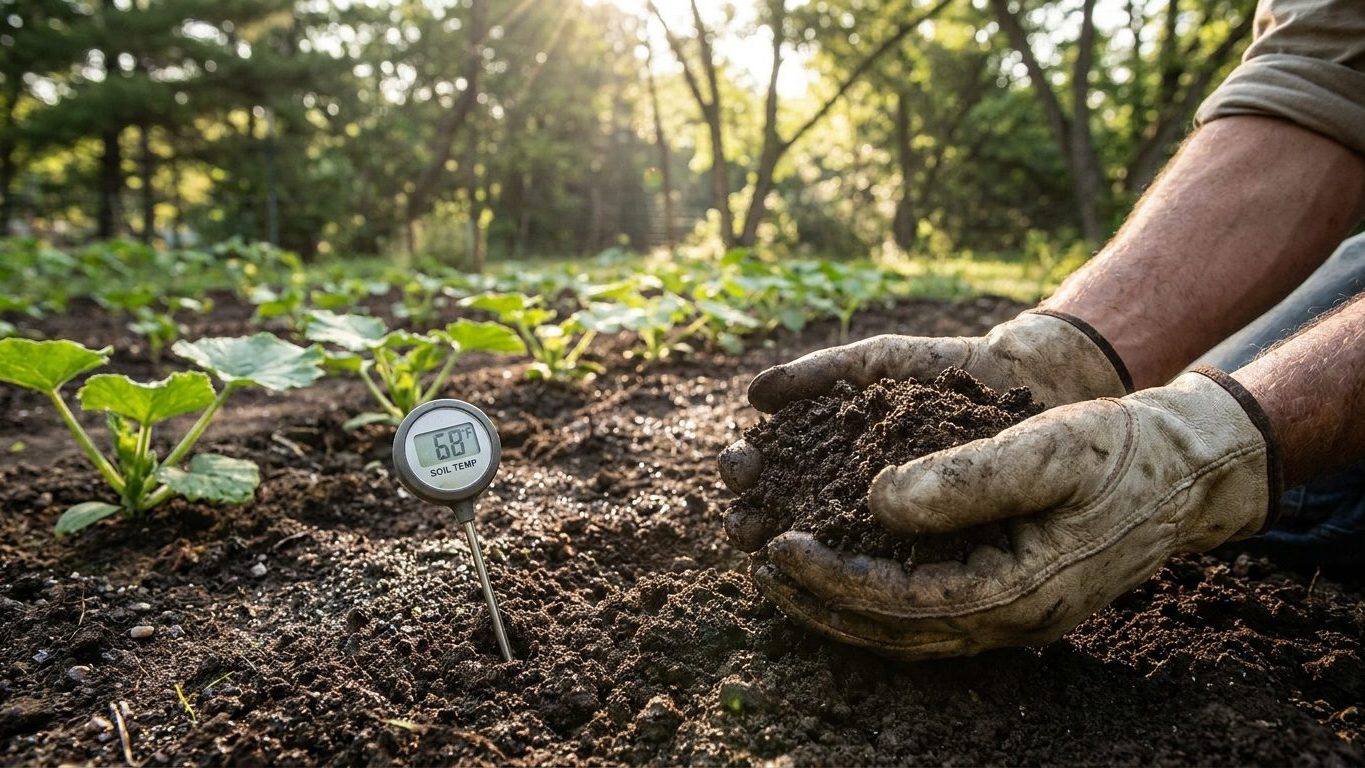
Soil warmth by feel is the first check. Winter squash roots stall in cold soil even after a transplant survives the air temperature. Pushing a finger a few inches into the bed before transplanting is a rough but honest test: soil that still feels cold and heavy to the touch in mid-May is a sign the local ground is running behind the regional average, whatever the calendar says.
The first flush of male flowers is the second signal. Squash plants typically produce male flowers before female ones, and their timing shows how the plant is responding to the specific light and warmth of that yard. A long gap before female flowers appear, and before fruit actually sets, often means the local microclimate is running cooler or shadier than the wider Anchorage average.
The appearance of the first true leaves, the ones that follow the initial seed leaves, marks the point where a transplant is truly established and drawing on its own root system rather than seed reserves. A slow, delayed emergence of true leaves after transplanting is often the clearest early sign that a particular bed runs colder than the rest of the yard, and it’s worth noting where in the garden that happens for next year’s planting.