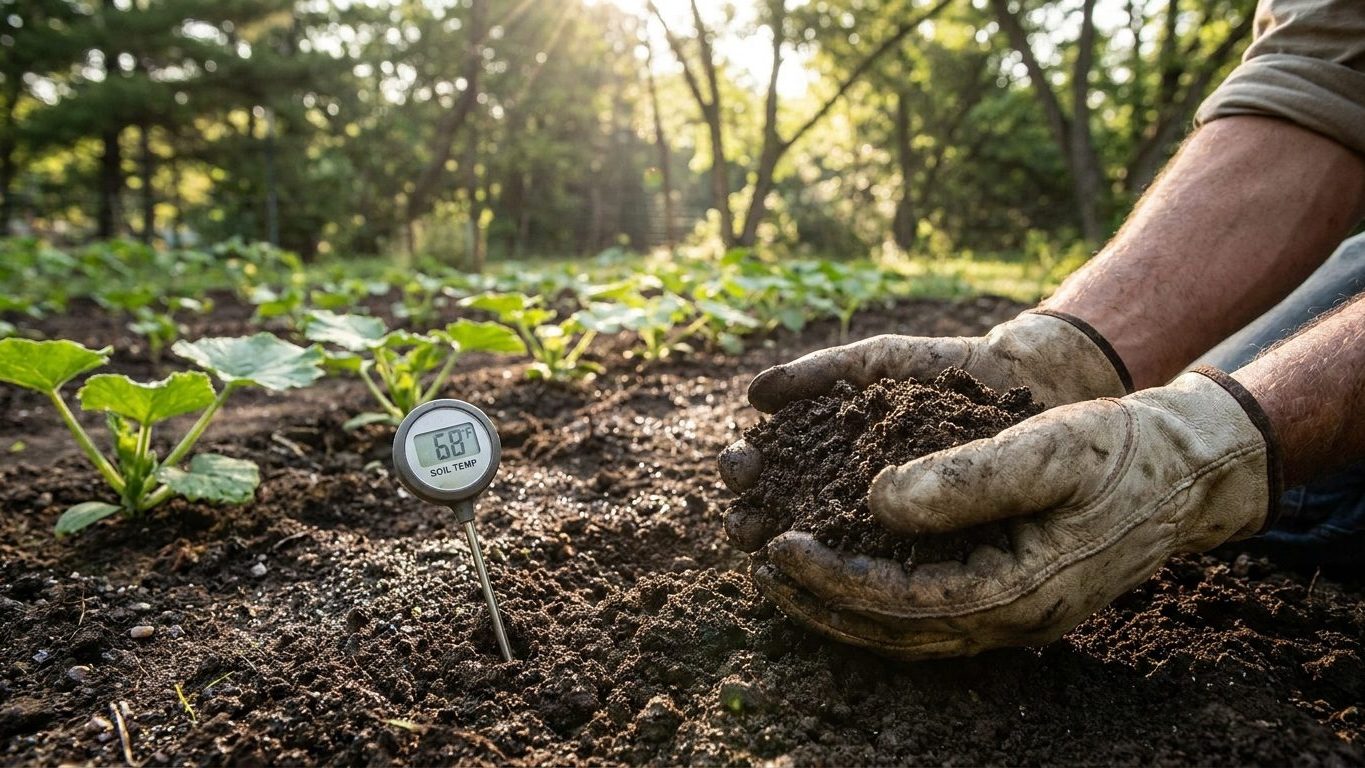

Direct-seed winter squash outdoors in Arkansas once the 36°F light-frost date has passed, which lands around early April for most of the state, and keep sowing through late May or even early June for a second harvest wave. The last hard freeze (32°F) typically falls somewhere between March 12 and March 28, but that’s a probability band, not a promise, and it ignores the lighter chill that still kills young squash. What follows explains where that window tightens, where it fails outright, and why the calendar shifts once you cross into the hills.
The short answer for Arkansas
Two frost thresholds matter here, and mixing them up is the single most common planting mistake. NOAA’s 1991-2020 climate normals, pulled from station USW00013963, put the last spring freeze at 32°F somewhere between March 12 and March 28, a 30 to 70 percent probability band rather than a fixed date. That’s the number people quote, but it’s built for a hard freeze, the kind that kills established perennials. Winter squash seedlings don’t need a hard freeze to die. A light frost does the job, and for that the National Weather Service office in Little Rock gives a tighter, more useful pair of dates: April 3 in spring, October 31 in fall, both measured at the 36°F threshold.
| Frost threshold | Spring date | Fall date |
|---|---|---|
| 32°F, hard freeze (30-70% probability band) | March 12 to March 28 | November 7 to November 20 |
| 36°F, light frost (NWS Little Rock) | April 3 | October 31 |
Why the sowing window runs April through May
Winter squash needs 80 to 110 days from seed to a fully cured fruit, depending on the variety. Counting back from the October 31 light-frost date, a July sowing is technically possible on paper. But the summer stands between seed and harvest, and Arkansas summers carry a mean of 69.2 days a year at or above 90°F. Squash flowers stop setting fruit reliably once daytime highs sit consistently near or above that mark, so a plant that starts blooming in the hottest stretch of July and August often drops flowers instead of setting them. Sowing in April or May puts flowering earlier, before the heat load peaks, and still leaves well over 150 days of frost-free growing before the light-frost date in late October. That cushion is generous by national standards, and it’s the reason gardeners here can afford to stagger plantings into early June without gambling the harvest.
What will not work here
The failure mode in Arkansas is almost never a short season. With roughly seven months between the April light-frost date and the October one, there’s more than enough time for even the slowest-maturing winter squash. The two things that actually wreck a crop are heat timing and watering habits mismatched to a humid, rain-heavy summer.
Flowering into the heat
Planting late, say in mid-June or July to catch a second round, pushes flowering straight into the stretch when 90-degree days pile up. Pollen viability drops in that kind of heat, bees forage less during the hottest hours, and the result is a vine full of blossoms and few fruits. A gardener who plants on the same June date every year and blames the seed or the soil is usually just fighting the thermometer instead.
Watering on a weekly schedule
Summer rainfall across June, July and August averages about 10.0 inches total, but it doesn’t arrive evenly. June brings 3.55 inches, July 3.33, and August, the driest of the three, only 3.16. That’s not a drought by national standards, but it’s also not enough to skip irrigation during fruit fill, especially since much of that rain tends to fall as short, heavy thunderstorms that run off rather than soak deep into the root zone. A once-a-week watering plan built around an “average” rainfall figure will leave squash roots dry for days at a stretch during a hot August, right when fruits need steady moisture to size up. The fix isn’t more water on a fixed schedule; it’s checking soil moisture at the root zone and watering when it’s actually needed.
Humidity compounds the problem. Combine regular summer rain with the kind of dense planting that keeps leaves wet and shaded from airflow, and powdery mildew and vine borers move in fast. Spacing that would be fine in a drier state becomes a liability here once the vines fill in during a wet July.
What changes across Arkansas
Arkansas isn’t one climate. The USDA Plant Hardiness Zone Map, built on 1991-2020 average extreme minimum winter temperatures, places the state across a 6b to 8a range. That’s a wide spread for one state, and it matters more for winter squash than the zone number itself suggests, because it’s a rough proxy for how much earlier or later the frost dates run from one end of the state to the other.
North versus south, hills versus lowlands
The reference station behind the frost dates cited above sits in the central part of the state, near Little Rock. Gardeners in the cooler 6b pockets, generally the higher elevations of the Ozark and Ouachita highlands in the north and west, should expect their own last light frost to land later than April 3 and their first fall frost to arrive earlier than October 31. That shortens the safe window from both ends at once. Gardeners in the warmer 8a stretches, generally the lower Delta and south-central lowlands, can often push both edges of the window in the opposite direction, sowing a bit earlier and harvesting a bit later.
None of this means there’s a single adjusted date to swap in. The zone range spans a full step and a half on the USDA scale, which is a meaningful climate difference, not a rounding error. The only way to know which end of that spread applies to a given piece of ground is to check the map itself rather than guess from a general sense of “north” or “south.”
Where to check this for your own county
Everything above is a state-level picture, built from one reference station and one statewide hardiness zone map. A county recommendation will always beat a state one, because county extension agents adjust for local elevation, local soil, and years of trial plots that a statewide normal can’t capture.
What to look for on the extension site
The University of Arkansas Cooperative Extension Service is the right next stop. Two things are worth searching for specifically once there:
- The local, county-level vegetable planting calendar, which will already have folded in the elevation and frost timing for that specific area instead of a statewide average.
- Winter squash varieties that extension agents have actually trialed in Arkansas conditions, since performance against local humidity and heat matters more than a seed catalog’s general description.
Extension offices also field direct questions from local growers, and a county agent can usually say, from years of local observation, whether a given spring has been running early or late compared to the statewide normals cited here. That kind of on-the-ground correction is exactly what a page like this one, built from state and regional data, can’t provide. Treat the dates above as the starting frame, and treat the county extension office as the source that narrows it down to an actual piece of ground.
If you follow the almanac, here is when to plant winter squash by the moon. It is a tradition, not a proven method.
Checking this against your own garden
Every date here is a normal, an average built from thirty years of data at one weather station. A reader’s actual yard can run a week or two ahead of or behind that average depending on slope, tree cover, soil type, and how much concrete or asphalt sits nearby holding heat. Three direct observations settle the question better than any calendar.
- Soil warmth by feel. Squash seed wants soil that’s warmed up, not just frost-free air. Cold, damp soil that clings to a trowel and feels chilly to the back of a hand will rot seed before it germinates, even weeks after the last frost date has passed on paper.
- The first flush of male flowers. Squash vines put out male blossoms before female ones, sometimes by a week or two. Seeing that first round of yellow male flowers is a sign the plant has settled in and is building toward fruit set, a useful check against whether the planting date actually matched the season that year.
- The first true leaves. The rounded seed leaves that emerge first aren’t the plant settling in; the first set of true, lobed squash leaves is. Their appearance, and how fast they follow the seed leaves, gives a rough read on whether the local soil and air temperature are actually supporting steady growth or just barely tolerating it.
None of these require a thermometer or a gauge, just a look at the bed every few days through April and May. Over a season or two, that habit of watching tells a gardener more about their own particular yard than any statewide date range ever will.