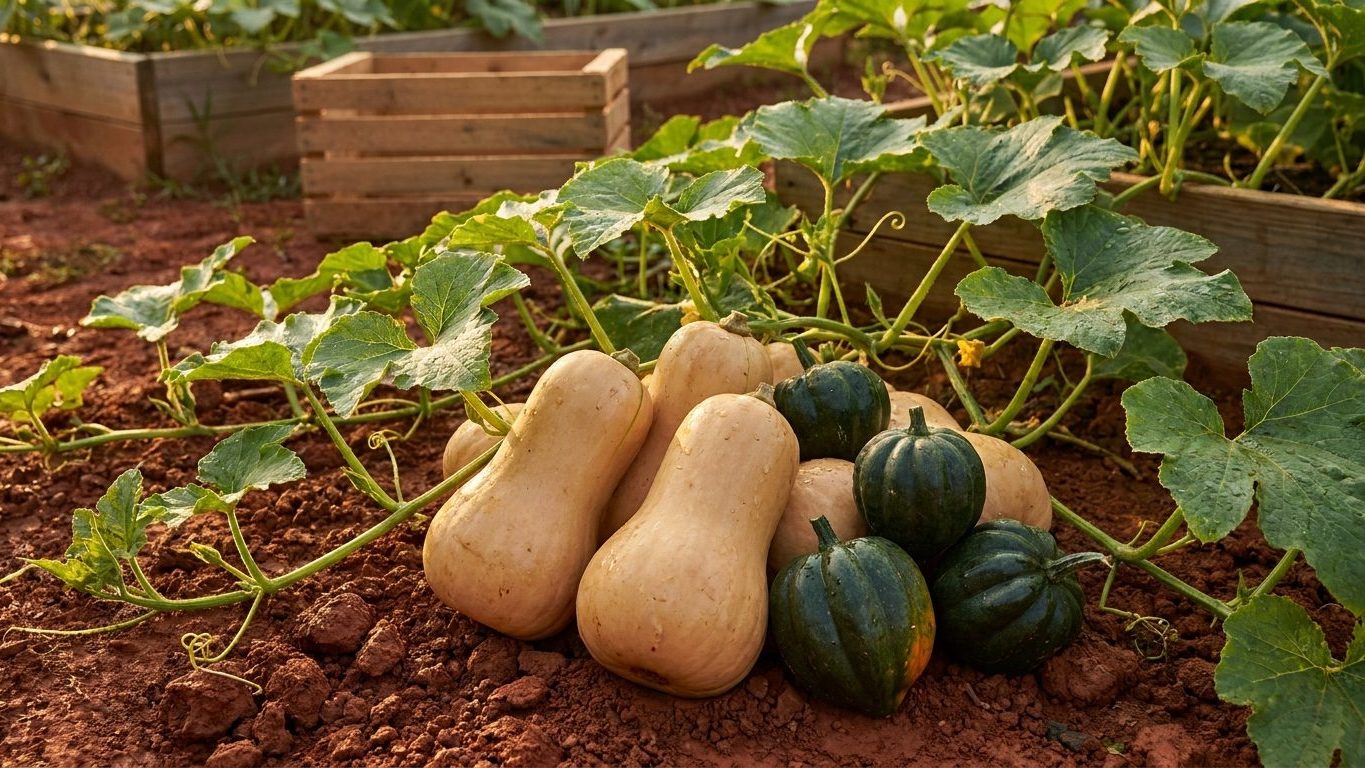

Butternut squash is the safest bet for most of Arkansas, thanks to a solid stem that shrugs off the squash vine borer and a heat tolerance that holds up through summers that hit 90F or hotter on 69 days a year. Acorn and delicata work too, but they need closer watching. Giant storage types bred for cooler, drier climates are the ones to skip.
The short answer for Arkansas
The decision here comes down to species, not just variety name. Cucurbita moschata, the group that includes butternut and the old Southern cushaw squash, has a solid stem core. That single trait matters more in Arkansas than almost anywhere else, because the squash vine borer, a moth larva that tunnels into hollow stems and kills the plant from the inside, thrives in exactly the warm, humid conditions this state delivers all summer. Butternut simply gives the borer less to chew through.
Acorn, delicata, and spaghetti squash belong to Cucurbita pepo, a species with hollow stems and much less natural resistance. They still grow well here and mature fast, generally 80 to 95 days, which lets a gardener get a harvest in before disease pressure peaks in late summer. But they need more active monitoring for borer damage and for powdery mildew, which spreads fast once the humid air of June and July sets in.
Kabocha and true Hubbard squash sit in Cucurbita maxima, a species that tends to need more days to reach full size and cure properly, often 100 to 120 days. That is not automatically a problem given how long the Arkansas growing season runs, but it does mean more weeks exposed to heat stress and fungal pressure, and less margin if planting gets delayed by a wet spring.
The season length itself is generous. Between the last spring frost, which falls somewhere from March 12 to March 28 depending on the year, and the first fall frost, arriving November 7 to November 20, most of the state has well over 220 days free of a hard 32F freeze. That is enough time for any winter squash type to reach maturity. The limiting factor in Arkansas is not the calendar. It is what happens to a vine sitting in 90-degree heat and thick humidity for three straight months.
So the practical short answer: lead with butternut or a moschata-type cushaw for the most forgiving experience, treat acorn and delicata as a fast, rewarding second choice that needs closer attention, and think twice before committing a lot of garden space to a long-season maxima variety unless there is a plan in place for pest and disease management.
What will not work here
Giant storage squash bred with a cool, dry autumn in mind is the clearest mismatch for this state. Some Hubbard and blue-skinned maxima varieties were developed for regions where fall air dries out fast, letting the rind cure hard on the vine before harvest. Arkansas falls do not offer that. Even after the growing heat breaks, humidity lingers, and a rind that should be hardening in dry air instead sits in damp conditions that invite rot at the stem end right when the squash is supposed to be entering storage.
Watering on a fixed weekly schedule is another approach that fails here, and the numbers explain why. Summer rainfall across June, July and August averages about 10.0 inches total, with August running driest at just 3.16 inches. That sounds like enough moisture until it’s weighed against 69.2 days a year above 90F, the kind of heat load that pulls water out of soil and out of leaves fast. A single weekly soaking cannot keep pace with that evaporation rate during a hot, dry stretch in August, and squash plants respond to inconsistent moisture with blossom drop and bitter or misshapen fruit. Worse, most of that summer rain tends to arrive as a thunderstorm dumping an inch in an hour, which runs off a compacted or clay surface rather than soaking in, so the rain gauge total and what the roots actually receive can be two very different numbers.
Tight spacing is the third trap. Vine crops packed close together might work in a drier climate, but in a state with this much summer humidity, dense foliage traps moisture around the leaves and creates ideal conditions for powdery mildew and downy mildew. Once mildew takes hold on a humid Arkansas evening, it spreads through a crowded planting in days, and a squash plant with damaged leaves cannot properly size or sweeten its fruit even if the vine itself survives.
Finally, any variety marketed as needing a short, cool growing window, the kind sold for high-altitude or far-northern gardens, wastes the long Arkansas season without gaining anything in return. Those varieties are bred to rush to maturity before an early frost threat that simply does not apply across most of this state.
What changes across Arkansas
Arkansas is not one climate, and the USDA Plant Hardiness Zone Map, built on average annual extreme minimum temperatures, places the state anywhere from zone 6b to zone 8a. That is a real spread, not a rounding error. A zone 6b winter in the Ozark highlands of the northwest can dip meaningfully colder in an extreme year than a zone 8a winter down in the southern lowlands, and that gap shapes more than just how tender a perennial has to be. It also shifts the safe planting window and the length of the effective growing season from one end of the state to the other.
A gardener working higher ground in the north or at elevation should expect a later safe planting date in spring and a real chance the first fall frost shows up on the earlier side of the November 7 to November 20 range, not the later side. That trims the number of full growing weeks available for anything on the slower end, like a 110-day maxima variety, and argues for leaning harder toward butternut, acorn, or delicata in those areas simply because they finish sooner.
In the warmer south and in the Delta, the extra weeks of heat cut the other way. There is more room to let a longer-season squash finish properly, but there are also more days above that 90F threshold, which raises the disease and heat-stress load discussed above. A gardener there gains time but has to manage moisture and mildew more actively across a longer hot stretch.
The only reliable way to find out is to check the current USDA Plant Hardiness Zone Map by ZIP code before locking in a planting date built around one end of that 6b to 8a spread.
Where to check this for your own county
Everything above describes Arkansas as a whole, using data from a single reference weather station. A county sixty miles away can run a week or two ahead or behind on frost dates, and can see meaningfully different rainfall and heat patterns depending on elevation, tree cover, and local geography. That gap between a state-level page and a county-level recommendation is exactly what a Cooperative Extension office exists to close.
The University of Arkansas Division of Agriculture runs the state’s Cooperative Extension Service, and its site is the right next stop. Two things are worth searching for there specifically. First, a county-level or regional planting calendar, which will translate the general frost-date ranges into dates tuned for a specific local station rather than the statewide reference point. Second, any variety trial results or extension bulletins covering winter squash performance in that same county or region, since local agents often track how particular butternut, acorn, or Hubbard varieties actually performed against real vine borer and mildew pressure in trial gardens nearby.
A county recommendation will always beat a state one when the two disagree. Statewide climate normals apply evenly across a state this size, but a local extension office works from what actually happened in gardens near a particular reader, season after season. That is a different and more precise kind of evidence, and it is worth the extra step of tracking it down before finalizing a variety list or a planting date.
Checking this against your own garden
Every date and average describes a typical Arkansas year. A reader’s own soil, garden, and season are what actually decide when to plant, and three simple observations outrank any calendar.
Soil warmth by feel is the first check. Pressing a bare hand into the planting bed in spring should feel comfortably warm, not cool or damp to the touch. Winter squash seed sitting in cold soil simply stalls rather than germinating, no matter what the calendar says about the last frost having passed. If the soil still feels cool weeks after the average last frost date for the area, that is a sign of a shaded bed, heavy clay, or a low spot that warms slower than the regional average, and planting should wait a bit longer regardless of the date on any chart.
The first flush of male flowers is the second signal. Squash plants send out male blossoms before female ones, and a garden producing plenty of male flowers with no fruit set yet is simply not behind schedule, it is following its normal sequence. Female flowers, recognizable by the small bulge at the base that becomes the fruit, typically follow within a week or two once pollinator activity picks up.
The first true leaves, the ones that appear after the initial rounded seed leaves and actually look like squash foliage, tell a grower how vigorously the plant is establishing in that specific soil and microclimate. Slow, pale true leaves point to a nutrient or drainage issue worth investigating in that bed, separate from anything about timing or variety choice.