
The safe window to direct-seed winter squash on the Colorado plains sits in the second half of May, once soil has warmed past the last spring frost date. But that date itself is a range, not a single morning, and what happens after planting matters as much as when you start.
The short answer for Colorado
At the NOAA reference station used for these normals, the last spring frost falls somewhere between May 1 and May 11, and the first fall frost between September 30 and October 12. Those are not fixed calendar days. They come from 1991-2020 climate normals and represent the 30-70% probability band for a 32F freeze, meaning frost has roughly a 30% to 70% chance of occurring on any given date inside that window. Planting winter squash before May 11 carries real risk; waiting until after that date, even into the third week of May, buys a margin most gardeners will want.
Do the arithmetic on the other end and the growing season runs from about 142 days (October 12 minus May 11 doesn’t align this way, so use the tighter pairing) up to roughly 164 days at the widest spread, depending on which end of each frost window actually shows up in a given year. That’s a generous window by squash standards, but it is not unlimited, and it belongs to one station: the reference point sits at 5,280 feet on the Front Range plains.
That elevation detail carries weight. Winter squash is warm-season, frost-tender at both ends of life, and slow to mature compared with a summer squash or a bean. A planting date that ignores the probability nature of these frost windows, and just picks the earliest plausible day, is betting against roughly a third to a majority of years, depending on where in the band you land. The safer play for most plains gardeners is to treat May 11 as the real starting line rather than May 1, and to watch soil conditions rather than the calendar alone before committing seed to ground.
None of this applies uniformly. A gardener in a mountain valley or on the Western Slope is working from a different frost calendar entirely, one this reference station cannot supply. The plains figure is a starting point, not a substitute for a local check, which the later sections of this page address directly.
What will not work here
Two separate problems stack up in a Colorado summer, and either one alone can sink a winter squash crop that would have been fine somewhere else.
The first is season length working against slow-maturing types. Large-fruited, long-season winter squash, the kind bred for big Hubbard-style fruit or heavy storage varieties, need every day of a long frost-free run to size up and cure properly before first frost. With the fall frost arriving as early as September 30 in some years, a variety that needs the full stretch of the growing season has almost no cushion for a late start, a cool spell in June, or a slow germination. Choosing the slowest-maturing squash on the seed rack and planting it in late May, rather than the earliest days of the window, is a common way to end up with fruit that never fully cures before the first hard freeze.
The second problem is heat and dryness acting together. The reference station averages 39.6 days a year at or above 90F, a heat load that drives fast evaporation from soil and leaves through the hottest stretch of summer. At the same time, summer rainfall totals only about 5.7 inches across June, July, and August, with August, often the peak fruiting month for winter squash, delivering just 1.58 inches. A watering routine built around once-a-week deep soaking, which works in wetter regions, leaves squash roots dry for days at a time once daytime highs push past 90F repeatedly. Vines wilt in the afternoon heat even with adequate soil moisture at times, but chronic underwatering on top of that heat load shows up as blossom drop and small, misshapen fruit rather than healthy vines simply coping with sun.
Neither problem is unique to squash, but the combination is specific to this territory’s numbers: a season long enough to tempt gardeners into slow varieties, paired with a summer dry and hot enough to punish anyone who waters on a wetter region’s schedule. Matching variety choice and irrigation frequency to those two numbers, rather than to general planting advice, is what separates a full harvest from a disappointing one here.
What changes across Colorado
Colorado’s hardiness zone range runs from 3b to 7b under the USDA system, a spread built entirely on average annual extreme minimum winter temperature. That six-zone range inside one state is unusually wide, and it means there is no single planting date, no single variety list, and no single watering schedule that fairly represents the whole territory. A number pulled from the Front Range plains reference station is a plains number, not a mountain one and not a Western Slope one.
Mountain towns can run a growing season short enough to see frost in July, a possibility flatly excluded by the plains frost window discussed above. At higher elevation, cooler nights slow squash growth even during the frost-free months, stretching the effective days-to-maturity a variety needs well beyond what a seed packet promises at lower elevation. Gardeners working at altitude should expect to compress variety choice toward the fastest-maturing types available, and to treat the plains frost dates on this page as a floor, not a guide, for their own risk.
The Western Slope differs again, with its own precipitation pattern and frost timing shaped by different terrain and airflow than the Front Range. Neither this page’s frost dates nor its rainfall figures were measured there, and borrowing plains numbers for a Western Slope garden risks planting too early or watering on the wrong rhythm for that region’s actual summer.
What none of this page can do, and what it will not attempt, is tell an individual reader which of these zones applies to their own yard. The USDA Plant Hardiness Zone Map is the tool built for that, and matching an address to a zone there takes a minute and settles the question a state-level page like this one cannot.
Where to check this for your own county
Colorado State University Extension, at extension.colostate.edu, is the source built to close the gap this page cannot close: the county-level detail sitting underneath a statewide frost window and a single reference station’s rainfall record.
Two things are worth looking for specifically once there. The first is a local planting calendar, built around the frost dates and elevation of the reader’s own county rather than the Front Range plains figures used above. A county sitting at higher elevation, or further west, will carry a different frost window entirely, and the county extension office will have worked from records closer to that actual garden. The second is any list of squash varieties trialled in that county’s own conditions, which carries more weight than a general seed catalog description written for a national audience with no particular climate in mind.
The distinction matters because a state page, this one included, is built from one reference station’s climate normals and a statewide hardiness zone range. It is a reasonable starting point for a plains gardener and a poor substitute for anyone else in the state. A county recommendation, built from local frost records and local variety trials, will always outperform a state-level average for the simple reason that it was built from the reader’s own conditions rather than a proxy for them. Where the two disagree, the county figure should win.
Checking this against your own garden
Every date on this page describes an average year at one weather station. The actual garden in front of a reader on any given May morning will tell a more accurate story, and three signs are worth checking before seed goes into the ground.
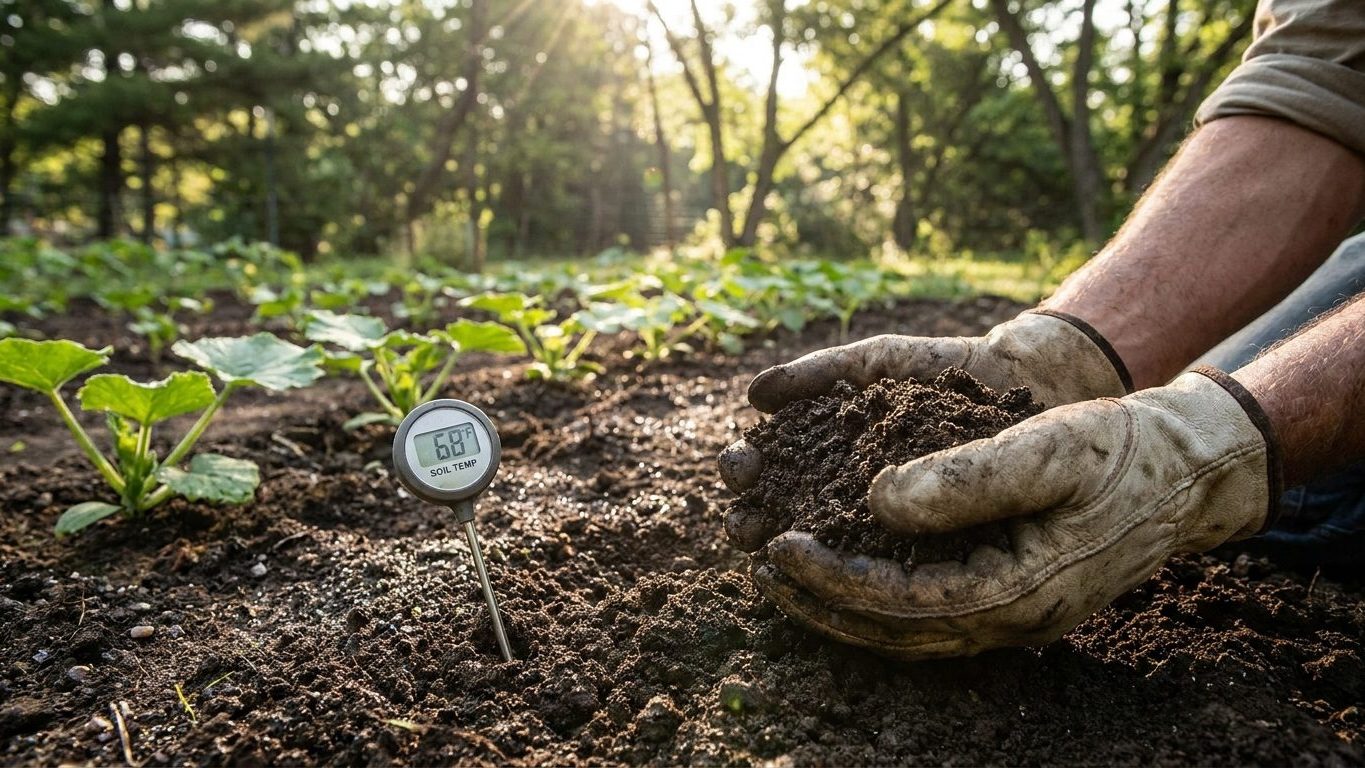
Soil warmth by feel is the first and most direct check. Winter squash seed germinates poorly in cold soil regardless of what the calendar says, and a hand pressed a few inches into the bed, checked in the morning before the sun has warmed the surface, gives a rough but honest read on whether the ground has actually caught up to the season. Soil that still feels cold to the touch in mid-May, even after the probability-based frost window has technically closed, is telling a gardener to wait, not to force the planting date.
The first flush of male flowers on an already-planted vine is the second signal, and it says something about pollination timing rather than planting itself: male flowers typically appear before female flowers, and a run of male-only blooms for a week or two is normal, not a sign of failure, before female flowers with the small swelling at their base start to open.
The appearance of true leaves, the second set that looks like the plant’s mature foliage rather than the rounded seed leaves, marks the point where a seedling has moved past its most fragile stage. A bed showing strong true leaves ahead of where the state calendar would predict is a sign of a warmer-than-average microclimate, a south-facing slope or a sheltered spot against a wall, and a gardener who notices that pattern across several seasons has learned something about their own yard that no station-wide normal can supply.