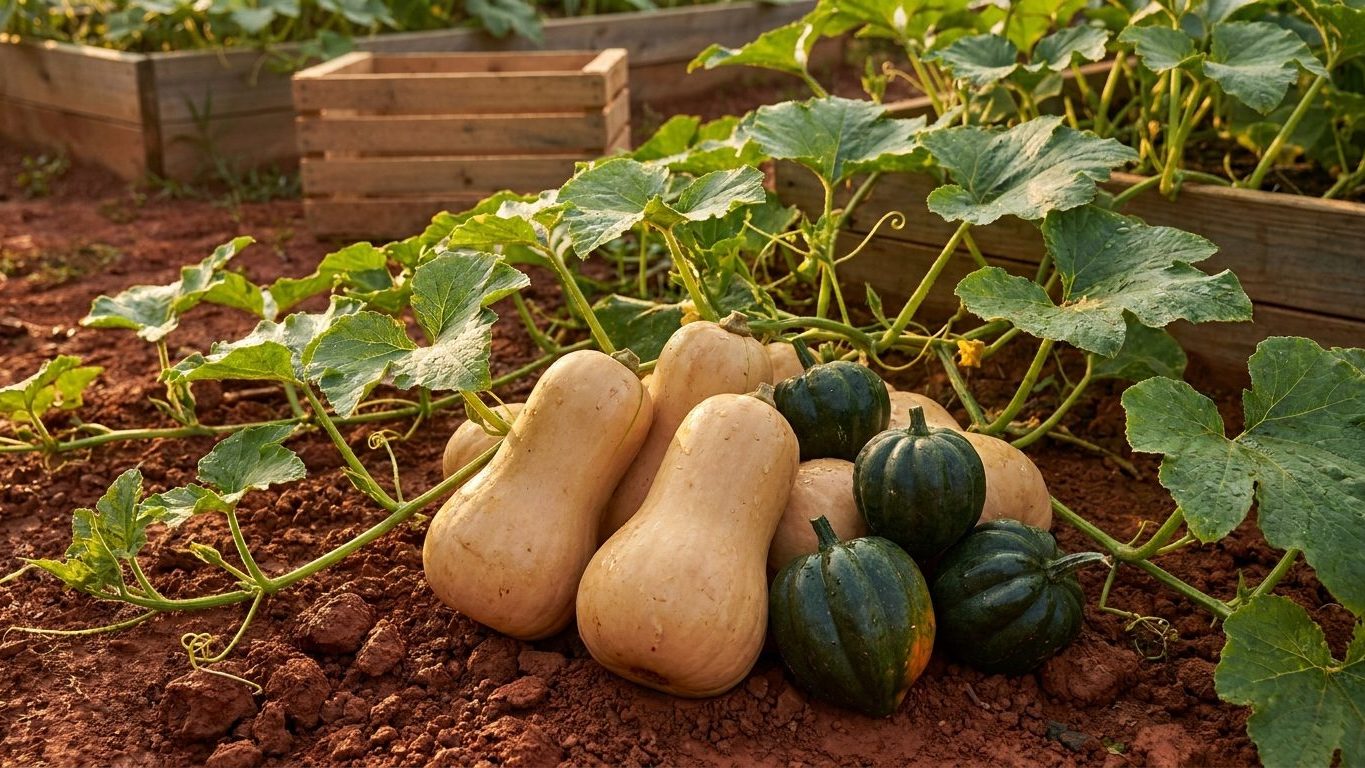

For most of Colorado’s populated corridor, from Denver to Colorado Springs to Fort Collins, medium-season winter squash such as acorn, delicata and spaghetti squash are the safest bet. Long-season types like Hubbard or giant kabocha only pay off where the frost-free window runs closer to its longer end, and mountain gardeners need to drop to short-season bush varieties entirely.
The short answer for Colorado
Start with the number that actually decides this: the frost-free window at the Denver-area reference station runs from a last spring frost between May 1 and May 11 to a first fall frost between September 30 and October 12. Stack the worst case against the worst case and you get roughly 142 days of growing season; stack the best case against the best case and you get closer to 164 days. That range, not a single date, is what a variety has to fit inside.
Winter squash varieties are usually sold with a “days to maturity” number, and that number is the real filter for a Colorado garden. A 142-to-164-day window has room for anything maturing in 100 days with margin to spare, and it can stretch to cover a 110-day variety if the season runs long and the transplant goes in early rather than being seeded direct. It does not have comfortable room for anything pushing past 115 to 120 days, because a single early frost at the short end of that window erases the buffer.
How the main types line up
| Type | Typical days to maturity | Fit for the Colorado window |
|---|---|---|
| Acorn | 80-100 | Comfortable fit almost everywhere in the window |
| Delicata | 90-100 | Comfortable fit |
| Spaghetti | 90-100 | Comfortable fit |
| Buttercup / Kabocha | 95-110 | Fits if started as transplants, not direct-seeded |
| Butternut | 100-115 | Fits only in the longer stretch of the window |
| Hubbard | 110-120 | Tight fit at best; risky at the short end of the window |
So the decision by type is straightforward. If the garden sits at an elevation and location resembling the Denver reference station, acorn, delicata, spaghetti and most buttercup or kabocha varieties are a sound default. Butternut and Hubbard belong in the plan only when the grower can start transplants indoors weeks ahead and is willing to accept some years where the last vines don’t finish curing before frost.
What will not work here

The single biggest failure mode in Colorado winter squash is choosing a variety on the slow end of the maturity scale and direct-seeding it, then losing the race to the fall frost. A 120-day Hubbard direct-seeded after the last frost date needs every single day of the 164-day best case to finish and cure properly. In a year that lands closer to the 142-day worst case, that same plant is still holding immature fruit when the first hard freeze hits, and unripe winter squash does not store the way a properly cured one does.
The second failure mode is watering on a weekly schedule and assuming the plant will manage. Colorado’s summer rainfall averages about 5.7 inches across June, July and August, with August, right when fruit is sizing and skins are hardening, being the driest month at just 1.58 inches. Pair that with an average of 39.6 days a year hitting 90°F or higher, and the evaporative demand on a sprawling winter squash vine is high while the rain supplying it is thin. A vine watered once a week on a hot, dry August stretch will show blossom drop, stunted fruit and, in sandier soils common along the Front Range, wilting between waterings rather than steady growth.
This is not a humidity problem the way it would be in a wetter state, so tight spacing to fight fungal disease is not the priority here. The failure in Colorado is closer to the opposite: dry, dusty conditions that stress vines and invite spider mites and powdery mildew from moisture stress rather than from excess humidity. Squash bugs and vine borers, which thrive when a garden is inconsistently watered and stressed, tend to hit these thirsty long-season vines hardest, compounding the problem for growers already pushing a Hubbard or a giant pumpkin variety toward its maturity limit.
Giant, long-vine pumpkin-type winter squash and most Hubbard varieties are the clearest examples of what does not belong in a typical Colorado plan unless the grower is prepared to irrigate consistently through August and start seedlings well before the last frost date rather than direct-seeding.
What changes across Colorado
Colorado is not one growing region wearing a single label. The USDA Plant Hardiness Zone Map places the state across zones 3b to 7b, built from average annual extreme minimum winter temperatures. That is one of the widest internal spreads any state carries, and it reflects the difference between a mountain valley that sees brutal winter lows and a lower-elevation plains location with a comparatively milder floor.
There is no single answer for “Colorado” once altitude enters the picture. The Denver-area frost dates and heat-day figures already cited come from a reference station on the plains at 5,280 feet. Mountain towns run far shorter growing seasons than that reference station, and some can see a frost even in July. A grower gardening at higher elevation should assume the practical growing window is meaningfully shorter than the 142-to-164-day range calculated for the plains, and should shift the variety choice toward the short end of the maturity scale, favoring quick acorn or delicata types over anything approaching 100 days.
The western slope differs again from both the mountains and the Front Range plains, with its own frost and heat pattern that this page does not have station-level data for. A grower there should not borrow the Denver figures as if they applied directly, and should instead treat the Denver-based numbers on this page as a starting reference to compare against local experience, not as a substitute for it.
The practical shift for anyone gardening in the north of the state or at higher elevation is straightforward: start seedlings indoors earlier, choose the shortest-maturity varieties in each type, and build in a margin against an earlier-than-average fall frost rather than planning around the latest possible one.
Where to check this for your own county
This page describes Colorado at the state level, built from a single reference station on the plains. A grower’s own county almost always has a more accurate answer, and that answer sits with Colorado State University Extension.
Two things are worth looking for once there. The first is a local planting calendar, which will reflect the actual frost pattern and elevation of that specific county rather than the Denver reference station used on this page. Mountain counties, western slope counties and Front Range counties each carry different numbers, and a county-level calendar accounts for that in a way a statewide figure cannot.
The second is any list of winter squash varieties that county extension offices or their master gardener programs have actually trialled locally. A variety that performs well in a Denver-area trial garden is not guaranteed to perform the same way at 7,000 feet or on the western slope’s different soil and heat pattern, and county-level trial results, where they exist, are built on conditions closer to a specific grower’s own plot.
A county recommendation beats a state one every time, because it is built from a narrower, more relevant set of conditions. This page is the state-level answer, useful for a first pass and for understanding why the state’s range is so wide, but a call or visit to the local extension office is the step that turns a general answer into a specific one.
Checking this against your own garden
Every date and figure on this page describes an average built from decades of past weather. A grower’s own garden this season outranks all of it, and three simple observations tell most of the story without needing any equipment.
Soil warmth by feel is the first check. Winter squash seed germinates poorly in cold soil, and a hand pressed into the top few inches of a garden bed gives a rough but reliable sense of whether the ground has actually warmed enough, regardless of what the calendar says the average last frost date should be. A bed in full sun against a south-facing wall will warm well ahead of an open, shaded plot even on the same property.
The first flush of male flowers is the second signal. Winter squash plants typically produce male flowers before female ones, and a steady run of male blooms with no females yet is normal, not a problem. Watching for when the female flowers, recognizable by the small swelling at the base of the bloom, start appearing gives a much more accurate read on when fruit set will actually begin than any generic maturity-date count.
The first true leaves, the ones that emerge after the initial rounded seed leaves and actually look like squash foliage, mark the point where a seedling has moved from surviving to growing. A plant slow to push true leaves in a given microclimate is a sign that spot runs cooler or drier than the rest of the garden, and it is worth adjusting expectations, and maybe the watering schedule, for that specific bed rather than assuming every corner of the yard behaves the same way.