
There’s no frost date to build a calendar around in Hawaii, so the usual “count backward from last frost” method simply doesn’t apply. Winter squash here gets timed to the islands’ one real seasonal signal: the short run of drier, hotter months from roughly April through August, when vines set fruit and rinds cure without rotting on wet ground.
The short answer for Hawaii
Start with what the frost data actually says, because it changes the whole question. NOAA’s 1991-2020 climate normals for the reference station (USW00022521) can’t even compute a freeze percentile for this location. Zero days a year at or below 32°F, spring and fall alike. That’s not a mild frost season, it’s the total absence of one in the places people actually garden. Frost happens only on the summits of Mauna Kea, Mauna Loa, and Haleakala, thousands of feet above any tomato bed or squash mound. Any planting calendar built on “weeks before last frost” is a mainland tool that has nothing to measure here.
What replaces it is rainfall and heat load. The reference station averages 18.7 days a year at 90°F or hotter, and summer rainfall runs thin: about 1.9 inches total across June, July, and August, with June the driest single month at just 0.5 inches. That stretch, hot and comparatively dry, is when winter squash vines want to be setting and finishing fruit, because thick rinds cure hard in dry heat and rot in standing wet.
Work backward from that window. Most winter squash needs somewhere between two and three-plus months from seed to a rind ready for curing, depending on the variety. Sowing in April, or May at the latest, lines fruit-set and cure-down up with the driest, hottest stretch the data shows, June through August. Sow later and the fruit finishes into whatever wetter weather follows, which this page doesn’t have numbers for and won’t guess at. Sow much earlier and you’re asking vines to flower and set fruit before the heat load that dries out powdery mildew spores and firms up rinds has built up. There’s no frost cutoff forcing your hand either direction, which is the part a mainland gardener has to unlearn.
What will not work here

The first failure is bringing a frost-based mindset to a place that has none. Marking a calendar square for “last frost” or “first frost” and planning six or eight weeks around it produces a schedule anchored to nothing, because the freeze data for this location is flagged not-computable in every direction. If a planting guide for Hawaii still talks about frost dates, that’s the tell it wasn’t built for these islands.
The second failure is watering on a mainland summer schedule. A weekly soak might carry a squash bed through a temperate July. It won’t carry one through a stretch averaging 18.7 days a year above 90°F while June delivers just 0.5 inches of rain and July only 0.52. Winter squash under that kind of heat load pulls moisture fast, and vines that go dry between waterings drop blossoms before they ever set fruit. The soil dries out quicker than the calendar suggests, and by the time wilted leaves are obvious in the afternoon sun, the plant has already been rationing water for days.
The third failure is treating spacing and siting the same way regardless of where on an island the bed sits. Hawaii’s trade-wind exposure means a windward garden and a leeward one a few miles apart can sit in genuinely different moisture regimes, even though the state-level rainfall figures here only cover the reference station’s dry summer months. Planting winter squash at tight, mainland-style spacing in a damp, wind-sheltered pocket invites the fungal pressure that thrives wherever leaves stay wet and airflow is poor, powdery mildew and fruit rot chief among them on a crop whose whole value is a rind meant to cure clean and dry. Wide spacing and good airflow matter more here than the seed packet’s minimum distance suggests, and there’s no frost season doing any of that work for you by simply ending the growing window early.
What changes across Hawaii
USDA’s hardiness zone map puts the state anywhere from zone 9a to zone 13a, which is one of the widest spreads any single state carries on that map. That range exists because elevation does almost all the work climate normally does elsewhere: a coastal lowland garden and an upcountry plot a few thousand feet higher can differ by several zones without either one ever seeing a freeze. There is no single Hawaii answer to “which zone am I in.” Check the USDA Plant Hardiness Zone Map for the specific spot.
What that spread means for a squash calendar is heat load, not frost risk. The 18.7 days above 90°F figure comes from the reference station near sea level; a garden sitting higher up the slope of a volcano is going to see far fewer of those days, sometimes none, and vines there mature more slowly through cooler air even in a month that’s baking hot at the coast. A gardener working near sea level can lean on the April-through-August dry stretch fairly directly. One working at elevation should expect fruit-set and cure-down to take longer, and should watch the plant rather than the calendar date to know when a squash is actually ready.
Windward-versus-leeward exposure adds another layer this page can’t quantify with the facts on hand: trade winds push rain onto windward slopes while leeward coasts stay comparatively dry, often within the same county. That’s exactly the kind of local variation a state-level rainfall figure from one reference station can’t resolve, and it’s reason enough to treat everything above as the state’s general shape, not a fixed date for any one yard.
Where to check this for your own county
The University of Hawaii’s Cooperative Extension Service, CTAHR, is the source built for exactly this gap. Find it at ctahr.hawaii.edu. A state page like this one can tell you the frost data doesn’t exist, that summer runs drier and hotter, and that the hardiness zone spread is enormous. What it can’t tell you is whether your particular valley sits in a wet windward pocket or a dry leeward one, or which squash varieties have actually held up against local pest pressure like melon fly and pickleworm, both of which matter far more to a Hawaii grower than any frost line ever would.
That’s the information a county-level extension office collects and this state page doesn’t have. Look for two things when you get there: a local planting calendar for your island or district, built around its own rainfall pattern rather than the single reference station cited here, and a list of winter squash varieties that extension agents have actually trialed in home gardens nearby. Those trial lists exist precisely because a variety that cures beautifully near Hilo’s rainfall can rot on the vine in a drier Kona garden, and no state-wide page can sort that out for you.
A county recommendation beats a state one every time, for the same reason a weather report for your actual town beats one for the whole region. This page has given you the mechanism, no frost, dry summer window, wide elevation-driven zone spread, but the specific dates and varieties for your patch of ground live with your local extension office, not here.
Checking this against your own garden
None of the numbers above outrank what the plant itself is telling you, and in a place with this much microclimate variation, your own observation is the more reliable instrument anyway. Three things are worth checking by hand and eye before you commit a bed to winter squash.
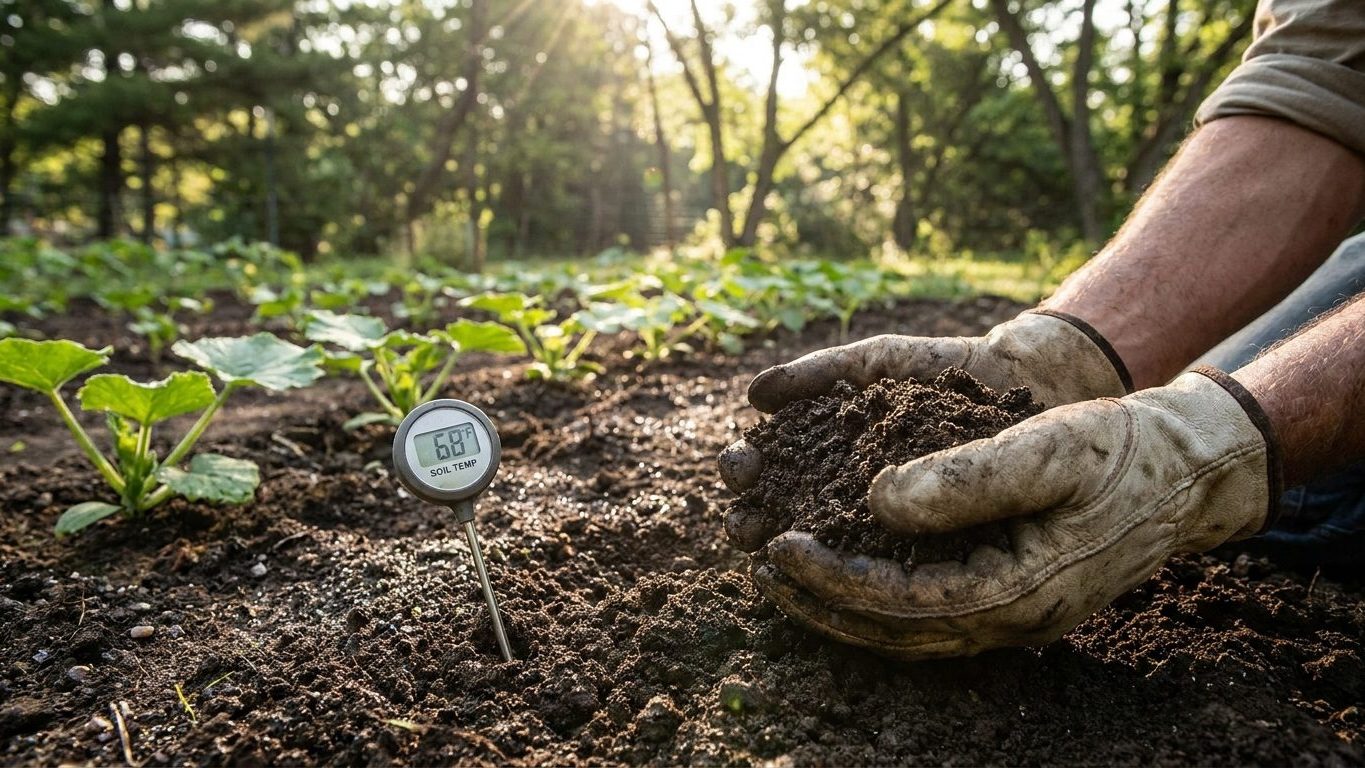
Soil warmth, checked by pushing a finger a couple of inches into the bed in the morning before the sun’s been on it long: if it still feels cool and damp rather than warm through, the ground hasn’t caught up to the season yet, whatever the calendar date says, and seed sown into it will sit rather than sprout.
The first flush of male flowers, which typically opens well before any female flower with a tiny swollen squash shape behind the petals shows up: seeing males appear tells you the plant has reached reproductive size for its spot, and it’s a better sign of how your specific bed is tracking the season than any regional average.
The first true leaves, the second set that emerges after the rounder seed leaves, and how fast they broaden: quick, sturdy true-leaf growth says the bed’s heat and moisture are working for that plant right now, while slow or pale growth is the garden telling you something the rainfall normals for a station miles away never will.
Some gardeners also time this by the Moon: when to plant winter squash by the moon, as almanac tradition rather than fact.