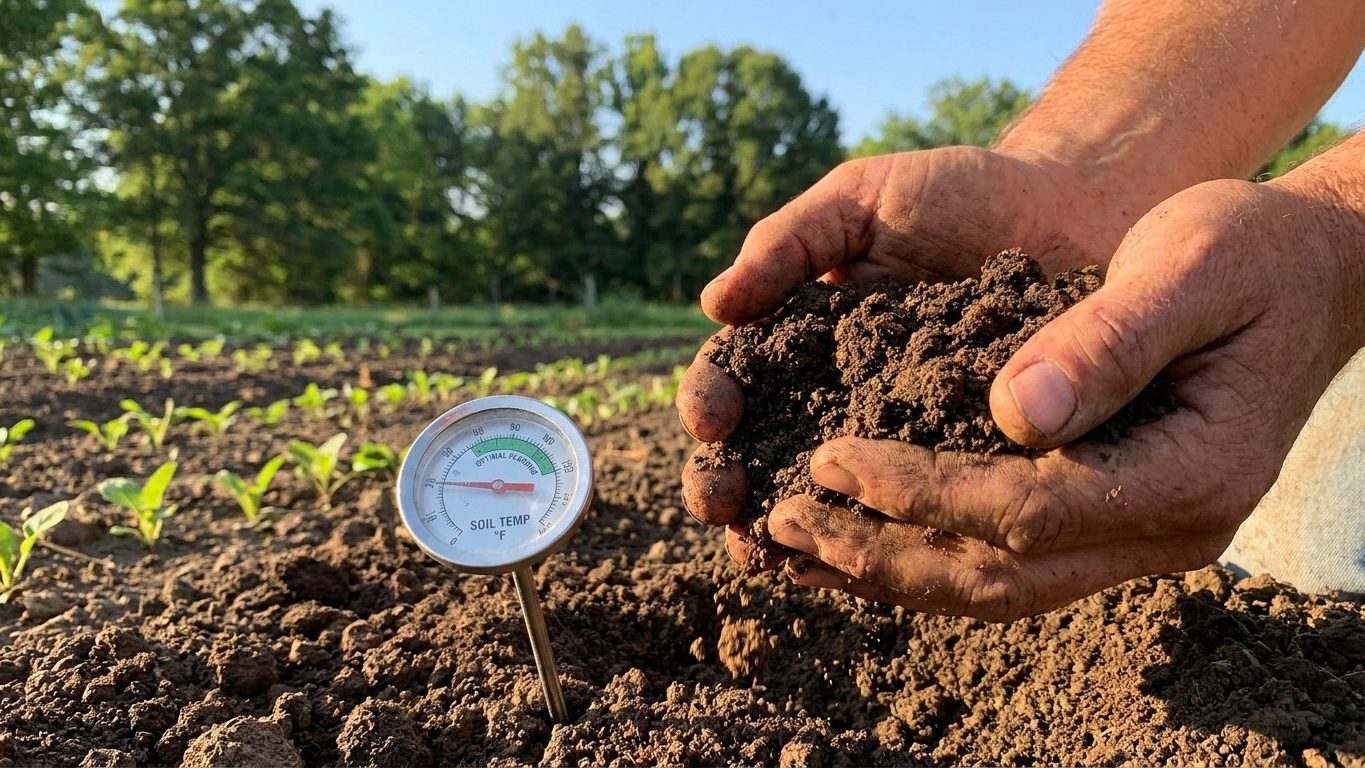

There’s no frost-based planting calendar for lowland Hawaii, because there’s no frost. Winter squash timing here depends instead on rainfall patterns, elevation, and whether a garden sits on the windward or leeward side of an island. The practical answer: plant during a drier stretch, choose a site with reliable drainage, and let rainfall data guide watering rather than a calendar date.
When the soil is warm enough in Hawaii

Most of the mainland United States plans winter squash around a last spring frost date. Hawaii breaks that model entirely. According to NOAA NCEI 1991-2020 Climate Normals for station USW00022521, every freeze percentile at 32°F and 36°F comes back as “not computable,” and the recorded average is zero days per year at or below 32°F. That’s not a rounding artifact. It means the statistical concept of a frost date doesn’t exist for this station, and by extension for the inhabited lowlands the station represents.
Frost in Hawaii is real, but it belongs to a different landscape. It shows up only on the summits of Mauna Kea, Mauna Loa, and Haleakala, thousands of feet above where anyone is tending a squash bed. So the question “when is my soil warm enough” doesn’t get answered by counting weeks after a frost that never touches the garden. Soil warmth is rarely the limiting factor in lowland Hawaii at all. Ground temperature stays in a range that supports germination for most of the year in the state’s warmer, lower-elevation zones.
What actually governs timing here is a mix of elevation and rainfall exposure. The USDA Plant Hardiness Zone Map (2023, built on 1991-2020 normals) places Hawaii across an unusually wide span, from zone 9a up through 13a. That’s a territory-wide range built on one variable, the average annual extreme minimum temperature, and it moves fast with elevation. A garden near sea level in a warm coastal town sits in a very different zone than one a few thousand feet up on the same island. Because the range is so wide, a reference city matters more than the range itself when someone is deciding what to do this month. A grower should anchor to conditions at their nearest low-elevation station rather than to the statewide span.
The real planning variable is soil moisture, not soil temperature. Windward slopes catch trade wind rainfall almost daily in wetter months, which can waterlog a squash bed before it’s ever planted. Leeward sides, in the rain shadow, dry out and need irrigation earlier in the cycle. So “when is the soil ready” in Hawaii translates to “when has the ground drained enough to work, and is the wet season tapering off.” That’s a site-by-site judgment call, best made by digging a handful of soil and squeezing it, not by checking a frost chart that has nothing to report.
How long the season lasts here
On the mainland, this section would subtract the last spring frost from the first fall frost and hand over a number of growing days. That subtraction can’t happen here, because both figures are absent from the record for the same reason: NOAA’s 1991-2020 Climate Normals mark every freeze percentile at station USW00022521 as not computable, with zero days per year at or below 32°F. There is no frost window to measure, so there is no frost-defined season length to report for lowland Hawaii.
What that absence actually means for a gardener is more useful than a number would be. Without a frost boundary at either end, the lowland growing season runs effectively year-round. Winter squash can go into the ground across a much wider stretch of the calendar than in a frost-bound state, where a grower has one shot bounded by two hard dates. In Hawaii the constraint shifts from “will it freeze” to “is this the wet season or the dry one, and how exposed is this plot to trade wind rain.”
That shift changes the math on succession sowing. In a short-season territory, a single sowing is often the only realistic option, because there isn’t enough calendar left for a second round to mature before frost ends it. Hawaii doesn’t have that ceiling. A grower who times a first planting around a drier stretch has room, in principle, to stagger additional plantings weeks apart, spreading out harvest and hedging against a bout of heavy rain that stalls one planting’s pollination. The site’s succession sowing guide walks through how to space those follow-up plantings and when a second round genuinely pays off versus when it just competes with the first for water and airflow.
It also changes whether transplanting versus direct seeding is worth the trouble. Where the window is tight, transplants buy precious early weeks. Where the window is wide open, as it effectively is in Hawaii’s lowlands, direct seeding loses less by comparison, and it avoids the root disturbance that winter squash, with its sensitive root system, tends to punish. The absence of a frost deadline doesn’t mean timing stops mattering. It means the pressure moves from the calendar to the rain gauge.
Heat and water in Hawaii

At the Honolulu reference station, NOAA’s 1991-2020 Climate Normals put the average number of days reaching 90°F or higher at 18.7 per year. That’s a real heat load, but it’s a count at one reference point, not a description of every garden in the state. A coastal plot in full sun near that station will feel closer to that number than a shaded upland garden several hundred feet higher, where trade winds and elevation knock several degrees off the same afternoon.
Winter squash is a crop where the fruit has to fully mature on the vine, in this case with no frost deadline forcing the issue, but with heat and water stress doing the work instead. An immature squash doesn’t cure properly and doesn’t store, so the plant needs a steady runway of conditions that let it finish filling out, not just survive to some end-of-season cutoff. In a hot, dry stretch, that means irrigation carries the fruit through its filling period rather than frost timing dictating when to stop worrying about maturity.
Rainfall works against a simple “it rains, so it’s fine” assumption. Summer rainfall at the same reference station runs about 1.9 inches total across June, July, and August, with June the driest month at just 0.5 inches, July at 0.52, and August climbing slightly to 0.84. That’s a modest, front-loaded-toward-fall pattern, and it’s low enough that a summer squash bed on this reference station’s conditions is going to depend on supplemental watering during those driest weeks, not on ambient rain. Sandy soil lets that little bit of rain drain through in a day; clay holds it longer, which matters as much as the rainfall figure itself.
Windward gardens elsewhere in the islands see a different story. Where trade winds push moisture into a slope regularly, the risk flips from drought stress to the opposite problem: persistent dampness that encourages powdery mildew and slows fruit ripening rather than speeding it. That’s not a hypothetical for humid regions generally, and Hawaii’s windward exposures fit that pattern closely enough that airflow around the plant, not irrigation, becomes the priority there. The same island can require opposite strategies a few miles apart, which is why a single statewide answer to “how much should I water” doesn’t hold up.
Which winter squash suit Hawaii
The honest answer to “which variety” is that this page can’t name one, and that’s not a dodge. Varieties get trialled locally by university extension programs precisely because performance shifts with elevation, rainfall exposure, and soil, all of which vary block to block across Hawaii’s islands more than in almost any other state. A cultivar that thrives on a dry leeward slope can struggle on a windward one three miles away. The University of Hawaii’s CTAHR extension service maintains the trial data and local recommendations that actually reflect those differences, and that’s the resource worth checking before buying seed.
What this page can offer is how to reason about types, given the territory’s own numbers. With no frost window at all, “days to maturity” pressure that shapes mainland variety choice mostly disappears here. A grower isn’t racing a fall frost, so an earlier-maturing type isn’t the forced choice it would be in a short-season state. That opens the door to types bred for longer, steadier fruiting, provided the site’s rainfall and heat pattern supports it.
Heat load, at 18.7 days a year above 90°F at the reference station, argues for types tolerant of warm-season stress, paired with siting that gives roots some afternoon shade or at least consistent soil moisture rather than full baking sun all day. Sites closer to Hawaii’s drier, hotter reference conditions should lean on irrigation planning as much as on cultivar choice, since even a heat-tolerant plant still needs water to fill fruit.
Humidity flips the priority on windward and wetter sites. Where summer rainfall patterns lean toward frequent dampness rather than the dry June-July-August numbers recorded at the reference station, disease resistance becomes the first filter, ahead of maturity speed or heat tolerance. Powdery mildew and related fungal pressure build fast in persistent humidity, and a resistant type bought locally, vetted through CTAHR’s trials, will outperform a generic online recommendation every time. That’s the case for checking the extension service before the calendar, the seed catalog, or anything else: in a state this climatically fragmented, the right variety is a local question, not a national one.