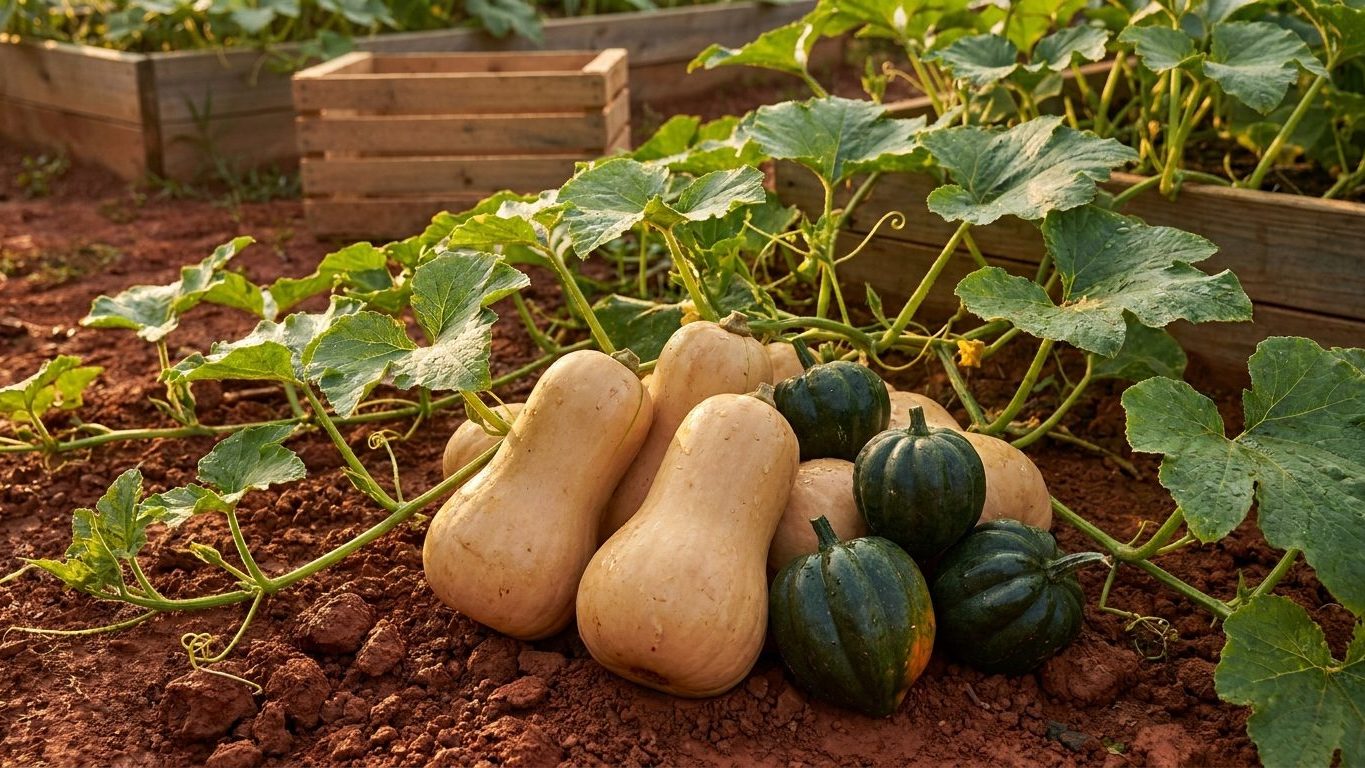

Illinois gardeners get the best results from short-to-mid-season winter squash: acorn, delicata, butternut, and spaghetti squash all mature comfortably within the state’s frost-free window. Long-season types like giant Hubbard or big kabocha squash are riskier, especially outside the warmer southern counties, because they need more days than many Illinois gardens reliably offer between the last spring freeze and the first fall one.
The short answer for Illinois
Start with the math, not the seed catalog. The reference station used for Illinois climate normals shows a last spring frost landing somewhere between April 11 and April 22, and a first fall frost arriving between October 24 and November 3. Take the tighter, more cautious combination, later spring frost and earlier fall frost, and you get a frost-free window of roughly 185 days at that station. Take the looser combination and it stretches closer to 206 days. That gap matters more than most planting guides admit.
A winter squash needs its full days-to-maturity count, plus another one to two weeks of curing time in the field before a hard frost, to develop the thick skin that makes it a keeper. Acorn, delicata, and spaghetti squash typically need 80 to 100 days from seed. Butternut runs closer to 90 to 110. Even at the shorter end of Illinois’ frost-free window, those types fit with room to spare, especially if started from transplants rather than direct-seeded.
Hubbard, kabocha, and other large-fruited types often need 100 to 120 days, and some heirloom Hubbard strains push past that. Stack that against a 185-day window minus a two-week cure and you are working with a margin of maybe three to four weeks statewide, less in the shorter-season pockets. That is not zero margin, but it is thin enough that a cool, wet spring or an early September cold snap can eat it entirely.
The state also runs a moderate heat load rather than an extreme one. The reference station averages just 14.0 days a year at or above 90°F. Compare that to the Deep South, where squash vines can shut down from heat stress for weeks at a time, and Illinois looks almost mild. That is good news for pollination, since winter squash flowers drop or fail to set fruit in prolonged heat above the low 90s. The tradeoff is that Illinois summers are humid enough, with about 12.1 inches of rain spread across June, July, and August, to favor foliar disease if vines are crowded.
: for most of Illinois, the decision by type favors bush and semi-vining short-season squash over sprawling, slow-to-finish giants, unless a gardener is in one of the state’s warmer southern counties and plans around that extra month of season.
What will not work here

The clearest failure mode in Illinois winter squash is running out of season on a long-maturity variety. A Hubbard-type squash needing 115 days, planted the week after the state’s later last-frost date of April 22, reaches maturity around mid-August. Add two to three weeks to cure before frost and the harvest deadline lands in early September, well before the earlier fall frost date of October 24. On paper that works. In practice, most home gardens are not the airport weather station the normals come from. Suburban and rural plots typically see their last spring frost arrive later and their first fall frost arrive earlier than the reference station, sometimes by one to two weeks on each end. Shave two weeks off both sides of that 185-day window and a 115-day squash suddenly has almost no cushion left for a slow, cool spring.
Sandy soil under Illinois’ summer rainfall pattern creates a second failure that has nothing to do with frost dates. July, the driest of the three summer months, averages only 3.71 inches of rain, and that total often arrives as a handful of heavy thunderstorms rather than steady soaking rain. On sandy ground, that water drains through within a day, leaving vines dry for a week or more between storms. Winter squash respond to that kind of irregular watering with blossom drop and misshapen, small fruit rather than outright death, which is a subtler but just as costly failure. A gardener who waters once a week on a set schedule, assuming the rain “mostly evens out,” is often the one who ends up with a disappointing harvest despite healthy-looking vines.
Dense spacing is the third trap, and it is specific to how Illinois summers deliver moisture. In a truly dry, low-humidity climate, crowding vines mostly costs yield. In Illinois, where warm nights follow rain-soaked days through July and August, tight spacing keeps foliage wet longer after storms and dramatically raises the odds of powdery mildew moving through the patch before fruit finishes curing. A vining butternut or Hubbard planted on 18-inch centers, a spacing that might survive in a drier state, tends to mildew out here weeks before the squash are ready. Give vining types real room, several feet between crowns, and treat tight spacing as a bet against the local humidity, one that does not usually pay off.
What changes across Illinois
Illinois is not one climate, and the USDA Plant Hardiness Zone Map makes that obvious: the state spans zones 5a through 7b, a range built entirely on average annual extreme minimum winter temperature. That is a wide spread for a single state, roughly the difference between winters that resemble southern Minnesota and winters that resemble central Tennessee. It does not map directly onto frost-free growing season length, but the two generally move together, and the practical effect for squash growers is real.
In the colder end of that range, typically the northern part of the state, the frost-free window runs shorter and the last frost arrives later relative to the statewide normal. Gardeners there get the most benefit from starting acorn, delicata, and spaghetti squash indoors three to four weeks before transplanting, rather than direct-seeding and hoping the season stretches far enough. Bush-type varieties, which mature faster than sprawling vines of the same species, buy extra insurance in these shorter-season areas.
Toward the warmer end of the zone range, generally the southern counties, the season runs measurably longer, and that extra month is exactly what makes a 110- to 120-day Hubbard or kabocha type feasible without cutting the curing window close. Gardeners there can also get away with direct-seeding later and still finishing well ahead of frost.
There is no single frost date or season length that applies to all of Illinois, and this page cannot tell an individual reader which zone their own yard falls into. That number depends on more than latitude: river valleys, urban heat, and elevation all shift it locally. The right move is to look up the exact zone for a specific address on the USDA Plant Hardiness Zone Map before locking in a variety list, then adjust the guidance above toward the shorter- or longer-season end depending on where that address lands.
Where to check this for your own county
Everything on this page comes from a single reference weather station and a statewide hardiness zone range, which is exactly why it is a starting point rather than a final answer. The University of Illinois Extension, reachable at extension.illinois.edu, publishes county-level guidance, because frost dates and season length shift meaningfully between, say, a river-bottom county in the south and a county near the Wisconsin border.
Two things are worth searching for specifically once there. First, a local or regional planting calendar, which will typically give a recommended sowing window built on data closer to that county than the airport-station normals cited here. Second, variety trial results or recommended-cultivar lists for winter squash, since county extension offices and Illinois’ network of local Master Gardener programs often track which specific acorn, butternut, or Hubbard strains have actually performed well in that soil and that microclimate over several seasons, information a statewide page has no way to capture.
A county-level recommendation will almost always beat a state-level one, for the simple reason that it is built on a smaller, more relevant sample of conditions. This page works from one reference station’s climate normals and a hardiness zone range that covers roughly a third of the country’s latitude spread top to bottom. That is useful for understanding the mechanics, why a 115-day squash is riskier than a 90-day one, why spacing matters more here than in a drier state, but it is not a substitute for whatever a local extension office says about the specific soil and frost patterns of one county. Treat this page as the reasoning, and the extension office as the local correction.
Checking this against your own garden
Calendar dates are averages built from thirty years of data at one weather station. A specific backyard is not an average, and three simple observations will tell a gardener more about their own plot than any date range can.
Soil warmth by feel is the first check. Winter squash seed sprouts poorly in cold, wet soil regardless of what the calendar says, and germination slows sharply below roughly 60°F. A gardener who can dig a few inches down in mid-spring and the soil feels cool and damp rather than merely cool, closer to cellar temperature than bathwater, is looking at ground that needs another week or two before seed goes in, no matter what the regional frost date suggests. A raised bed or a south-facing slope will often warm noticeably faster than an open, low-lying yard just a mile away.
The first flush of male flowers is the second signal. Winter squash typically produces male blossoms before female ones, and a steady run of males with no females yet is normal, not a sign of trouble. It marks the point where pollinator activity starts to matter and tells a gardener the plant has shifted out of pure vegetative growth.
The appearance of true leaves, the second set that looks like the plant’s mature foliage rather than the rounded seed leaves, is the third marker. It signals the seedling has established a real root system and can handle transplanting or a light frost scare better than it could a week earlier. Watching these three things in a specific yard, rather than counting days on a page, is what actually tells a gardener whether their own microclimate is running ahead of or behind the regional normal.