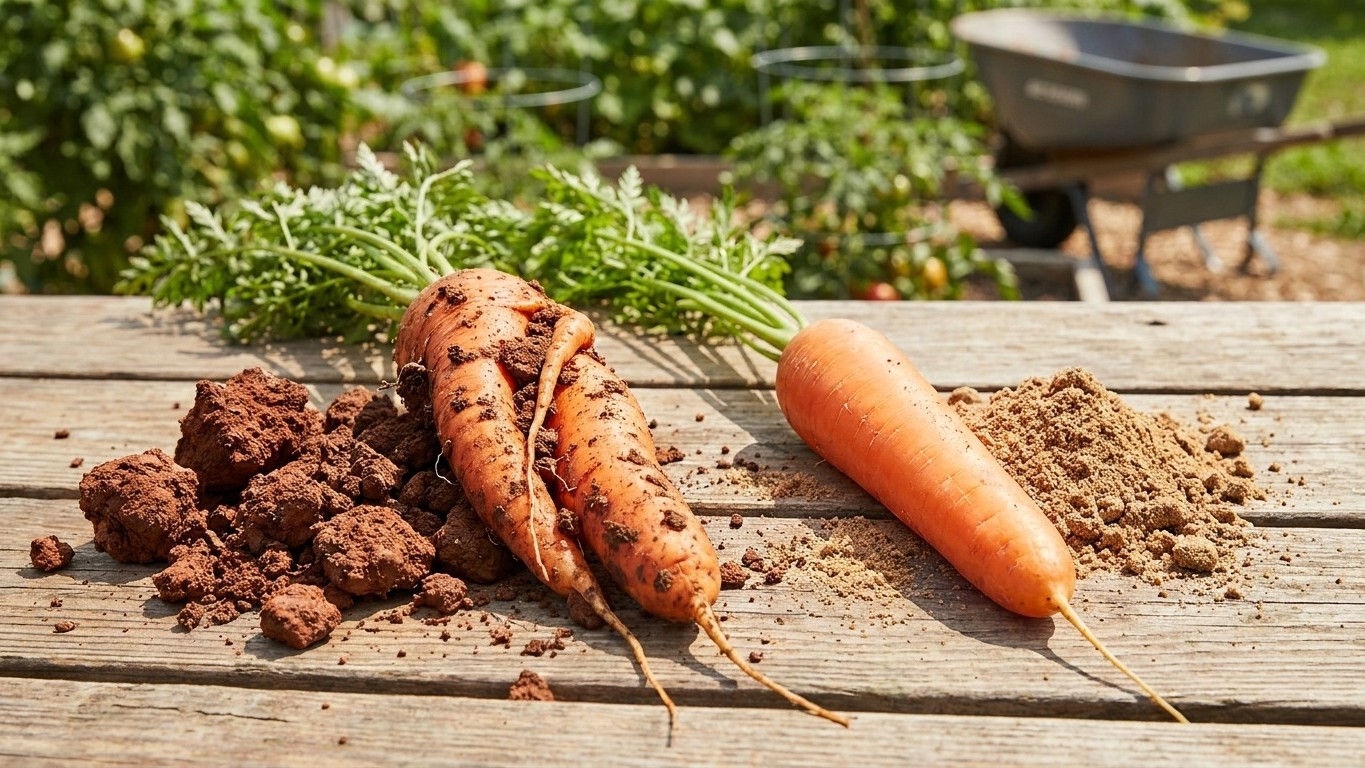

Pull carrots when the roots reach the size on the seed packet, which for most types is 70 to 100 days from seeding. Clemson Extension puts harvest at about 65 to 75 days after planting for earlier types. After that, storage sets the clock: carrots with their tops on last about 10 to 14 days, and trimmed carrots in cold, humid air last far longer. Here is how to hit both marks in southern New England, and which spot in a house comes closest to the right conditions.
Keeping them, and for how long
The Home & Garden Information Center at Clemson Cooperative Extension says to store carrots at 33 °F and high humidity to prevent wilting (Clemson factsheet on carrots, beets, radishes and parsnips). That temperature sits barely above freezing. It is colder than a typical cellar, a pantry or a garage in early fall, and it is the number to measure against.
Warmer storage costs carrots quickly. At 50 °F, a reader loses them to sprouting and softening in a fraction of the time the colder setting allows. Dry air does its own damage, because a root that loses water goes rubbery before it ever rots.
Why do carrot tops have to come off before storage?
The leaves keep pulling moisture out of the root after the carrot leaves the ground. A bunch with the greens attached looks fresh while the root underneath goes limp. Clemson gives bunched carrots, the ones with tops on, about 10 to 14 days in storage. Twist or cut the tops off at harvest, leaving a short stub, and the root holds its water far longer. Trimmed carrots can keep for months, which is the reason most gardeners top them in the garden rather than in the kitchen a week later.
How long do carrots keep at 33 °F?
Treat every storage length as a ceiling reached only when conditions are right: steady cold, high humidity, firm roots with no cuts or soft spots. A carrot pulled in wet ground and bruised by a shovel tine will not last as long as a clean one lifted whole. A fridge that cycles warm when the door opens shortens the clock too.
For packing, brush off loose soil rather than scrubbing, since wet skin invites rot. Then seal the carrots in a perforated bag or a lidded container with a slightly damp towel. The goal is humid air around the root without standing water. Check the container every week or two, and eat any carrot that has gone soft, forked tips included, before it spoils its neighbors.
Where in the house that actually is
A refrigerator comes closest. A working fridge runs only a few degrees above freezing, and carrots handle that cold well. Plenty of other garden crops do not: tomatoes, basil and winter squash turn mealy or dark in the same air. So carrots can ride in the crisper drawer while those others sit on the counter. Close the drawer’s humidity vent if it has one, and keep the carrots in a bag or container so the cold air does not dry them out.
Every other place in a house misses in a different direction. A heated kitchen or pantry runs far too warm, and carrots there soften and sprout within days. A garage follows the weather. On a mild October afternoon it might sit near 60 °F, and on a January night it might drop below freezing. An unheated basement or root cellar is the middle case. In fall, it often holds well above 33 °F because the foundation soaks up summer heat. A cellar can work for a few weeks of early storage, but it will not match the number Clemson gives.
Appliance dials are not thermometers, and a fridge set to “medium” can land anywhere across several degrees. Set a cheap thermometer in a glass of water in the crisper drawer, or at the spot you plan to use, and read it after a full day. If it reads much above 33 °F, the carrots will keep for less time. If it dips to freezing, move them up a shelf or turn the dial back a notch. That one reading costs a few dollars and saves a whole harvest, which is cheaper than finding a bag of slimy roots in February.
How do you know carrots are ready to pull?
Start with the calendar, then confirm with the plant. Carrots are sown where they grow, so the count begins on the day the seed goes into the row. Clemson says to harvest about 65 to 75 days after planting, and packets for longer-season types run 70 to 100 days. Mark the sowing date on a stake or in a notebook, because it is easy to lose track across a long season.
Then look at the shoulders. Brush the soil back from the top of one root. If the shoulder is close to the width listed on the packet, the carrot is ready. If it is still thin, wait another week and check again. Pull one test carrot instead of guessing, taste it, and judge the size. A carrot left too long gets woody and can split, so lean toward earlier when in doubt.
Does Rhode Island soil change how you pull them?
It can. Utah State University Extension says carrots want deep, sandy, well-drained soil rich in organic matter, and that heavy or rocky soil makes the root fork. The state soil of Rhode Island, the Narragansett series, is a young soil (an Inceptisol) that is well drained and sits in the loam-to-silt range: 34 percent sand, 6 percent clay and 60 percent silt in the surface layer, with about 4.0 percent organic matter. Its surface pH is about 5.3, which is strongly acid. Those are representative values for the mapped surface, not a reading from any particular bed.
Low clay and good drainage are favorable for carrots, and plenty of ground in the state tends to drain well. But a state covers hundreds of soil series, and a yard that a builder scraped, filled or stoned over may look nothing like it. To check your own, dig a hole and see whether it hits stones or hardpan. Then fill a jar with soil, add water, shake, and let it settle. Sand drops first, silt next and clay on top, so you can see the layers. For a pH number, send a sample to your state extension’s soil lab. Heavy ground calls for plenty of compost and double digging, or a raised bed. The full picture is in Will Carrots Fork in Rhode Island Soil?.
At harvest, firm or dry soil can snap roots when you pull on the tops. Water the row the day before, or loosen the ground beside the carrots with a garden fork, then lift. For the whole season’s picture, from seed to storage, see Growing Carrots in Rhode Island.
Roots left in the ground are also exposed to whatever tunnels through the soil. What Eats Carrot in Rhode Island, and When covers which pests take the crop and which weeks they are active. That timing is a good reason not to leave a ripe row in the garden indefinitely.
Common questions
Can you leave carrots in the ground into winter?
Carrots can wait in the row for a while in cool weather, and a thick layer of mulch slows the cold from reaching them. Once the soil begins to freeze hard, though, roots are hard to lift and may be damaged. Pull them before the ground locks up, and check your county extension office for local timing, since it differs from the coast to the hills.
Why do my stored carrots go limp?
Two causes account for most limp roots: tops left on and air that is too dry. The leaves draw water out of the root, and low humidity pulls out more. Cut the tops off right after harvest and store the carrots at 33 °F and high humidity, as Clemson Extension advises.
How long do carrots keep in the refrigerator?
Bunched carrots with the tops attached keep about 10 to 14 days at 33 °F in high humidity, according to Clemson. Trimmed carrots can last for months under the best conditions. A fridge that runs warmer than 33 °F, or dry air in the drawer, shortens that, so check the temperature with a thermometer.
Do forked or damaged carrots store as well as perfect ones?
Forked roots keep about as well as straight ones if the skin is unbroken. Roots that were nicked by a tool, split, or bruised during harvest spoil first. Set those aside to eat soon and keep only clean, whole roots for long storage.