
Winter Squash in Manitoba goes into the ground around May 23, the average last spring frost for the Winnipeg area, and needs to finish before the average first fall frost on September 22. That’s a mean 122-day window, and only the shorter-season winter squash varieties fit inside it with any margin.
The short answer for Manitoba
Start winter squash from transplants rather than direct seed if you want any buffer, moving them into the garden around the last week of May or the first days of June. Direct seeding is possible, but it eats into a season that’s already tight. The frost dates driving this calendar (May 23 last spring frost, September 22 first fall frost, both from Environment and Climate Change Canada’s 1981-2010 normals at Winnipeg Richardson Int’l A) are averages, not guarantees. In roughly half of all years, frost arrives later than May 23 in spring or earlier than September 22 in fall. Treat both dates as the middle of a range, not a line you can plant right up against.
That gives a mean frost-free stretch of 122 days. Winter squash varieties are typically rated by days to maturity, and that number matters more here than almost anywhere else in the growing map:
| Squash type | Typical days to maturity | Fits Manitoba’s mean window? |
|---|---|---|
| Acorn | 75-85 days | Yes, with margin |
| Delicata | 80-100 days | Yes, tighter |
| Butternut | 90-110 days | Marginal, transplant only |
| Hubbard | 100-120 days | Risky, most years too tight |
| Large storage pumpkin | 100-120+ days | Not reliable |
Zero days above 90F on average also matters. There’s no heat surge in a typical Manitoba summer to push fruit through the last stretch of ripening the way a hot August does farther south. Growing degree days accumulate slower here, which is another reason the shorter-maturity end of the winter squash list is the safer bet, not just the days-to-maturity number printed on the seed packet.
What will not work here

Long-season winter squash is the first thing to cross off the list. A Hubbard rated at 110 or 120 days needs almost the entire mean frost-free window with zero room for a late spring frost, an early fall frost, or a cool stretch in July. Since the May 23 and September 22 dates are averages, not safe dates, a grower who direct-seeds a 115-day Hubbard right at the mean last frost is betting on a better-than-average year. In years when frost comes early, that bet fails, and it fails with unripe fruit still on the vine.
Direct seeding itself is the second problem. Every day spent waiting for soil to warm enough for squash seed to germinate is a day subtracted from an already short season. Transplants started indoors three to four weeks before the last frost effectively buy back that lost time, which is why transplanting, not direct seeding, is the more common approach for anyone growing butternut or larger squash types in this climate.
Water management, not drought, is the real risk
Manitoba isn’t a dry-summer climate in the way a prairie state farther south can be. Summer rainfall averages about 9.7 inches across June, July and August, with August the driest month at 3.03 inches. That’s enough moisture in most years that squash won’t face the kind of hard drought stress seen in hotter, drier regions, especially with zero days above 90F to drive extreme evaporation. But 3 inches in August is still light for a plant that’s actively filling fruit, and rain that arrives as a single thunderstorm often runs off rather than soaking into the root zone. A watering habit built around “it rained this week so I’m fine” is the mistake here, not the drought itself. Check the soil, not the rain gauge alone, before skipping a watering in August.
Close spacing is a smaller risk in this climate than in a humid, hot one, since fewer days above 90F mean less fungal pressure overall. Still, vining winter squash planted too tightly in a wet August can develop powdery mildew late in the season, right when the fruit needs those leaves working to finish ripening.
What changes across Manitoba
The 3b hardiness zone figure cited above comes from Natural Resources Canada’s Plant Hardiness Site, and it applies to the Winnipeg reference area specifically, using 1991-2020 normals under the seven-variable Canadian system. That system isn’t the same as the USDA zone system used elsewhere on this site, and the two don’t convert directly. A Canadian zone can span multiple USDA equivalents, so don’t try to map this number onto USDA-style zone charts.
More importantly, Manitoba is not one climate. Winnipeg’s frost dates and zone rating describe the southern part of the province. Farther north, and at any higher elevation, the frost-free window compresses further: later last frosts in spring, earlier first frosts in fall, or both. A grower outside the Winnipeg area shouldn’t assume the May 23 to September 22 window applies to their own yard. There’s no single hardiness number for “Manitoba” as a whole, only a range that runs colder as you move north from the reference station.
Rather than guess where your property falls on that range, check Natural Resources Canada’s Plant Hardiness Site for your specific municipality. If your local zone reads colder than 3b, shift this entire calendar later in spring and earlier in fall than the dates given here, and lean even harder toward the shortest-maturity winter squash varieties, since the already-tight 122-day window shrinks further the farther north you are.
Where to check this for your own county
Manitoba organizes its agricultural resources by region and municipality rather than by county, but the principle is the same as anywhere else on this site: a provincial or regional recommendation is a starting point, not the final word for your specific piece of land. Manitoba Agriculture is the provincial extension service, and it’s the place to look for planting guidance calibrated to your specific district rather than the Winnipeg reference station used throughout this article.
Two things are worth hunting for on that site specifically. First, any local or regional planting calendar that reflects your district’s actual frost pattern rather than the provincial capital’s. Second, variety trial results or recommended cultivar lists for vegetable growers in your area. Extension programs in short-season climates often maintain lists of squash varieties that have actually performed well in local trials, which carries more weight than a days-to-maturity number printed by a seed company that may have tested the variety somewhere warmer.
A recommendation specific to your district beats a provincial average every time, for the same reason the Winnipeg frost dates in this article are a mean and not a promise. This page gives you the provincial picture and the reasoning behind it. Your local office, extension bulletin, or agricultural rep can tell you whether your specific area runs warmer or colder than the reference station, and which winter squash varieties other growers nearby have actually gotten to ripen.
Checking this against your own garden
Once the calendar dates have gotten you into the growing season, your own observations outrank any date printed on this page. Three things to watch, in order:
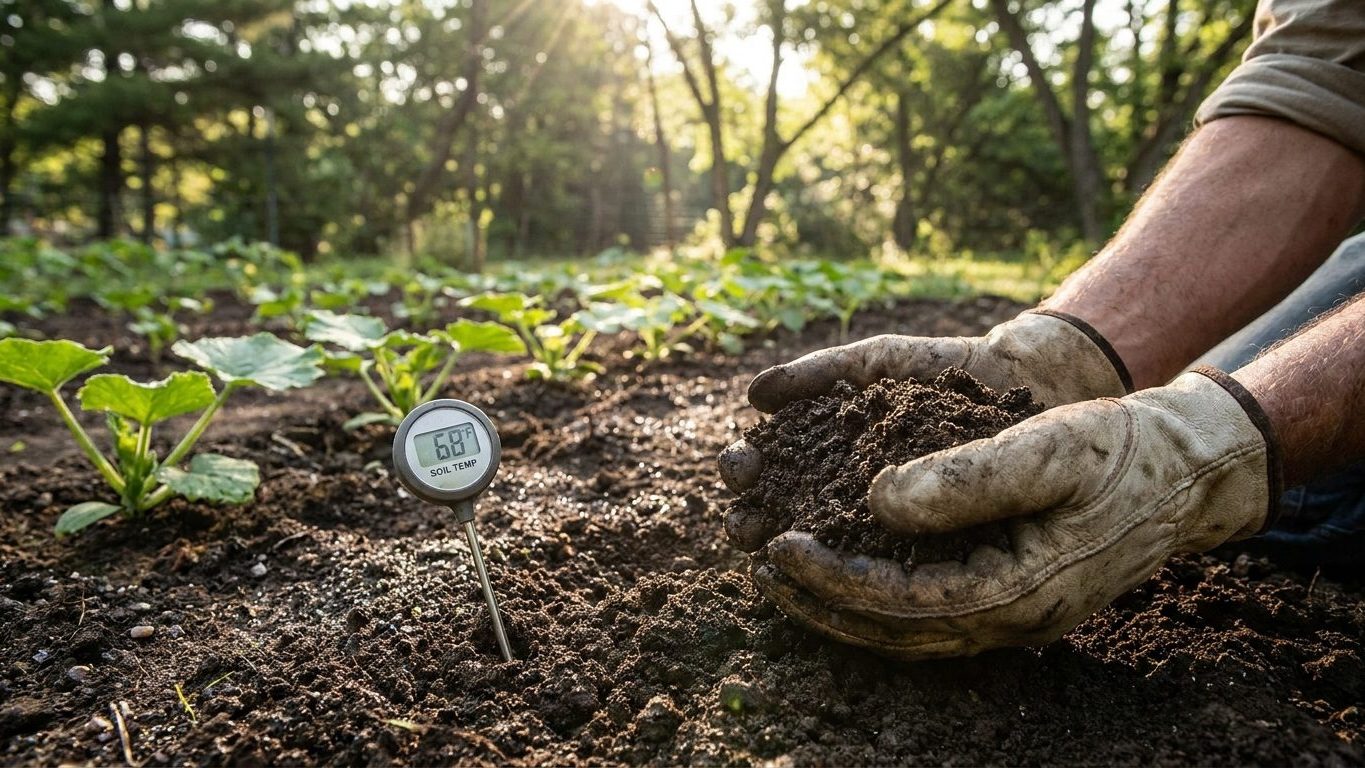
- Soil warmth by feel: press a bare hand into the planting bed a few inches down. If it still feels cold rather than merely cool, squash roots won’t establish well even after the calendar date has passed, particularly in a spring that’s running behind Winnipeg’s average.
- The first flush of male flowers: winter squash typically opens male flowers before female ones. Their appearance signals the plant has moved from vegetative growth into reproductive mode, and it’s a useful marker for whether your particular plants are tracking ahead of or behind a typical season.
- The first true leaves: the rounded seed leaves that emerge first aren’t the plant’s real leaves. Watch for the first set of true, lobed squash leaves, since their timing tells you how your specific microclimate, shaded by a fence, warmed by a south wall, exposed on an open field, compares to the provincial averages used to build this calendar.
None of these require any equipment beyond attention. A garden that runs consistently ahead of these averages can push toward the longer-maturity end of the winter squash list; one that runs behind should stay firmly with acorn or delicata and treat butternut as the outer limit.
The Moon calendar is a separate, older custom: see when to plant winter squash by the moon, written as tradition rather than fact.