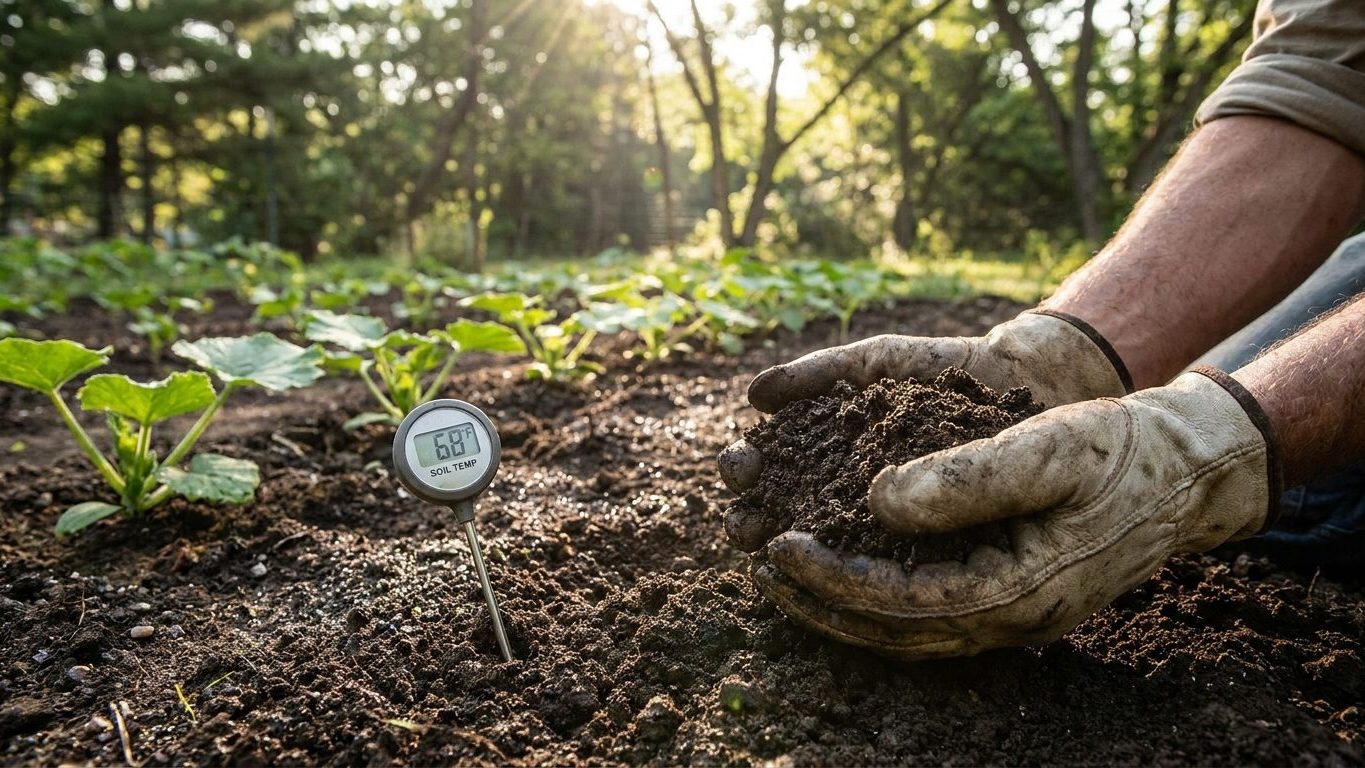

Winter Squash in Minnesota goes into the ground after the last spring frost clears, which falls between April 17 and April 30 for the Twin Cities. But that date only marks when frost risk drops below 30%, not when squash actually thrives, and the real planting window opens later once soil warms.
The short answer for Minnesota
Wait until the soil has shaken off the last frost threat before sowing winter squash, which for the Twin Cities means the window from April 17 to April 30. That date range comes from NOAA’s 1991-2020 climate normals, and it marks the span where a 32F freeze has between a 30% and 70% chance of still happening. It is not a guarantee, and it is not a recommendation by itself. It is a probability band built from three decades of weather records at the reference station near Minneapolis.
Winter squash is frost-tender at every stage, and its seeds barely germinate in cold soil. That means the practical sowing date sits after this window closes, not at its start. Gardeners who direct-sow right on April 17 are betting against a coin flip that still favors frost some years. A safer read of these facts: treat late April as the earliest edge of possibility, and treat the days that follow, once soil has had time to warm under spring sun, as the real target.
Counting backward from fall
The other end of the season matters just as much. First fall frost arrives between October 11 and October 23 in the Twin Cities, the same probability band applied to the season’s close. Winter squash varieties vary widely in how many days they need from seed to harvest, and a gardener has to count backward from that October window to know whether a given variety has time to finish. A long-season type sown too late, or planted in a cool spring that delays germination, can run out of runway before the first freeze locks in.
Minnesota’s hardiness zone range, 3a to 5a under the USDA system, underlines why this matters more here than in milder states. That zone map is built on one variable, the average annual extreme minimum winter temperature, and it says nothing directly about summer length. But a state spanning that wide a zone range also spans a wide range of frost-free seasons, and the Twin Cities sit at the mild, southern edge of it. Anyone gardening further north is working with a noticeably shorter window on both ends, which is the subject of its own section below.
What will not work here

The slowest-maturing winter squash varieties, the long-season hubbard types and giant pumpkin cultivars bred for show weight rather than speed, run the highest risk of failing to finish in a Minnesota season. Between the April 17-30 spring frost window and the October 11-23 fall frost window, the frost-free stretch in the Twin Cities is real but not unlimited, and it shrinks fast the further north or the higher in elevation a garden sits. A variety that needs a long stretch of warm days from transplant to harvest is gambling against a calendar that does not always cooperate, especially in a cool, wet spring that delays planting past the ideal window.
Heat is not the main threat here, at least not the way it is further south. Minneapolis averages just 10.6 days a year at or above 90F, a modest heat load compared to warmer states, which means flower drop from extreme heat stress is rarely the failure mode in Minnesota gardens. What fails more often is a watering routine built on assumption rather than observation. Summer rainfall averages about 13.0 inches across June, July, and August, with July running driest at 4.06 inches against June’s 4.58 and August’s 4.34. That sounds like enough to skip watering most weeks, and on clay soil it often is close to enough. On sandy soil, the same rain drains through within a day, and a garden that relies on the seasonal average without checking its own soil type ends up under-watered right through the driest month of summer.
The other failure mode is treating the whole state as one planting calendar. A gardener in the northern reaches of Minnesota’s 3a-5a range who plants on Twin Cities dates is exposed on both ends: frost risk lingering later into spring than the southern window suggests, and the first fall freeze arriving noticeably sooner. That mismatch, not heat and not rainfall, is the most common way a Minnesota winter squash planting comes up short.
What changes across Minnesota
A hardiness zone range of 3a to 5a is not a rounding error. It is the difference between a garden that can push its luck a little in spring and one that cannot. The Twin Cities sit at the mild, southern end of that range, which is exactly why their frost dates, April 17-30 for spring and October 11-23 for fall, read as generous compared to what a northern Minnesota garden actually gets. The stated caution on those dates is direct: northern Minnesota runs two to three weeks tighter at both ends. That is not a small adjustment. Stacked on both sides of the season, it can shave close to a month off the total frost-free window compared to the Twin Cities figures.
That gap is also why this page cannot hand down one single sowing date for the whole state. A range spanning 3a to 5a means a gardener in one corner of Minnesota is working with a meaningfully different growing season than one in another, even though both live under the same state name and the same general climate story. Elevation plays a role too, and so does proximity to Lake Superior, which moderates temperature swings along the North Shore in ways that inland northern counties do not share.
The practical move is not to guess which end of that spread applies to a given backyard. It is to place that backyard on the USDA Plant Hardiness Zone Map directly, using an address or zip code, and read the zone that comes back. That number, combined with the two-to-three-week northern adjustment noted in these facts, gives a far more honest planting window than applying the Twin Cities dates to a garden three hours north of them.
Where to check this for your own county
The University of Minnesota Extension service is the next stop, and it exists specifically to close the gap between a state-level page like this one and a county-level answer. Its site is at extension.umn.edu, and it is the source built for exactly this kind of question.
Two things are worth looking for once there. First, a local planting calendar, if the county or regional office publishes one, since that calendar will already have baked in the frost-date adjustment. Second, any list of winter squash varieties that the extension office or a nearby research station has actually trialled in that county’s growing conditions. A variety that performs well in University of Minnesota trials near the Twin Cities is not automatically the right pick for a garden three growing zones colder, and county-level trial data, when it exists, accounts for that in a way a statewide range cannot.
This page works at the state level because that is the scale where NOAA climate normals and USDA hardiness zones are published and can be cited directly. A county recommendation, built from local trial results and local frost records, will always beat a statewide one, simply because it has less ground to average over. Treat this page as the starting frame, the range within which a real answer sits, and treat the extension office as the place where that range narrows down to a specific county, and often a specific variety list.
Checking this against your own garden
None of these dates beat what a gardener can feel and see in their own soil, and three simple checks outrank every calendar figure on this page.
- Soil warmth by feel: winter squash seed sits sluggish in cold ground no matter what the calendar says. Pushing a bare hand a few inches into the planting bed and feeling for real warmth, not just above-freezing, is a better sign that germination will go well than any date range built from thirty years of averages.
- The first flush of male flowers: squash plants typically produce male flowers before female ones, and their appearance signals the plant has moved past early establishment into active growth. A garden running warm and sheltered will show this earlier than the surrounding area; a garden in a cold pocket or exposed to wind will lag behind, and that lag is useful information about that specific microclimate.
- The first true leaves: the rounded seed leaves that emerge first are not the plant settling in, they are just the seed unpacking itself. The first set of true, squash-shaped leaves is the better marker that the plant has taken hold and is responding to the conditions of that particular bed, not just to the seed’s stored energy.
Watched together over a season or two, these three signs start to reveal whether a given garden runs warmer or cooler than the regional average, and by how much. That is information no climate normal can hand over directly, because it belongs to one plot of soil, not to a weather station miles away.
If you follow the almanac, here is when to plant winter squash by the moon. It is a tradition, not a proven method.