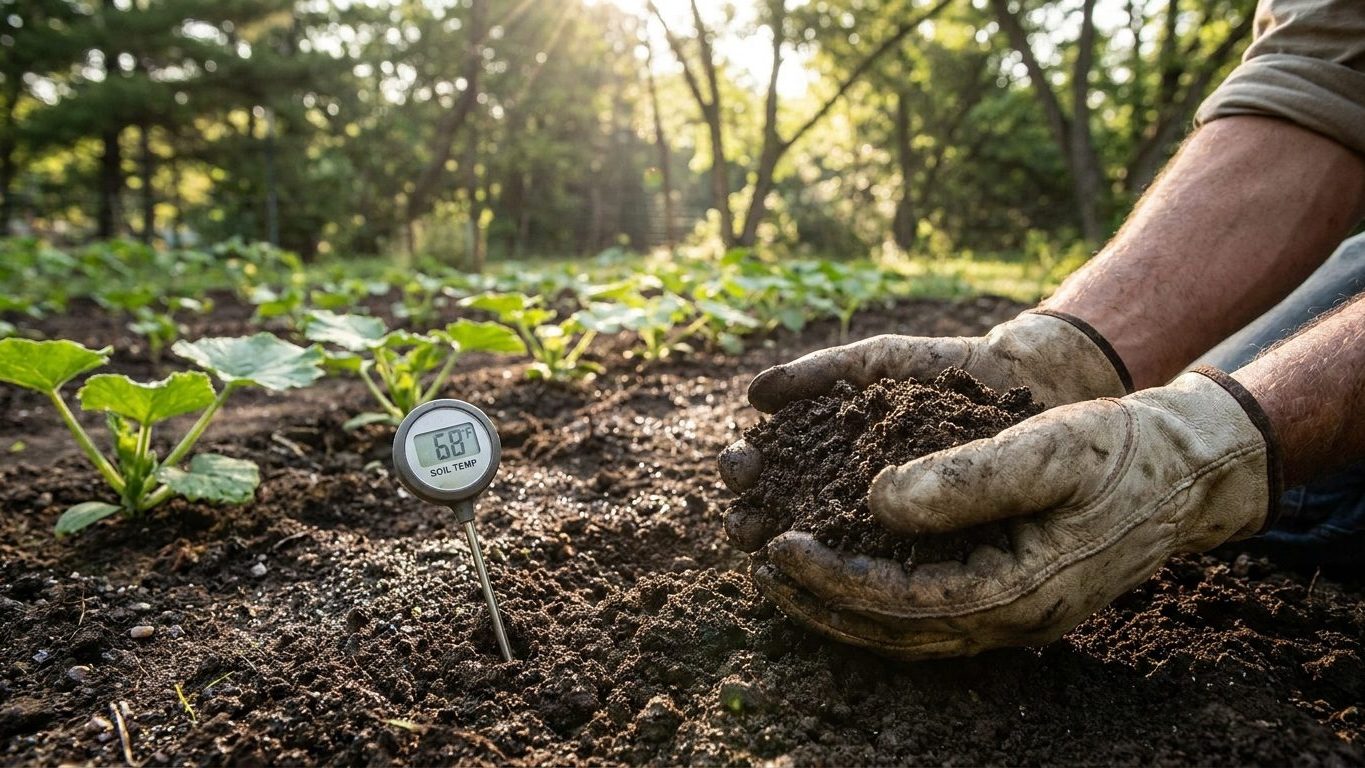

In Nebraska, winter squash goes into the ground after soil has warmed past the last spring frost window of April 12 to April 23, and it needs to size and cure before the first fall frost, which lands between October 15 and October 26. That gap is wide enough for most varieties, but not for every one of them, and the numbers behind it matter more than the calendar dates alone.
The short answer for Nebraska
Direct-seed or transplant winter squash between May 5 and June 1 in most of Nebraska, using the reference frost window of April 12 to April 23 as your starting point and adding one to two weeks for soil to actually warm, not just for the air to clear of frost risk. That April date range is a 30-70% probability band for a 32°F freeze at the NOAA reference station, not a guarantee, and it describes an airport weather station, not your backyard. Suburban and rural gardens around that station typically see their own last frost land later, sometimes by one to two weeks, so treat late April as optimistic rather than average.
Work backward from the fall side, too. The first fall frost at the same reference station falls between October 15 and October 26, which is also a 30-70% probability band, not a hard stop. Rural and suburban plots tend to freeze earlier than that airport figure, again by one to two weeks in many cases. Count backward from October 15, the earlier end of that range, rather than October 26, if you want a buffer instead of a gamble.
That gives a working season of roughly 137 to 160 days between a mid-to-late-May planting and an October 15 frost, depending on exactly when you get seed or transplants in. Most winter squash types fall inside that window with room to spare: acorn and delicata mature in 80 to 100 days, butternut in 100 to 110. Hubbard types and the largest storage pumpkins, which can run 110 to 120 days or more, eat almost all the slack this state’s frost dates allow, especially if a wet spring pushes planting past the first week of June.
This page can’t tell you your own zone or your own county’s exact frost dates because those numbers vary across the state (more on that below). What it can say, based on the reference-station facts above, is that the planting window itself is generous by national standards, but the margin for the slowest varieties is thinner than the raw day count suggests once you build in a realistic soil-warming delay and a conservative fall frost estimate.
What will not work here
Seeding winter squash the moment the calendar clears April 23 is a common mistake, and the frost data explains why it backfires. That date is only the upper end of an 11-day probability band running from April 12; some years the real last frost lands even later at a given site, and squash seed sitting in soil that hasn’t warmed past the mid-60s simply rots before it germinates. Cold, wet soil kills more squash seedlings in this state than any early frost does. Wait for the soil itself to feel warm to a bare hand a few inches down, not just for the frost date to pass on paper.
Slow varieties pushed too late
The second failure mode shows up at the other end of the season. A 120-day hubbard or a giant storage pumpkin planted in the first week of June, because a wet spring delayed fieldwork, is racing a fall frost that can arrive as early as October 15 at the reference station, and earlier still in many outlying gardens. Do that math before committing garden space to the slowest types: 120 days from June 1 lands on September 29 in a perfect season, but any cool stretch in September stalls fruit sizing, and an early frost that beats the October 26 end of the range catches unripe fruit with thin, uncured shells that won’t store.
Weekly watering during a dry, hot July
The third failure is a watering habit, not a planting date. Summer rainfall at the reference station averages about 12.6 inches across June, July and August, but July itself is the driest of the three at just 3.55 inches, right in the stretch when the region also averages 28.1 days a year at or above 90°F. A once-a-week soaking schedule, common advice for gardens with steadier summer rain, leaves squash vines wilting by midweek during a hot, dry July here. The combination of low rainfall and high heat load drives evaporation fast enough that vines need checking every two to three days during that stretch, not once a week, especially on sandy soil that drains within a day of a storm rather than holding moisture like clay does.
What changes across Nebraska
Nebraska spans USDA hardiness zones 4a to 5b, and that spread, built on average annual extreme minimum temperatures, is a proxy for how differently the seasons run from one end of the state to the other. A zone and a half of difference is not a rounding error; it typically tracks with real differences in both how late spring frost risk lingers and how early fall frost arrives.
The reference frost dates used above (April 12 to April 23 for last spring frost, October 15 to October 26 for first fall frost) come from one station in the eastern part of the state, which sits toward the warmer 5b end of that range. Gardeners farther west and at higher elevation, closer to the 4a end, should expect their own last frost to run later than April 23 and their first fall frost to arrive earlier than October 15, which shortens the safe planting-to-harvest window described above on both ends at once.
That matters most for anyone eyeing the slower winter squash types. A 110-to-120-day hubbard or large pumpkin that fits comfortably in the eastern part of the state’s window can be genuinely tight farther west, where both frost margins tighten. The practical shift for a western or higher-elevation garden is to plant at the earliest safe date rather than the middle of the window, and to lean toward the 80-to-100-day types (acorn, delicata, most butternut) rather than the 120-day storage types, unless local experience says otherwise.
None of this tells you which zone you’re actually in. The USDA Plant Hardiness Zone Map is the tool for that, and it’s worth five minutes before you commit a planting date to memory.
Where to check this for your own county
This page describes Nebraska as a whole, built on one reference weather station and a statewide hardiness zone range. Your county is not the state average, and the gap between the two is exactly where a lot of squash crops fail or succeed. Nebraska Extension, run through the University of Nebraska-Lincoln, publishes the county-level detail: extension.unl.edu.
Once there, look for two specific things rather than browsing generally. First, a county or regional planting calendar that gives frost dates closer to your actual garden than the airport-station figures used here; those local numbers often shift the safe window by a week or two in either direction, which is enough to change whether a 115-day squash is a safe bet or a gamble. Second, look for variety trial results or extension bulletins naming winter squash varieties that have actually performed well in Nebraska conditions, since local trials account for the state’s heat load and dry-summer pattern in a way a national seed catalog description doesn’t.
A county-level recommendation from your local extension office will always beat a state-level one, and this page is, by design, the state-level one. Think of it as the starting frame, not the final word: it tells you the shape of the season across Nebraska and where the pressure points are, but the extension office covering your specific county has watched actual planting results in soil and weather much closer to yours than a single reference station can capture.
Some gardeners also time this by the Moon: when to plant winter squash by the moon, as almanac tradition rather than fact.
Checking this against your own garden
Every date on this page is a probability drawn from thirty years of weather records at one station. Your own garden, checked directly, beats all of it, and you don’t need any equipment beyond your hands and eyes to read it.
Start with soil warmth by feel. Push a bare finger two to three inches into the bed where you plan to sow. If it feels cold and damp rather than merely cool, the soil hasn’t caught up to the calendar yet, regardless of what the frost-date range suggests, and seed sown into it now is more likely to rot than sprout. Wait until that same spot feels warm through, typically a week or two after the reference last-frost date passes.
Next, watch for the first flush of male flowers. Winter squash produces male blooms before female ones, often by a week or more, and an early, heavy flush of males with no fruit-set yet is completely normal, not a sign of failure. It tells you the plant has reached reproductive maturity for your specific microclimate, which is a more useful marker than counting days from the packet.
Finally, track how fast true leaves appear after the first seed leaves (cotyledons) unfold. Quick, vigorous true-leaf growth within a week signals warm, well-suited soil and a strong start; a stalled seedling sitting at cotyledon stage for two weeks or more is telling you the bed is running cooler than the general Nebraska window would suggest, and it’s worth adjusting your own personal calendar earlier or later next season based on that single observation rather than the state average.