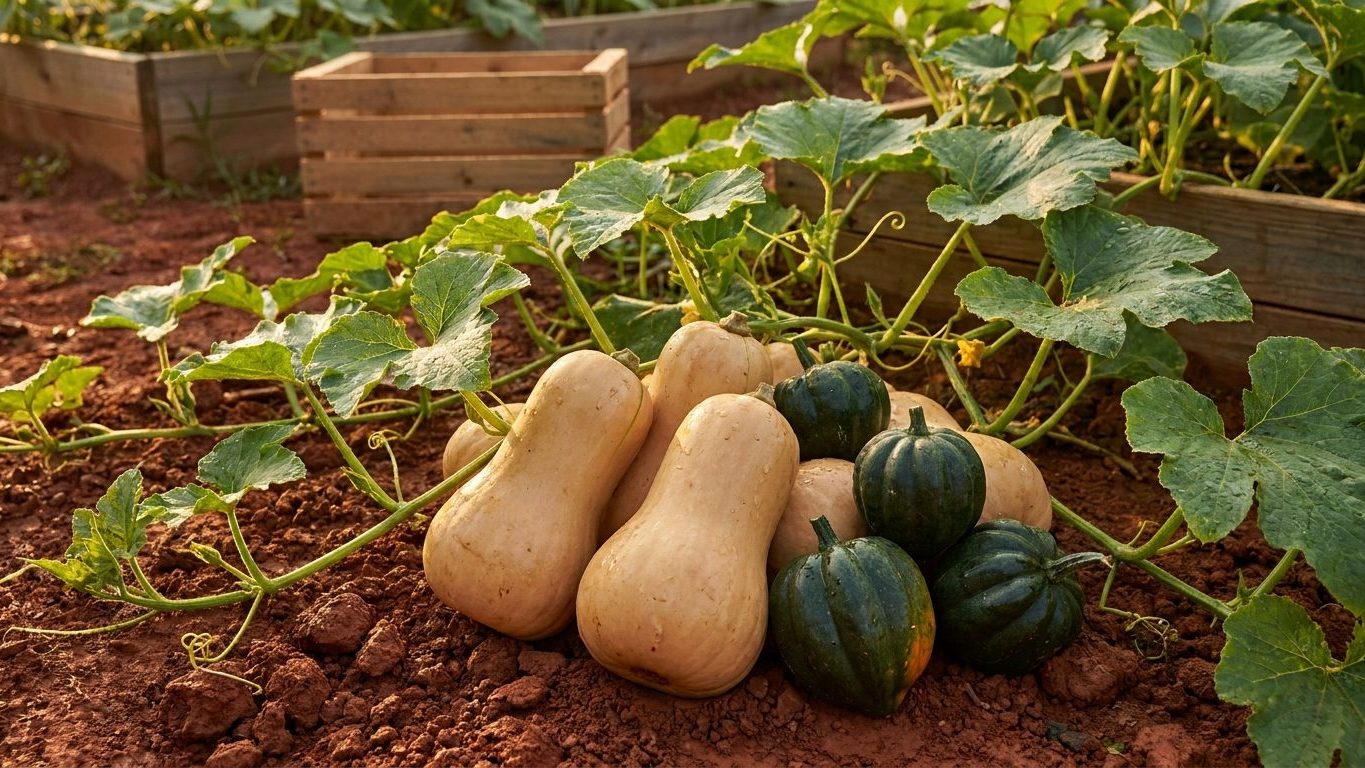

For Mississippi gardens, the winter squash that consistently perform best belong to Cucurbita moschata, the species that includes butternut, Seminole pumpkin, and tromboncino. They shrug off the state’s heat and humidity and resist the squash vine borer far better than their cousins.
The short answer for Mississippi
Season length is not the constraint here. With a last spring frost falling between March 6 and March 22 and the first fall frost not showing up until November 7 to November 22 at the reference station, Mississippi gardeners are working with roughly eight months of frost-free growing time. Almost every winter squash variety sold, even the 110-day pumpkins, fits inside that window with room to spare. So the decision isn’t about maturity dates. It’s about what survives 71.1 days a year at or above 90°F and the humidity that comes with 14.1 inches of rain across June, July, and August.
That heat load and the humidity that follows it point toward one species: Cucurbita moschata. Butternut squash, the Seminole pumpkin (a Southeastern heirloom bred by Native American communities in Florida and long grown across the Deep South), and tromboncino all carry solid stems that squash vine borers struggle to tunnel through, and their foliage tolerates the muggy stretch of a Mississippi July better than most.
How the common types stack up
| Type | Species | Heat tolerance | Vine borer resistance |
|---|---|---|---|
| Butternut | C. moschata | High | Good |
| Seminole pumpkin | C. moschata | Very high | Good |
| Tromboncino | C. moschata | High | Good |
| Acorn | C. pepo | Moderate | Poor |
| Delicata | C. pepo | Moderate | Poor |
| Hubbard / Buttercup | C. maxima | Low | Poor |
If you’re growing squash for the first time in a Mississippi garden, start with butternut. It’s the variety extension offices statewide report the fewest complaints about, and it stores well past the growing season, which matters when a Deep South harvest often comes in heavy all at once.
What will not work here

Cucurbita maxima types, Hubbard, buttercup, banana squash, are the ones to skip. They need cool nights to set fruit reliably, and a summer averaging over 70 days above 90°F simply doesn’t deliver enough of those nights. Blossoms drop, fruit set stalls, and gardeners end up with sprawling vines and little to show for them by September.
Acorn and delicata squash, both C. pepo, have a different problem: the squash vine borer. That pest lays eggs at the base of the stem in early summer, and pepo varieties have soft, hollow stems that offer almost no resistance. Once the larvae tunnel in, the vine wilts within days, usually right when fruit is starting to size up. Mississippi’s long, hot season gives the borer two generations in some years, not just one, so a single missed inspection can cost the whole crop.
Watering on a weekly schedule, a habit that works fine in cooler, drier climates, fails here too. June averages only 4.43 inches of rain, the driest of the summer months, and it often arrives as a single storm that runs off rather than soaking into the root zone. Combined with 90-degree-plus heat driving evaporation, a once-a-week soak leaves squash roots dry for days at a stretch. Winter squash needs deep, even moisture through fruit set, and that means checking soil moisture two or three times a week during dry spells, not trusting a calendar.
Tight spacing is the other quiet failure. Mississippi’s humidity keeps foliage wet longer after rain or dew than in drier states, and squash planted at the spacing recommended for arid regions traps moisture between plants. That’s a direct invitation to powdery mildew and vine decline, both of which show up as premature vine collapse well before frost. Wider spacing and, where possible, trellising sprawling types like tromboncino improves airflow and cuts disease pressure substantially.
What changes across Mississippi
Mississippi spans USDA Hardiness Zones 7b to 9a, and that spread changes more than winter cold tolerance for perennial plants. It’s a proxy for how long and how intense the summer heat runs, which is exactly what decides squash performance here. A garden in the northern part of the state, closer to zone 7b, tends to see a shorter run of extreme heat days than a Gulf Coast garden near zone 9a, where humidity and heat both linger later into fall.
That means the vine borer and disease pressure described above aren’t uniform statewide. A north Mississippi garden may get away with slightly tighter spacing or a pepo variety some years; a Gulf Coast garden pushing toward zone 9a should treat moschata varieties as close to mandatory and stay disciplined about airflow and inspection, because the growing season there runs hotter and more humid for longer.
There is no single answer for “Mississippi” as a whole here, only a spread. A gardener in the Delta, the hill country, or the coastal counties is working with a different slice of that 7b-9a range, and guessing which end you’re on isn’t reliable. Check the USDA Plant Hardiness Zone Map directly for your ZIP code before deciding how far to push the more heat-sensitive squash types, or whether to lean entirely on moschata varieties for a given year.
Where to check this for your own county
Your county is not the state, and a county-level recommendation from a local extension office will always beat a general one, because it accounts for local soil, local pest pressure, and local rainfall patterns.
The Mississippi State University Extension Service, at extension.msstate.edu, is the place to go next. Two things are worth looking up there specifically. First, the local planting calendar for your county or region, since frost dates from one reference weather station can run a week or two off from what your particular garden experiences, especially if you’re outside a city or at any elevation. Second, look for variety trial results or recommended-cultivar lists for vegetable gardens in your area. County extension agents often track which specific butternut, Seminole, or acorn varieties have actually performed well in local trial gardens, information that goes well beyond a species-level recommendation.
Extension offices also run soil testing services, which matter for winter squash more than most crops, since these are heavy feeders that will underperform in low-fertility soil regardless of how well the variety is matched to the climate. A soil test through your county office is inexpensive and worth doing before the season, not after a disappointing harvest.
Checking this against your own garden
Soil warmth by feel comes first. Winter squash seed germinates poorly in cold soil, and pushing seed into ground that still feels cool to the touch in early spring, even after the calendar says the frost risk has passed, usually means slow, uneven germination. Wait until the soil feels warm through the top few inches on a sunny afternoon before direct-seeding.
The first flush of male flowers is the second signal. Squash plants produce male blossoms before female ones, sometimes by a week or two, and a garden throwing male flowers early is telling you it’s tracking ahead of a typical season, which matters for timing pest inspections around the vine borer’s egg-laying window described earlier.
The first true leaves, the serrated ones that follow the rounded seed leaves, show whether a plant is settling in well. Slow, pale true-leaf growth after a normal-looking germination usually points to a nutrient gap or compacted soil rather than anything the weather is doing, and it’s a cue to check soil conditions before the plant is stressed further by the summer heat still to come.