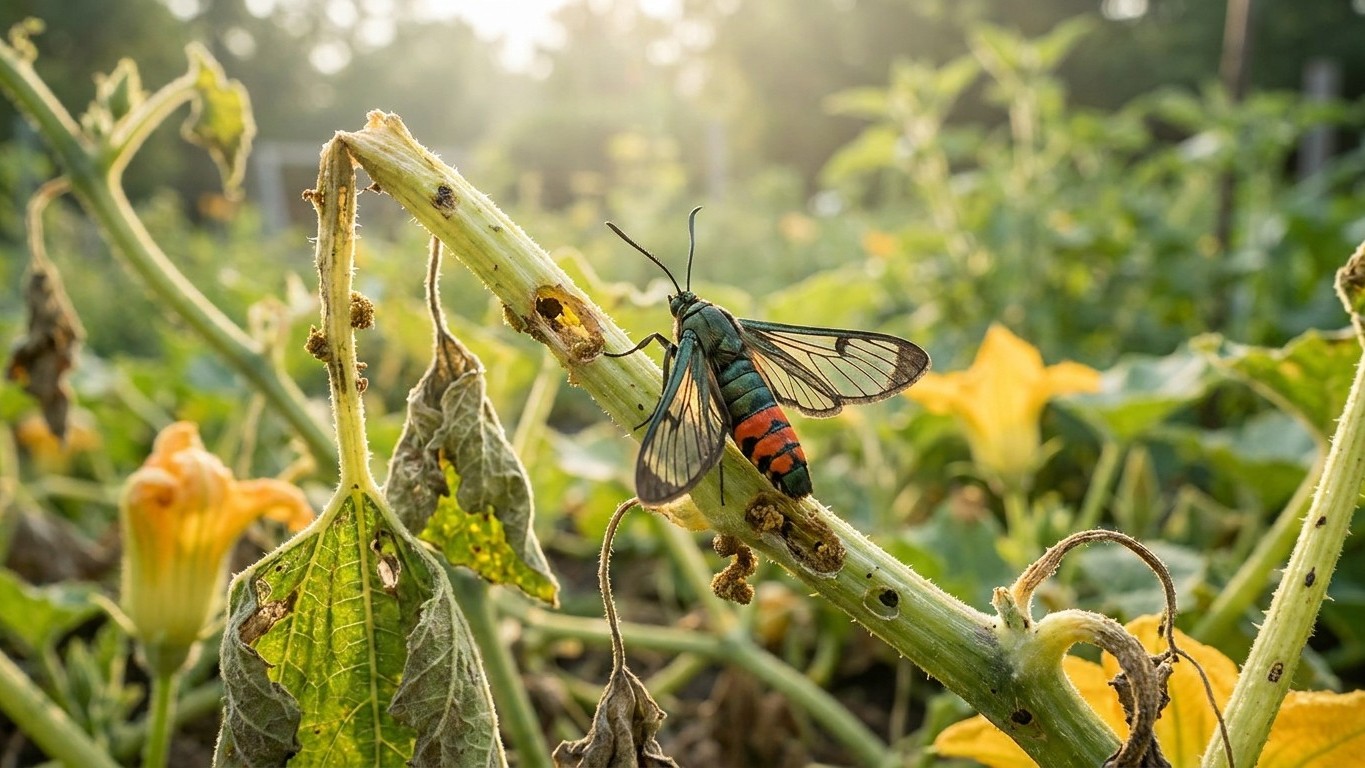

Squash vine borer shows up in Mississippi gardens from late spring into fall, with the worst damage concentrated late in the season as populations build. There’s no single flight date published for the state; the pattern is a slow climb through summer, not a short window. Row covers timed to transplanting and quick action at the first sign of frass are what actually save a crop.
The weeks to watch
Mississippi State University Extension doesn’t publish a specific flight-date window for squash vine borer the way it does for some other pests. What the extension guidance does say, plainly, is that squash vine borer and pickleworm run “much heavier late season” in Mississippi gardens. That’s the operative fact here: this isn’t a pest with one sharp peak you can circle on a calendar. It builds.
A first wave as soil warms
The general pattern for squash vine borer across the South holds in Mississippi too: adult moths emerge once soil temperatures climb in late spring, and the day-flying, red-orange moths start laying eggs at the base of squash stems soon after. This first wave tends to be lighter than what follows, since populations haven’t had a chance to build yet.
The late-season surge Mississippi flags
The heavier pressure comes later, which lines up with a second point in the extension bulletin: pickleworm, a related late-season pest, doesn’t overwinter in Mississippi at all and shows up almost entirely in the back half of the growing season. Squash vine borer behaves similarly here, with damage accumulating through summer and peaking as gardens head toward fall. A squash planting that looked clean in June can be riddled with entry holes by August.
Reading the calendar from your last frost
The one date most Mississippi gardeners actually plan around is the last spring frost, and for the reference weather station used by NOAA’s 1991-2020 climate normals, that falls somewhere between March 6 and March 22. That’s a range, not a promise, and it comes from an airport weather station. Suburban and rural gardens typically see their own last frost later, sometimes by one to two weeks, so check with your county extension office before locking in a planting date.
Squash vine borer doesn’t answer to a calendar. It answers to soil warmth, so an early, warm spring pushes moth activity forward and a cold, wet one delays it. What that means in practice: gardeners typically start seeing the telltale wilted vine four to six weeks after transplants go into the ground, once vines are running and stems have thickened enough for a larva to tunnel in.
- Start with your local last frost date. In the Mississippi reference city, that’s the March 6 to March 22 window, adjusted a week or two later for many home gardens.
- Add the time to transplanting (typically a couple weeks after frost risk passes for squash) plus the four-to-six-week lag before damage usually appears, to get a rough sense of when row covers need to come off before flowering.
What it attacks, and what the damage looks like
The symptom almost always arrives before the diagnosis. A single vine wilts hard in the afternoon sun while every other vine on the same plant looks fine. Look closer at the base of that stem and there’s often a small hole with a pile of moist, greenish-yellow, sawdust-like frass pushed out beside it. That frass is the giveaway; it’s the larva’s droppings, and it means the damage is already happening inside the stem, not on the surface.
The larva, a fat white grub with a brown head, does all the damage by tunneling through the stem and cutting off water flow to everything past the entry point. The adult moth causes no plant damage at all; it’s a courier, laying eggs and moving on. That matters for treatment, because once the larva is inside the stem, sprays and surface treatments stop being useful.
Crops at risk in a Mississippi garden include:
- Summer squash (yellow crookneck and straightneck varieties are especially vulnerable)
- Winter squash and pumpkins
- Gourds
- Cucumbers and melons, though these are attacked far less often than true squash
How Mississippi sits in this pest’s range
Squash vine borer is a widespread pest across nearly the entire eastern United States, and Mississippi sits well within that range rather than on some edge of it. For a pest this widespread, the difference between states isn’t whether it shows up, it’s when and how hard. Mississippi’s climate gives the insect a long warm season to build numbers, which is exactly why the state’s extension guidance singles out the late-season buildup rather than a single spring flight.
That long season cuts both ways for gardeners. A cool, late spring can push the first wave back and buy some breathing room for early plantings. But it also means the late-summer population has more weeks to compound, which is why squash planted for a fall harvest often takes the worst hit of the year. Gardeners further north, where the growing season is shorter, sometimes deal with one clean generation and move on; Mississippi’s extended warmth doesn’t offer that kind of reprieve.
What actually works against it
Cheapest and easiest fixes come first here, with the understanding that once a larva is inside the stem, most of these options stop helping.
- Time plantings around the pest’s build-up. Getting squash in the ground early, right after frost risk clears, lets plants establish and often set fruit before the heaviest late-season pressure arrives.
- Use row covers from transplant through early bloom. The mechanism is simple: a physical barrier keeps egg-laying moths off the stem base. Covers have to come off once flowers open, though, or pollinators can’t reach the blossoms.
- Check stem bases weekly and scrape off eggs. The tiny, flat, brownish eggs sit right at the base of the plant before they hatch. Removing them by hand is tedious but stops the larva before it ever bores in.
- Mound moist soil over stem nodes as vines run. Squash vines can root at nodes along the stem. Encouraging that secondary rooting means a plant can sometimes survive even after the main stem is compromised.
- Do vine surgery on plants already showing frass. Slitting the stem lengthwise near the entry hole, removing the larva, and covering the wound with moist soil can save an infested plant, but only while the damage is still limited to one section of stem.
- Clear old vines and rotate planting sites each year. Larvae pupate in the soil near the base of the plant, so removing debris and moving squash beds reduces the number of moths that emerge nearby the following season.
Some gardeners wrap stem bases in foil or nylon to block egg-laying, and plenty report it helping. The evidence on how consistently it works is thin, so treat it as a low-cost experiment rather than a guarantee.
Common questions
Can a squash plant survive after squash vine borer damage?
Sometimes, especially if the plant has rooted at other nodes along the vine or if the damage is caught early enough for vine surgery. A plant with only one damaged section often keeps producing from the healthy parts of the vine.
Are some squash varieties more resistant to squash vine borer?
Butternut squash and other varieties with solid, less hollow stems tend to fare better than yellow crookneck and zucchini types, which have hollow stems that are easier for larvae to tunnel through.
Does planting squash later in the season avoid the pest in Mississippi?
Not reliably. Mississippi’s extension guidance notes squash vine borer runs heavier late in the season, so a late planting can actually meet the worst of the pressure rather than avoiding it.