
Winter squash goes into Missouri ground once the soil has warmed past frost risk, roughly mid-May in the north and a bit earlier farther south, with harvest timed against a fall frost that can arrive as early as October 18. Everything else on this page fills in the “roughly” and the “bit earlier.”
The short answer for Missouri
The reference station used for these normals (Kansas City) puts the last spring frost between April 6 and April 20 and the first fall frost between October 18 and October 29. Those are not single dates. They mark the window in which a 32F freeze has a 30 to 70 percent chance of happening, which is the standard NOAA way of saying “this is genuinely uncertain, not a calendar guarantee.” Winter squash, unlike a hardy green, dies outright at 32F, so gardeners don’t plant right at the edge of that window. They wait for the low-probability side, then add a buffer.
In practice that means direct-seeding or transplanting winter squash from about May 10 through early June, once soil has had two to three weeks past the last-frost midpoint to warm up. Squash seed germinates poorly in cold soil regardless of air temperature, so an early May planting often just sits and rots rather than getting a head start.
The other end of the calendar matters just as much and gets ignored more often. Winter squash needs 80 to 110 days from seed to a cured, storable fruit depending on the variety, acorn types running shorter, hubbard and some large pumpkins running longer. Counting backward from the first fall frost band of October 18 to 29, a 100-day squash seeded on June 1 finishes right around September 9 to the frost date, with almost no margin. Seed it in mid-June instead and a long-season variety is racing an early frost it may lose.
One caution from the source data changes the picture for a lot of readers: the Kansas City reference station (MCI) sits well north of the city itself, and the downtown station runs about five days earlier in spring. Southern Missouri, further still from MCI, is milder again. So the “mid-May” answer above is a starting point for the northern part of the state. Gardeners closer to the Missouri Bootheel or the southern border are generally safe planting a week to ten days earlier than this page’s numbers suggest, and their fall frost also arrives later, which opens up varieties that would be too risky farther north.
What will not work here
Two Missouri numbers do most of the damage to an underprepared squash planting, and neither is exotic. The first is heat: the reference station averages 32.7 days a year at or above 90F. That’s over a month of high-evaporation weather sitting right in the middle of the squash growing season, June through August, exactly when vines are setting fruit and need consistent soil moisture the most.
The second number is rainfall, and it’s smaller than most gardeners assume. Summer rainfall across June, July and August averages about 14.1 inches, but it isn’t spread evenly. June brings 5.25 inches, July drops to 4.58, and August, the driest month, delivers only 4.24 inches. That’s barely an inch a week in August, arriving as summer thunderstorms rather than gentle soaking rain, which means a good chunk of it runs off instead of reaching the root zone. A watering plan built around “it rained this week, so I’m fine” fails in a Missouri August. Winter squash fruit needs closer to 1 to 2 inches a week through sizing and cure-out, and the gap between what falls and what’s needed has to be made up by hand or by drip line, particularly in August.
Combine those two facts and a few specific mistakes stand out. Watering once a week on a fixed schedule, ignoring the heat spikes, routinely under-delivers during the hottest stretches and shows up later as blossom drop or stunted fruit. Planting the longest-season varieties, hubbard squash or some of the bigger storage pumpkins, without seeding by late May at the latest leaves too little runway before the October 18 start of the frost window. And packing plants tightly on the assumption that “it’s a dry state” ignores that Missouri’s rain, even at a modest 14.1 inches for the summer, still arrives concentrated enough in June to create humid, still air around crowded vines, which is exactly the condition powdery mildew and other squash diseases need. Wider spacing and airflow matter here even though the state isn’t classically humid the way the Gulf Coast is.
What changes across Missouri
Missouri is not one growing climate, and the USDA Plant Hardiness Zone Map (built on average annual extreme minimum winter temperature, 1991-2020 normals) puts the state across a wide 5b to 7b range. That’s a two-zone spread from north to south, which in practical terms means a difference of several weeks in both the spring frost-free start and the fall frost-free end, on top of the five-day gap already noted between the MCI reference station and downtown Kansas City.
| Part of the state | General pattern | What it means for planting |
|---|---|---|
| Northern Missouri | Cooler end of the 5b-7b range, later spring warm-up | Hold to late May, favor shorter-season squash (80-95 days) |
| Kansas City area (reference station) | Last frost April 6-20, first fall frost Oct 18-29 | This page’s baseline window: mid-May through early June planting |
| Southern Missouri | Milder end of the range, per source caution | Earlier planting possible, longer-season varieties more viable |
There is no single planting date for “Missouri” the way there might be for a smaller, more uniform territory. A reader in the state’s northern counties is working with a meaningfully shorter season than one near the Arkansas line. This page can’t tell an individual gardener which zone their own property falls into, since that depends on elevation, slope and local microclimate as much as latitude. What it can say is: check the USDA Plant Hardiness Zone Map for your specific location before locking in a variety’s days-to-maturity against this page’s frost dates, because the gap between 5b and 7b is large enough to change the answer.
Where to check this for your own county
Everything above comes from a single reference station and a statewide hardiness range, which makes it useful for comparing Missouri to another state but genuinely secondary to what your own county extension office publishes. The University of Missouri Extension service maintains county-level offices and county-specific guidance that accounts for local soil, elevation and microclimate in a way a single Kansas City weather station never will.
Two things are worth pulling up there specifically. First, a local planting calendar, if the county office publishes one, will give a frost-date range built on data closer to your actual garden rather than a station that, as the source data itself notes, sits well north of Kansas City proper. Second, look for any list of winter squash varieties trialled in your part of the state. Extension offices often run variety trials suited to local disease pressure and season length, and a variety recommended for your county has already been tested against your actual growing conditions rather than a statewide average.
This page is deliberately the state-level answer: a starting point built from a national climate dataset, useful for understanding the broad shape of a Missouri squash season, but not a substitute for a county recommendation. If your county’s guidance says something different from the mid-May-through-early-June window given here, follow the county. It’s working from finer-grained information than a single reference station ever can.
Some gardeners also time this by the Moon: when to plant winter squash by the moon, as almanac tradition rather than fact.
Checking this against your own garden
Frost dates and rainfall normals describe the county on average over thirty years; they say nothing about the particular week your own soil is ready. Three direct observations outrank every date on this page, and none of them require anything beyond a hand and a bit of attention.
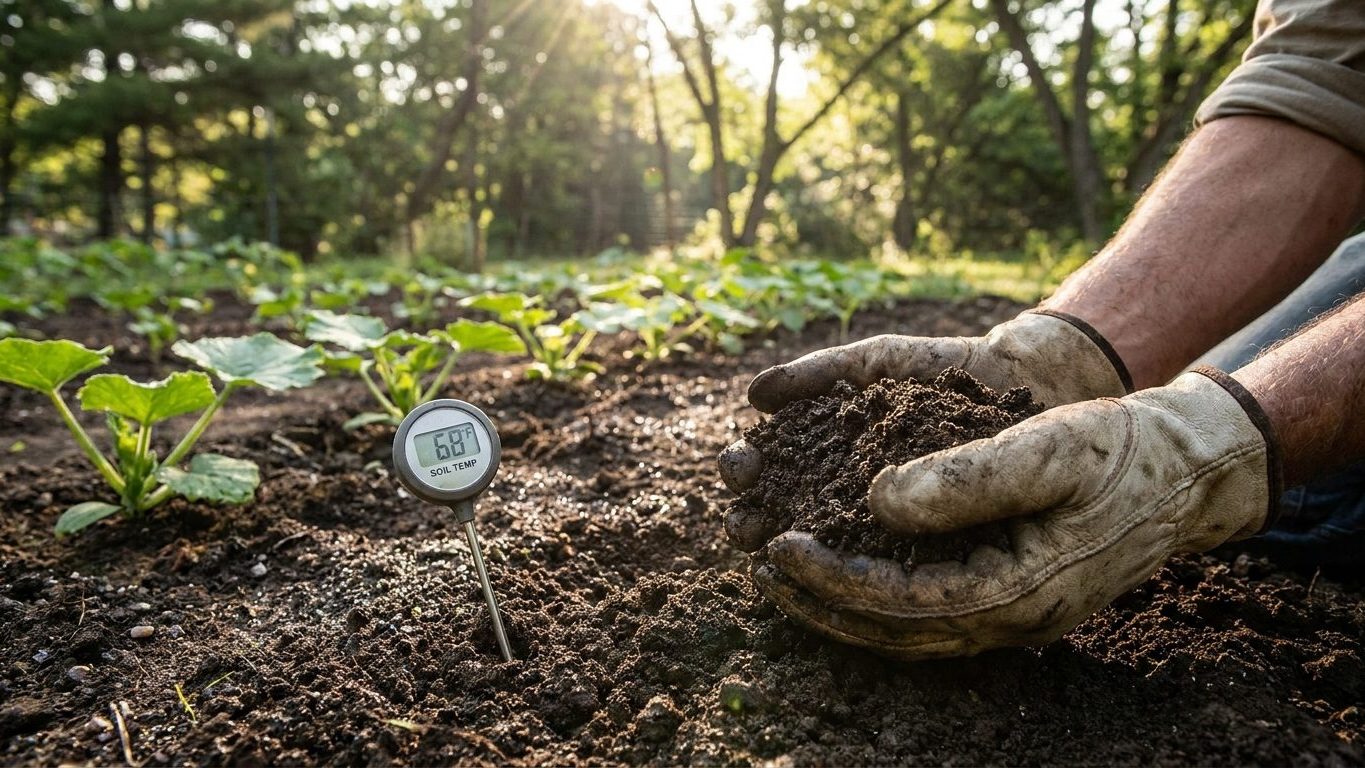
Soil warmth by feel is the first and most reliable check. Push a finger or a trowel a few inches into the planting bed on a morning after several sunny days. If the soil feels only cool, not cold, and holds together loosely rather than clumping wet, it’s approaching the range winter squash seed needs to germinate reliably, generally warmer than most people expect this early in the season. Cold, damp soil that clings to a tool is still telling you to wait, regardless of what the calendar says.
The first flush of male flowers is the second signal, and it shows up before any female flower does, usually as bright yellow blooms with a plain stem behind them. Their appearance means the plant has moved out of pure vegetative growth and is gearing up for fruit set, a sign that the vine has read the local warmth and daylight as sufficient, whatever the reference station says.
The third is the appearance of true leaves, the second set that emerges after the rounder seed leaves, showing the characteristic scalloped squash shape. Their timing and vigor say a lot about whether the current stretch of weather is actually supporting steady growth or just tolerable survival. Slow, pale true leaves after a cool snap suggest a microclimate running behind averages; fast, dark green ones suggest the opposite, and either way, that’s more current information than a thirty-year climate normal can offer.