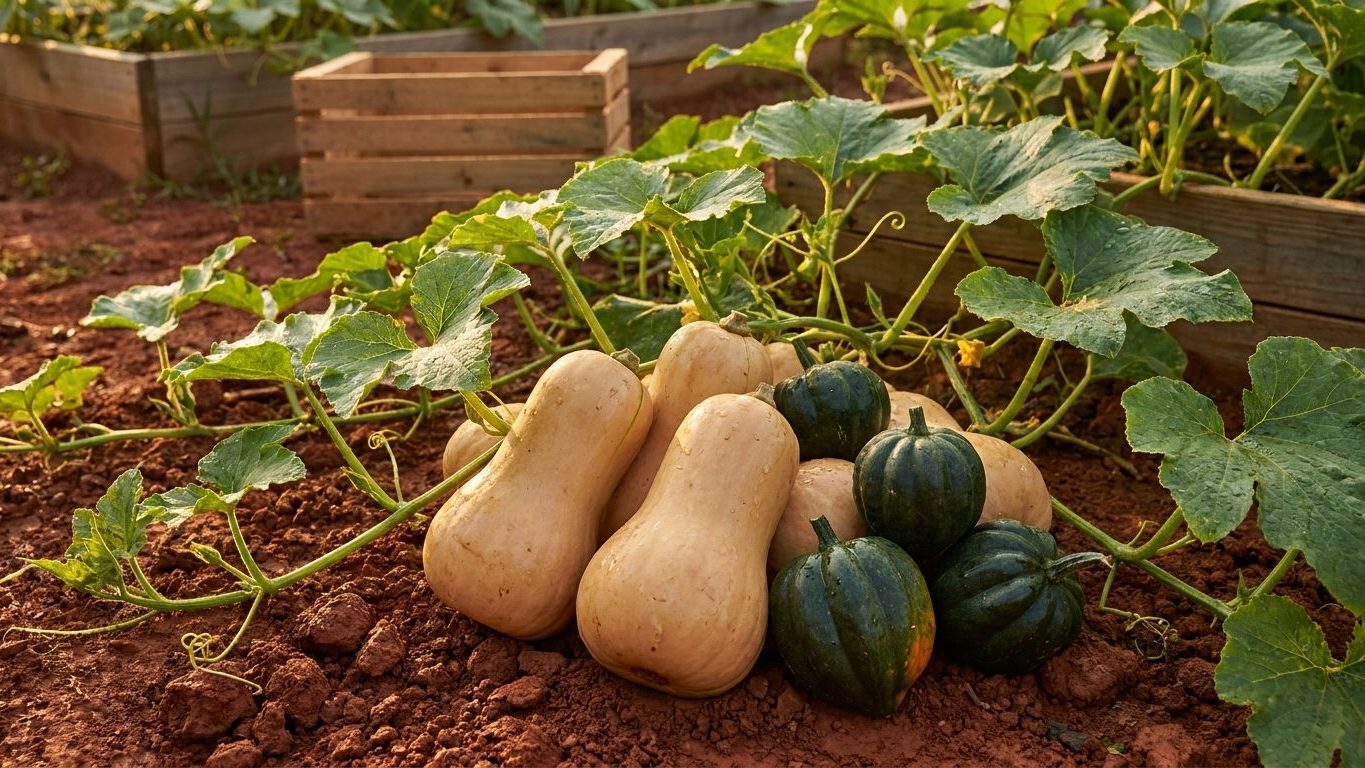

Short-season, cool-tolerant winter squash types, acorn, buttercup, delicata, and smaller pie pumpkins, are the safe bet for New Brunswick. Large storage types that need a long, hot stretch to fill out and sweeten, giant Hubbard, big moschata pumpkins, some long-vine butternut strains, are a gamble here more often than not.
The short answer for New Brunswick
Start with the number that actually decides this: the average frost-free window at the Moncton reference station runs from May 23 to October 2, which is 132 days. That’s a mean, not a guarantee, so in roughly half of all years the last spring frost lands later than May 23 and eats into that total. Practically, a New Brunswick gardener should plan around a working season closer to 100-110 reliable days once that late-frost risk and the slow, cool start typical of this climate are subtracted.
That number by itself rules some types in and others out. Winter squash varieties bred to reach maturity in 80 to 95 days, the acorn, buttercup, delicata and smaller kabocha types, fit comfortably inside even a shortened New Brunswick season. Add to that the fact that days above 90F average exactly 0.0 here: there is no heat surge in July or August to push a slow-maturing vine across the finish line the way there might be further south. A squash that needs both a long season and real heat to finish is asking for two things this province simply doesn’t supply.
Spaghetti squash and standard butternut sit in the middle. Both can work, but the shorter-vine, quicker-maturing strains within those types will beat the longer-season selections almost every year. The decision, isn’t really about brand names or seed catalog favorites. It’s about matching days-to-maturity against a 132-day mean window that a grower should treat as generous, not guaranteed, and about accepting that a summer with zero days over 90F will never rescue a squash that’s behind schedule in August.
The practical rule of thumb: anything listed at 100 days or under to maturity is a reasonable bet in most New Brunswick gardens. Anything past 110 days needs either black plastic mulch, row cover for an early start, or a grower willing to accept that some years it simply won’t ripen before the October frost closes things out. This is the frame for everything that follows: season length and the total absence of real summer heat, not personal preference, are what separate the winter squash that belong here from the ones that don’t.
What will not work here
The biggest failure mode in New Brunswick winter squash is planting for a longer, hotter season than the province actually has. Large Hubbard types and the biggest moschata pumpkins are bred with the assumption of 120 days or more of warm, sustained growth, plus stretches of real heat to convert starch to sugar in the final weeks. With zero days a year reaching 90F at the Moncton reference station, that heat conversion simply doesn’t happen at the rate these varieties expect. The vine can look fine, the fruit can size up, and it still arrives at October 2 pale, watery and underripe.
Rainfall works against the slow types too, though in a less obvious way. Moncton averages about 10.5 inches of rain across June, July and August, with August, the critical ripening month for most winter squash, still receiving 3.18 inches. That’s enough moisture, combined with cool nights, to keep foliage damp longer than a drier, hotter climate would. Long-season vines that stay in the ground into late September are exposed to more weeks of that humid window, and powdery mildew and vine borer pressure both climb the longer a squash plant sits in the garden. A fast 85-day acorn squash is off the vine and cured before the worst of that pressure builds. A 120-day Hubbard is still fighting it in mid-September.
Spacing makes the humidity problem worse
Growers who Plant Winter Squash close together to save space, a workaround that might pass in a drier climate, run into trouble faster here. Tight spacing traps humidity around the leaves at exactly the time of year, mid to late summer, when the province’s own rainfall numbers already keep things damp. Wide spacing and good airflow aren’t cosmetic advice in New Brunswick; they’re a direct response to a summer rainfall total that, while moderate, arrives without the offsetting heat that would otherwise dry leaves out quickly between showers.
None of this means winter squash is a poor fit for the province. It means the failures are predictable and specific: the slowest-maturing, most heat-dependent types, planted too close together, in a season that offers neither the days nor the degrees they were bred for.
What changes across New Brunswick
New Brunswick is not one climate, and the hardiness zone figure available here, 5a under the Canadian system, reflects conditions at the Moncton reference station only. That number uses Natural Resources Canada’s own methodology, built from seven climate variables rather than the single minimum-temperature measure the USDA system uses, and it should never be read as, or converted into, a USDA zone. NRCan is explicit that the two systems don’t line up on a shared scale.
Because this figure describes one reference point, a gardener elsewhere in the province, further north, further inland, or at higher elevation, should expect a colder effective zone than 5a, with a shorter practical growing season than the 132-day Moncton mean suggests. The Fundy coast and low-lying river valleys tend to moderate a little; upland and northern districts tend to run colder and later into spring. There is no single zone number for the whole province.
What that means for winter squash specifically: a grower in a colder pocket of the province should lean even harder toward the fastest-maturing types discussed above, acorn and delicata over butternut, and should treat black plastic mulch or early transplants under cover as closer to standard practice than optional extra. A grower in a milder coastal spot might stretch to a mid-season butternut with more confidence, though still well short of the longest-season Hubbard types.
The only responsible way to know where a given garden actually falls is to check the map itself rather than guess from a province-wide average. Natural Resources Canada’s Plant Hardiness Site lets a reader look up hardiness zone by municipality directly, which is the only way to replace this page’s single reference-station figure with something specific to an actual garden.
Where to check this for your own county
Everything above is built from one reference station and one province-wide reading of the numbers. That’s useful for a general decision, but it is not a substitute for what a reader’s own county has actually trialled. New Brunswick’s counties, from Restigouche in the north to Charlotte in the south, cover a real spread of microclimates, and a planting calendar built for the province as a whole will always be a step behind one built for a specific county’s conditions.
The Agriculture and Agri-Food Canada site is the working starting point here. The provincial department’s own site currently blocks automated verification, so this page points to the federal resource as the one confirmed to be reachable. From there, a reader should look specifically for two things: any local or regional planting calendar that adjusts the province-wide frost dates for their part of New Brunswick, and any variety trial results or extension bulletins naming winter squash cultivars actually grown and evaluated in their county.
That second point matters more than it sounds. A cultivar list built from trials in one county carries real weight, because it reflects actual harvest dates and disease pressure from a specific place, not a general rule extrapolated from a single weather station. This page has done the province-wide version of that work, reasoning from Moncton’s frost dates, hardiness zone and summer rainfall. A county-level recommendation, where one exists, will always beat it, because it’s built from a smaller, more specific set of conditions closer to an individual reader’s own soil and slope.
Checking this against your own garden
Every date and average on this page describes a typical year at one weather station. A reader’s own garden will confirm or override all of it, and three simple observations do most of that work without any equipment.
Soil warmth by feel is the first and most direct check. Winter squash seed sits and rots in cold, wet soil rather than germinating, so a grower who can comfortably rest a bare hand in the planting row for several seconds, with the soil feeling cool but not cold, has a better read on planting readiness than any calendar date, including the May 23 mean used above.
The first flush of male flowers is the second signal worth tracking. Squash plants typically produce male flowers before females, and their timing reflects how much accumulated warmth the plant has actually experienced that season, not just how many calendar days have passed since planting. An early, strong flush of male blooms in a given garden suggests that garden is running warmer than the province-wide average would predict; a late, sparse flush suggests the opposite, and points toward favoring the fastest-maturing types discussed earlier.
The appearance of the first true leaves, the second set that follows the rounder seed leaves, marks the point where a young squash plant is genuinely established rather than just surviving. A garden where true leaves appear quickly and vigorously after germination is telling its owner that the local microclimate runs a bit ahead of the Moncton reference numbers. A slow, delayed set of true leaves is telling the opposite story, and it’s worth listening to over any single date printed on a seed packet or a page like this one.