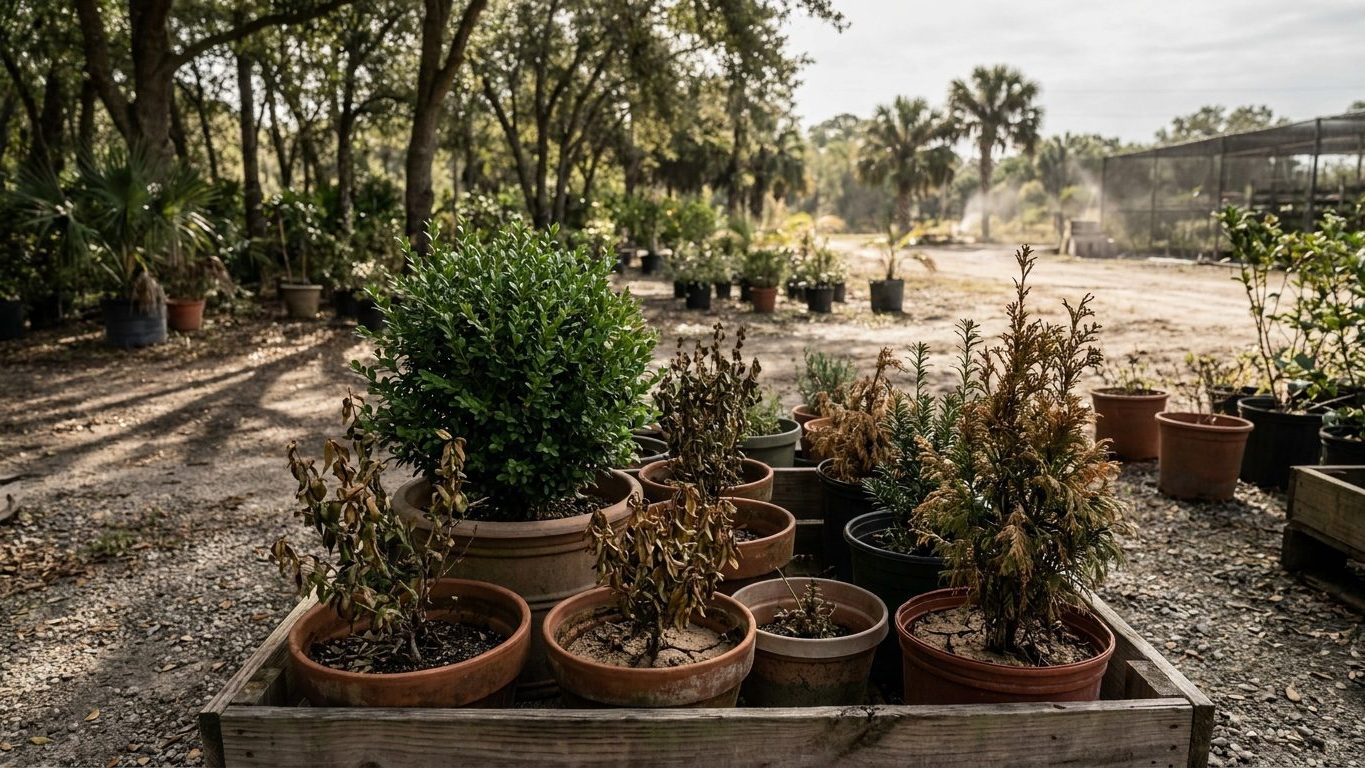

Six of the twelve common hedge species fail somewhere in Wyoming, and none fail everywhere. Boxwood, Leyland cypress, inkberry holly, privet, cherry laurel and yew drop out as you move into the cold zones. Arborvitae, eastern red cedar, eastern hemlock, American hornbeam, winterberry holly and arrowwood viburnum survive the whole state. Which side of that line your yard falls on depends on your USDA zone.
What actually holds in Wyoming
A USDA zone rests on one number: the average annual extreme minimum temperature. The USDA Plant Hardiness Zone Map 2023, built on 1991-2020 normals, puts Wyoming anywhere from 3a to 6a. A plant labeled hardy to zone 5 is a sure thing in one county and a dead stick in the next. The rating also only promises survival through winter. It says nothing about whether a hedge will look good once it gets there.
The growing season adds its own limits. The reference weather station, at about 6,000 feet, has roughly 130 frost-free days between a last spring frost in the May 7 to May 18 window and a first fall frost in the September 24 to October 5 window (NOAA NCEI 1991-2020 Climate Normals). Higher up, frost can show up in any month. A late freeze can burn tender new growth on a hedge plant that sailed through the winter.
Which hedge plants fail in the colder parts of Wyoming?
Six species hold in only part of the state, and each one needs its zones spelled out.
| Plant | Holds in USDA zones | Height as a hedge | Cuts back hard? |
|---|---|---|---|
| Yew (Taxus x media) | 4a to 6a | 3 to 8 feet | Yes |
| Privet (Ligustrum vulgare) | 4a to 6a | 4 to 12 feet | Yes |
| Inkberry holly (Ilex glabra) | 4a to 6a | 5 to 15 feet | Yes |
| Boxwood (Buxus sempervirens) | 5a, 5b, 6a | 2 to 6 feet | Yes |
| Cherry laurel (Prunus laurocerasus) | 6a only | 6 to 15 feet | Yes |
| Leyland cypress (x Hesperotropsis leylandii) | 6a only | 15 to 25 feet as a screen | No |
In zone 3a, all six are out. In zone 4, yew, privet and inkberry hold, while boxwood, cherry laurel and Leyland do not. In zone 5, boxwood joins the list. Only in 6a, the warmest zone in the state, does everything on the table survive. Leyland and cherry laurel are the ones to watch, because both are common in catalogs and both are marginal at best across most of the state.
Which hedge plants hold across all of Wyoming?
Six species survive from 3a through 6a: arborvitae (Thuja occidentalis), eastern red cedar (Juniperus virginiana), eastern hemlock (Tsuga canadensis), American hornbeam (Carpinus caroliniana), winterberry holly (Ilex verticillata) and arrowwood viburnum (Viburnum dentatum). Cold tolerance is the only thing this settles, and the soil section below covers the rest. Winterberry loses its leaves in winter, so it won’t screen a view in January. Hornbeam and arrowwood are leafless then too.
Gardeners near the northern border can compare notes in Hedge Plants for Montana: What Holds, and What Only Looks Hardy, where the cold end of the range plays out the same way.
The hedges you can never cut back down
Three of the twelve species cannot regrow from old wood: Leyland cypress, eastern red cedar and arborvitae. Cut into the bare, leafless interior of one of these and it stays bare. Every cut has to stay inside the green growth, so you either keep up with it every year or live with the height it reaches.
Which hedges can’t be cut back once they get too big?
Leyland cypress is the worst case for a small yard. It grows 3 to 4 feet a year and reaches 15 to 25 feet as a screen, and it cannot be cut back to size later. Trim it from late spring to midsummer, and hold it to zone 6a only. A tree that gets away from you and survives only in the warmest pockets of the state is a poor bet.
Eastern red cedar adds 12 to 24 inches a year and runs 8 to 20 feet as a screen. Prune it in late winter and keep to light cuts only. Arborvitae is slower at 6 to 9 inches a year, and it holds 4 to 15 feet as a hedge. Prune it in late winter before growth starts, or in midsummer. Neither one will let you rebuild the hedge from a stump, so pick the mature height you want before planting and space the plants to match.
Which hedges forgive a hard cut?
Everything else regrows from old wood, though the timing differs. Yew (late spring, after the new growth hardens), boxwood (late spring, after the last frost) and arrowwood (right after flowering) all take correction well. So do inkberry and winterberry, which you trim in late winter while they are dormant. American hornbeam is cut in midsummer after the first flush, and privet gets two cuts a season, in spring and midsummer. Eastern hemlock regrows too, but it is trimmed in late spring with light cuts only.
A hedge that has outgrown its space can be cut back and rebuilt over a few seasons if it is one of these species. Mid-October is not the time. Frost has likely arrived at the reference station already, and most of these plants are headed into dormancy. Wait for the windows above.
Matching the plant to the job
A hedge is a job description before it is a plant. A privacy screen, a low formal border and a loose flowering boundary call for different species. The six that survive statewide give you options for each.
| Plant | Hedge height | Growth a year | Prune | Regrows from old wood |
|---|---|---|---|---|
| Eastern hemlock | 10 to 20 feet | 12 to 24 inches | Late spring, light cuts | Yes |
| Eastern red cedar | 8 to 20 feet | 12 to 24 inches | Late winter, light cuts | No |
| Arborvitae | 4 to 15 feet | 6 to 9 inches | Late winter or midsummer | No |
| American hornbeam | 6 to 15 feet | 12 inches | Midsummer | Yes |
| Winterberry holly | 5 to 15 feet | 6 to 12 inches | Late winter | Yes |
| Arrowwood viburnum | 6 to 10 feet | 12 to 24 inches | Right after flowering | Yes |
For a tall evergreen screen of 10 feet or more, hemlock, red cedar and arborvitae are the candidates. Only hemlock can be rebuilt from old wood if the hedge gets away from you. For a mid-height boundary of 6 to 10 feet that can drop its leaves, arrowwood fills in fastest, and hornbeam makes a taller, denser line. Winterberry works too, though it is better known for its berries than for structure.
For a low formal hedge of 2 to 6 feet, boxwood is the classic. It grows only 3 to 6 inches a year and holds only in zones 5a, 5b and 6a. Yew does a similar job in zones 4a to 6a, with 6 to 12 inches a year and a height of 3 to 8 feet. Privet is the quickest of the low-to-mid hedges at 2 to 3 feet a year. It needs two trims a season to stay tidy.
Growth rate decides how long the gap stays open. A hedge growing 6 to 9 inches a year takes many seasons to close, and one growing 2 to 3 feet a year closes faster. For spacing and planting basics that apply to any of these, see Hedges.
The ground you are planting into
Wyoming’s state soil is the Forkwood series, an Aridisol. That is a dry-climate soil, usually alkaline and often carrying salts. The surface layer averages a pH of about 7.2, which is near neutral. It is a loam to silt texture, with 42 percent sand, 20 percent clay and 38 percent silt, and it holds only about 1.5 percent organic matter. It is well drained. These are representative values for the surface horizon of the series as USDA maps it (NRCS Soil Data Access, 105 components), not a reading of your bed.
Your yard may look nothing like it. River bottoms, hill country and any lot a builder has scraped or filled can differ completely. But the series shows what ground in a dry climate tends to do: it drains quickly, holds little organic matter and often leans alkaline. Hedges planted in it need water through their first seasons, since the soil shed moisture and the climate gives little. Yew in particular dislikes wet roots, and well-drained ground suits it.
Alkaline soil is the bigger concern for some of the statewide-hardy plants. Hemlock, winterberry and inkberry tend to prefer acidic, moist ground, so a plant that survives your winter may still struggle in your soil. Arrowwood, arborvitae and red cedar are less likely to complain, though a soil test is still the only way to know your own pH.
University of Wyoming Extension can point you to a soil test and tell you how local conditions differ. Hedge lists written for other states sort the same plants differently. Compare the zone ranges in Hedge Plants for Connecticut: What Holds, and What Only Looks Hardy or Hedge Plants for Missouri: What Holds, and What Only Looks Hardy and you will see why a plant that is safe there can fail here.
Common questions
What is the hardiest hedge plant for Wyoming?
Six species hold from zone 3a through 6a: arborvitae, eastern red cedar, eastern hemlock, American hornbeam, winterberry holly and arrowwood viburnum. Hardiness covers cold only, so check each plant’s soil preferences before you buy.
Can you grow boxwood in Wyoming?
Only in zones 5a, 5b and 6a. It grows 3 to 6 inches a year, reaches 2 to 6 feet as a hedge, and is pruned in late spring after the last frost. In colder zones, yew is the closest substitute for a low formal hedge.
When should I trim a hedge?
It depends on the plant. Late winter suits inkberry, winterberry and red cedar, and late spring suits yew, boxwood and hemlock. Arrowwood is cut right after it flowers, and hornbeam in midsummer. In mid-October, most hedges should be left alone.
How do I find my USDA zone?
Look up your location on the USDA Plant Hardiness Zone Map 2023, which runs from 3a to 6a across Wyoming. Elevation and valley position can shift the result within a few miles, so your county extension office can confirm what holds locally.