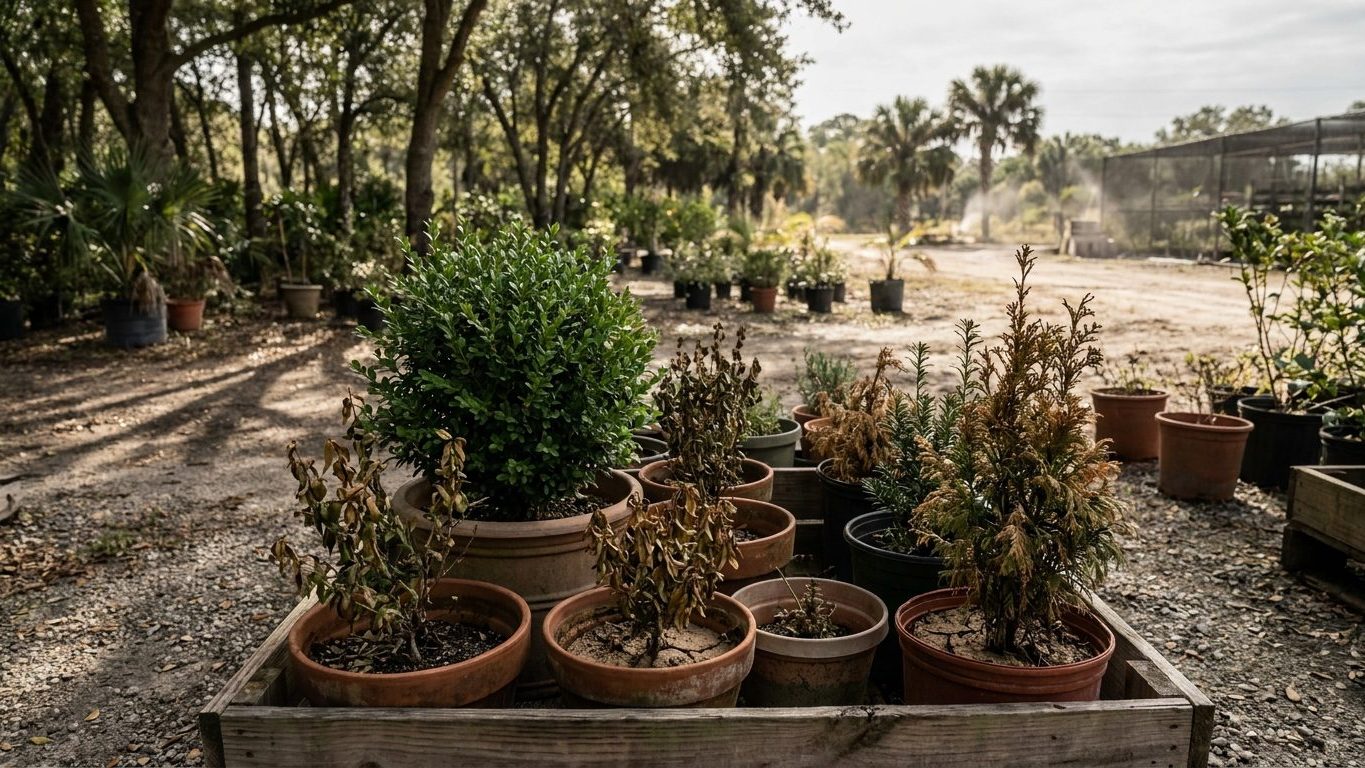

Wisconsin spans USDA zones 3b to 6a, and that spread splits hedge plants into two groups. Of twelve common hedge species, six survive winter anywhere in the state: American hornbeam, winterberry holly, eastern red cedar, arborvitae, eastern hemlock and arrowwood viburnum. The other six hold only in part of it: boxwood, Leyland cypress, inkberry holly, privet, cherry laurel and yew. None fails everywhere. Three of the twelve also can never be cut back to size once they outgrow it, and that matters as much as the zone.
What actually holds in Wisconsin
A USDA hardiness zone rests on a single number: the average annual extreme minimum temperature, taken from the 2023 map built on 1991-2020 normals. It says nothing about summer heat, wind, wet feet or late freezes. Wisconsin runs through six half-zone bands, from 3b up to 6a, so a hedge that sails through winter in one county can die back to the ground in another.
Which hedge plants fail in colder parts of Wisconsin?
Six of the twelve species stop short of the coldest zones. Two of them, Leyland cypress and cherry laurel, hold only in zone 6a, which is the mildest corner of the state, where Lake Michigan softens winter. Boxwood needs zone 5a or warmer.
| Plant | Holds in these Wisconsin zones | Growth | Regrows from old wood |
|---|---|---|---|
| Boxwood | 5a, 5b, 6a | 3 to 6 inches a year | Yes |
| Leyland cypress | 6a only | 3 to 4 feet a year | No |
| Inkberry holly (evergreen) | 4a through 6a | 6 to 12 inches a year | Yes |
| Privet | 4a through 6a | 2 to 3 feet a year | Yes |
| Cherry laurel | 6a only | 1 to 2 feet a year | Yes |
| Yew | 4a through 6a | 6 to 12 inches a year | Yes |
Find your own zone on the USDA map before you buy anything. Lakeshore sites and city lots often sit a half zone warmer than farmland a few miles inland, and the state’s higher, colder north can sit well below the southern counties.
Which hedge plants survive anywhere in Wisconsin?
Six species cover every zone from 3b to 6a, so they are the safe starting list for a northern yard:
- American hornbeam: about 12 inches of growth a year, 6 to 15 feet as a hedge.
- Winterberry holly: loses its leaves in winter, 5 to 15 feet.
- Eastern red cedar: 12 to 24 inches a year, 8 to 20 feet as a screen.
- Arborvitae: 6 to 9 inches a year, 4 to 15 feet.
- Eastern hemlock: 12 to 24 inches a year, 10 to 20 feet.
- Arrowwood viburnum: 12 to 24 inches a year, 6 to 10 feet.
Gardeners near the western border will find the same sorting done for their climate in Hedge Plants for Minnesota: What Holds, and What Only Looks Hardy, and those near Lake Michigan’s far shore can compare notes in Hedge Plants for Michigan: What Holds, and What Only Looks Hardy.
The hedges you can never cut back down
Three of the twelve species will not sprout from old wood: Leyland cypress, eastern red cedar and arborvitae. Cut into the brown, leafless interior of any of them and the gap stays a gap. Green growth is all they have to work with, so the only way to hold the height is to trim the tips every year and stay inside the foliage. A hedge of these that gets ahead of you cannot be reset. It has to be replaced.
Leyland cypress is the sharpest case. It grows 3 to 4 feet a year and heads for 15 to 25 feet as a screen, and it holds only in zone 6a. Late spring to midsummer is its pruning window, and the cuts have to be small and frequent.
Eastern red cedar grows 12 to 24 inches a year and reaches 8 to 20 feet. It takes light cuts only, in late winter. Arborvitae is slower, at 6 to 9 inches a year, and reaches 4 to 15 feet as a hedge. Trim it in late winter before growth starts, or in midsummer.
How do you keep an arborvitae or cedar hedge at the size you want?
Choose the site for the height the plant will reach, not the height it is when you carry it home. Then take off a little new growth each year, never more than the green tips. If a hedge of one of these three is already too tall, the options are to live with it or to pull it out and start again.
The other nine species are more forgiving. Yew, hornbeam, privet, arrowwood, inkberry, winterberry, boxwood, cherry laurel and hemlock all regrow from old wood, so a hedge that has gone shaggy can be cut hard and rebuilt over a few seasons. Hemlock regrows too, yet it still takes light cuts only, in late spring. If you want room for mistakes, the regrowing group is the better bet.
Matching the plant to the job
Privacy screens, low formal edges and loose wildlife hedges ask for different plants. Height and growth rate decide most of it.
For a tall evergreen screen across the whole state, the choices are eastern hemlock, eastern red cedar and arborvitae. Hemlock makes the densest, softest wall at 10 to 20 feet and regrows when cut, though only light cuts are wise. Cedar is an evergreen that holds statewide. Arborvitae is the slowest of the three, and easy to keep in check if you start trimming early.
For a low, formal edge, yew is the standard. It holds from zone 4a up, grows 6 to 12 inches a year, reaches 3 to 8 feet, and takes late-spring cutting after the new growth hardens. Boxwood suits a tighter, smaller edge at 2 to 6 feet and only 3 to 6 inches of growth a year, but it needs zone 5a or warmer and prefers a late-spring cut after the last frost. Inkberry holly is the evergreen alternative to boxwood in zones 4a and up, at 5 to 15 feet, with a late-winter prune while dormant.
For a looser hedge that works as a windbreak or a place for birds, arrowwood viburnum and winterberry holly are statewide choices. Arrowwood should be pruned right after flowering. Winterberry loses its leaves, so it gives no winter screening, and it takes its cut in late winter while dormant. American hornbeam, trimmed in midsummer after the first flush, gives a dense, tidy hedge at 6 to 15 feet.
Privet is the fast, cheap option at 2 to 3 feet a year and 4 to 12 feet tall. It also needs the most work, with two cuts a season, in spring and in midsummer.
The same twelve sort out very differently where winters are mild, as in Hedge Plants for Mississippi: What Holds, and What Only Looks Hardy, and a cold Northeastern state such as New Hampshire looks closer to Wisconsin’s north in Hedge Plants for New Hampshire: What Holds, and What Only Looks Hardy. For the wider picture of design and care, start from the main Hedges guide.
The ground you are planting into
Wisconsin’s official state soil is the Antigo series, named by state law in 1983. It is an Alfisol, a forest soil of moderate fertility that holds nutrients reasonably well. The representative surface layer is a silt loam: about 70 percent silt, 20 percent sand and 10 percent clay. It has about 3.0 percent organic matter, a pH of about 5.5 (slightly acid) and drains well. These are the USDA’s recorded values for the surface of that series, not a reading from any garden bed.
The practical meaning is that much of the state’s ground tends to be silty, well drained and mildly acid. That suits yew and hemlock, and inkberry holly. Silt can also crust over and compact when it is worked wet, so avoid digging planting holes in saturated ground.
Your own yard may be nothing like it. River bottoms, hill country and any lot that a builder scraped or filled will behave differently. Before planting a long run, get a soil test. The county office of University of Wisconsin Extension can explain how to collect a sample and how to read the pH and organic-matter results.
Timing matters too. At the reference station, the last spring frost falls between April 16 and April 29, and the first fall frost between October 17 and October 29. None of the twelve species has a pruning window in mid-October. Leave the shears in the shed, and plant now only if the ground is still workable and you can water until it freezes.
Common questions
Can I grow boxwood in northern Wisconsin?
Boxwood holds only in zones 5a, 5b and 6a, so it is not a reliable choice in the colder zones of 3b, 4a and 4b. In those places, inkberry holly or yew gives a similar clipped edge and holds from zone 4a up. In zone 3b, hemlock, arborvitae and arrowwood are among the six that survive.
Which hedge grows fastest and still holds across the whole state?
Eastern red cedar, eastern hemlock and arrowwood viburnum all grow 12 to 24 inches a year and hold in every Wisconsin zone. Red cedar cannot regrow from old wood, so it needs steady light trimming. Hemlock and arrowwood regrow if they get ahead of you.
Can I cut an overgrown arborvitae back to the size I want?
No. Arborvitae does not sprout from old wood, so cutting into bare interior leaves permanent holes. Leyland cypress and eastern red cedar behave the same way. If one is too big for its spot, replacing it is usually the only fix.
When should I trim a hedge in Wisconsin?
The window depends on the plant. Inkberry and winterberry take their cut in late winter while dormant. Boxwood, yew and hemlock go in late spring. Arrowwood is trimmed right after flowering. Hornbeam goes in midsummer, and privet gets two cuts, one in spring and one in midsummer. Fall is not a trimming season for any of them.