
Winter Squash in New Brunswick goes into the ground after the average last spring frost of May 23, either as transplants started indoors in early May or as direct-seeded hills once soil has warmed. That date is a mean, not a guarantee, and the growing season it opens runs to an average first fall frost of October 2, a window of roughly 132 days that also shifts year to year.
The short answer for New Brunswick
Plant Winter Squash outdoors, or move transplants out, starting around May 23. That date comes from Environment and Climate Change Canada’s 1981-2010 normals at the Moncton station, and it marks the midpoint of when frost typically stops, not a safe cutoff. In half of all years, frost arrives after May 23, sometimes by a week or more. A gardener who plants on the average date is betting on a coin flip.
The other end of the season matters just as much. The average first fall frost at the same station is October 2. Subtract one average from the other and the frost-free window comes to about 132 days, but since both ends are averages rather than fixed points, the real window in any given year could run shorter, sometimes much shorter, if spring drags or fall arrives early.
That 132-day figure is the number every winter squash variety has to fit inside, and it’s the reason variety choice matters more here than in warmer regions. Winter squash varieties range widely in days to maturity, and a New Brunswick garden has less room for error than a longer-season territory does:
| Maturity group | Typical days to maturity | Fit with a ~132-day average window |
|---|---|---|
| Fast (acorn, delicata types) | 80-95 days | Comfortable margin even in a shorter-than-average year |
| Mid-season (butternut, buttercup) | 95-110 days | Workable if planted at the earliest safe date |
| Long-season (large Hubbard, banana types) | 110-120+ days | Little to no margin; a late spring or early fall frost can end the crop unripe |
For most home gardens here, that points toward sowing as close to May 23 as the soil allows, and leaning toward varieties in the 85-100 day range rather than the slowest-maturing types, simply because the season doesn’t reliably offer enough days to spare.
What will not work here

The longest-season winter squash varieties are the clearest mismatch for this territory. A variety needing 115 or 120 days to mature is asking for more frost-free days than the average window even provides, before accounting for the years when spring runs late or fall arrives early. Planting one of these on faith that “the books say it works” ignores the actual frost data for this province’s reference station.
Heat is the second mismatch, and it’s easy to miss because it’s invisible in a seed catalog. The Moncton station records zero days a year reaching 90F or higher. Winter squash varieties bred or selected for hot-summer regions, the kind that size up and sweeten under sustained heat, simply don’t get that push here. A gardener transplanting seed saved from a hot-climate garden, or following advice written for a region with weeks of 90-degree days, will watch fruit stay smaller and slower to color than expected, not because anything went wrong, but because the heat that variety needs never arrived.
Watering advice built for hot, dry summers is the third mismatch. This region averages about 10.5 inches of rain across June, July and August, with the driest month, August, still bringing 3.18 inches. That’s not a drought-prone summer, and treating it like one, watering on a fixed weekly schedule regardless of rainfall, risks waterlogging squash roots in a season that’s already delivering moisture on its own. The bigger risk here runs the other way: humid, cool, rain-fed summers with no 90-degree heat to dry foliage back out favor powdery mildew and other fungal disease, especially where squash hills or rows are planted close together and airflow is poor. Wide spacing and attention to drainage matter more here than a rigid watering calendar.
Finally, direct-seeding into soil that hasn’t caught up with the calendar rarely ends well. Squash seed sown into cold, wet ground before the frost risk has genuinely passed tends to rot rather than germinate, regardless of what the average frost date suggests, since an average can mask a soil that’s still cold underneath.
What changes across New Brunswick
New Brunswick is not one climate, and the numbers above describe one place: the Moncton reference station. The hardiness zone recorded there is 5a on the Canadian system, a system built from seven climate variables rather than the single minimum-temperature measure the USDA scale uses. That distinction matters because Canadian zone figures don’t convert cleanly to the US zones used elsewhere; they’re not the same kind of measurement, and a Canadian 4a can overlap several different USDA zones at once.
More importantly, a province-level zone number describes one station, not every garden in the province. Coastal areas tend to run milder and later into fall than inland or upland districts, where frost typically arrives earlier and lingers longer into spring. A garden well north of Moncton, or one sitting at higher elevation, should expect a later effective last frost and an earlier effective first frost than the dates given here, which shortens that already-tight 132-day window further.
Natural Resources Canada’s Plant Hardiness Site maps zones down to the municipality level, using the same 1991-2020 normals framework, and that map is the tool for narrowing a province-wide figure down to a specific location. The spread across New Brunswick is real: a variety and planting date that work near Moncton may need to shift a week or two earlier in fall risk, and later in spring safety, for a garden further north or higher up.
Where to check this for your own county
The dates and figures come from a single weather station, and they’re a provincial-level starting point, not a county-level answer. The next step is Agriculture and Agri-Food Canada.
Once there, the two things worth hunting down are a local or regional planting calendar, if one exists for the reader’s specific area, and any list of squash or vegetable varieties that have actually been trialled in that county or district. A variety that performed well in a multi-year trial near the reader’s own garden carries more weight than any general days-to-maturity number pulled from a seed packet, because it reflects local soil, local microclimate and local pest pressure all at once.
This distinction matters because a county-level recommendation will always beat a province-wide one. Moncton’s normals apply broadly across New Brunswick. A county extension resource, where one exists, narrows that down to conditions much closer to an actual garden.
Checking this against your own garden
Every date is an average pulled from decades of station data, and no average knows what a specific patch of soil is doing this particular spring. Three things a gardener can check by hand outrank any calendar date.
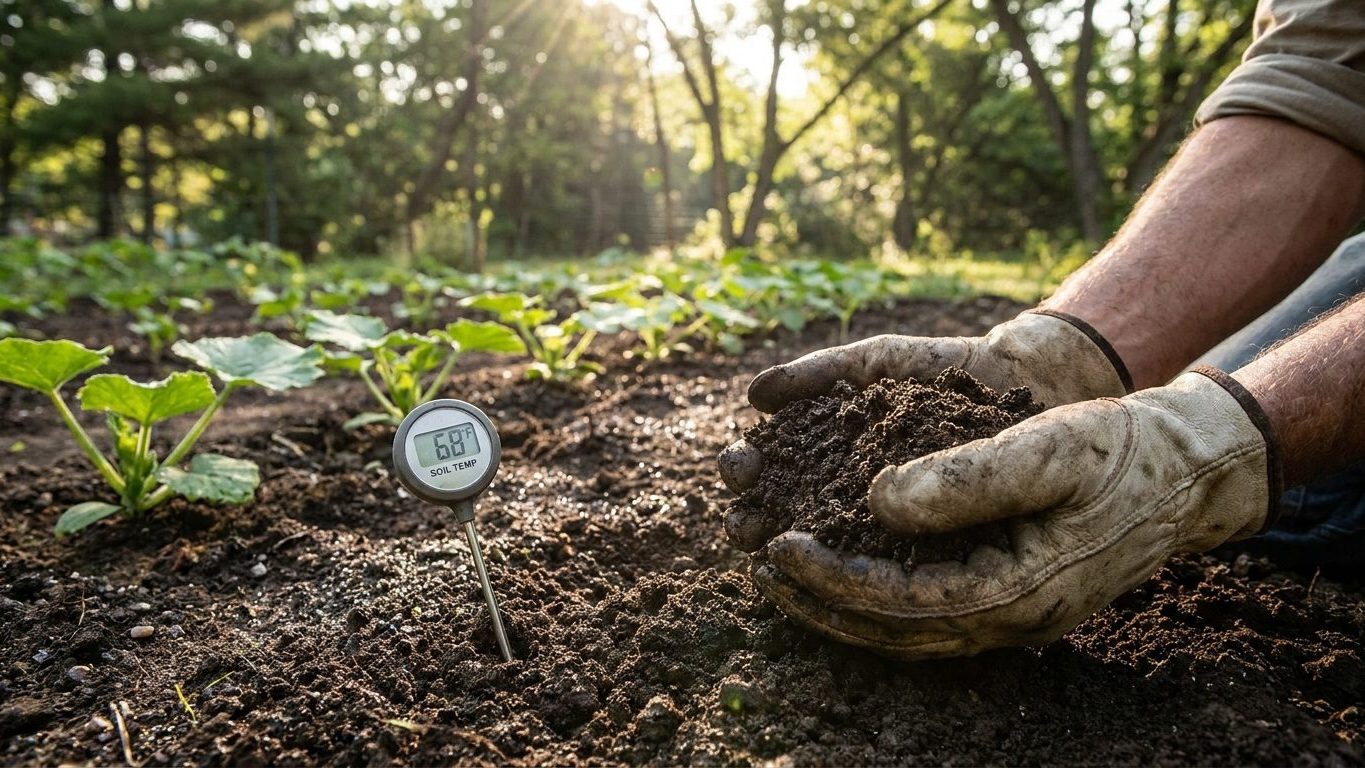
Soil warmth by feel comes first. Winter squash seed wants soil that feels warm, not just frost-free, before it goes in the ground; cold, damp soil that still feels chilly to the touch is a sign to wait, regardless of what the calendar says the average frost-free date should be.
The first flush of male flowers is the second signal. Squash plants typically produce male flowers before female ones, and their appearance marks the plant shifting into active growth, a useful check on whether the season is running warm or cool compared to a typical year in this area.
The first true leaves, the growth that appears after the initial rounded seed leaves, mark the point where a seedling has moved past its most vulnerable stage. Watching for that stage on a plant’s own timeline, rather than counting days since a package date, gives a better read on how a specific garden’s microclimate compares to the provincial averages.
If you follow the almanac, here is when to plant winter squash by the moon. It is a tradition, not a proven method.