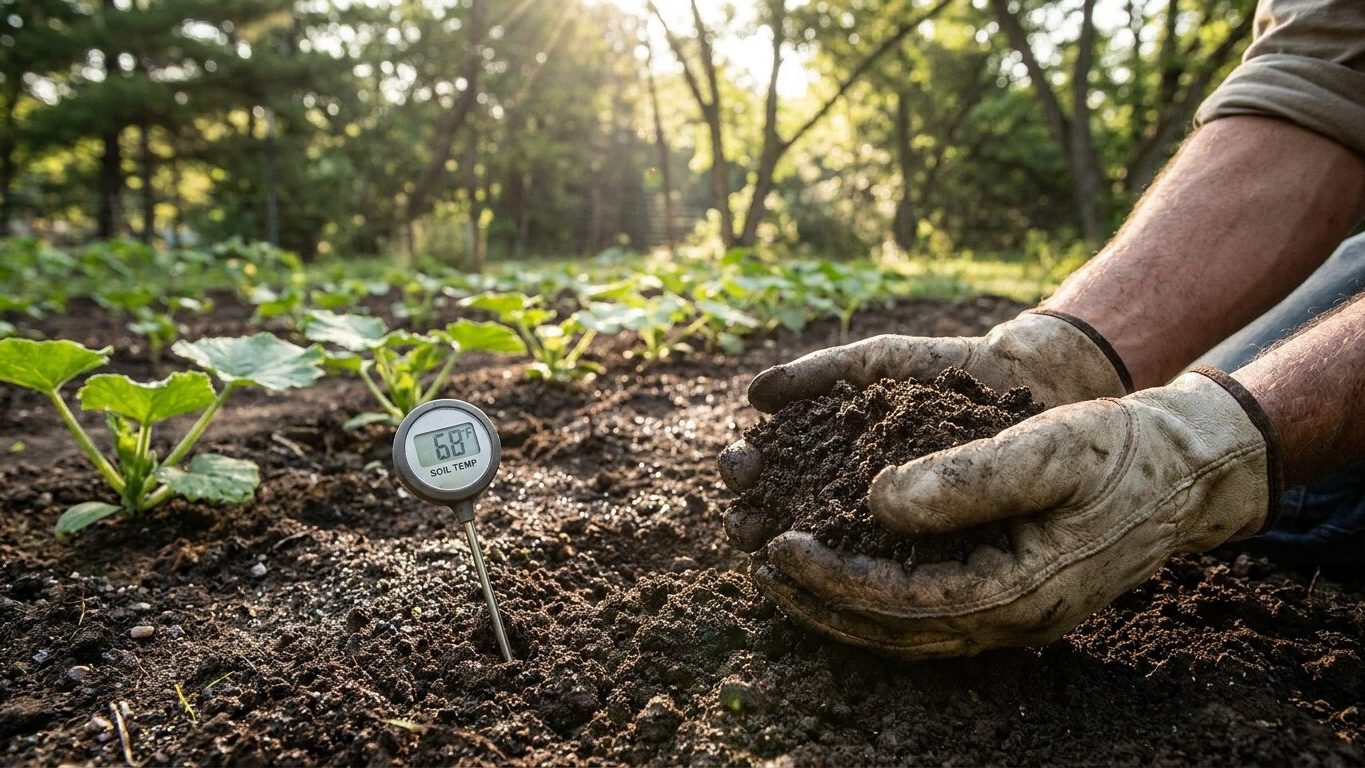

Start winter squash seedlings indoors in early May, then move them outside once nights stay reliably above 50°F, typically late May into the first week of June. Direct seeding in open ground is a gamble here. That’s the plan; the numbers behind it explain why the margin for error is thinner than gardeners farther south are used to.
The short answer for Newfoundland and Labrador
Environment and Climate Change Canada puts the average last spring frost at St. John’s A at May 30, and the average first fall frost at October 17. That’s a 140-day frost-free stretch on paper. But these are mean dates from the 1981-2010 climate normals, not safe dates and not a probability band. In roughly half the years on record, frost has shown up later than May 30 in spring, or earlier than October 17 in fall. Treat both dates as the midpoint of a window, not a guarantee.
That changes how you should read a “140 days” season. Winter squash varieties run anywhere from about 80 days to well over 110 days to maturity, and most benefit from another one to two weeks on the vine to cure and harden their skins before storage. Subtract a realistic frost buffer from both ends, and the workable window shrinks to something closer to 100-110 days in an average year, less in a cooler one.
Start seeds indoors around three to four weeks before your planting-out date, giving seedlings a head start the outdoor season can’t reliably provide. Transplant into the garden once soil has warmed and the risk of a late frost has passed its worst point, generally the first days of June rather than May 30 itself, since half of all years run later than that mean date. Choose the shorter end of the maturity range: something in the 85-100 day bracket gives you a working buffer against a fall frost that could, in a below-average year, arrive well ahead of October 17.
One more number matters here. The station records zero days a year above 90°F. That’s not a caution about heat stress, it’s the opposite problem: there’s essentially no heat surplus to push fruit through a fast finish if you fall behind schedule. A slow start in a cool June has no hot July to make up the lost ground. Every week gained at planting time is a week you’re unlikely to get back later in the season.
What will not work here

Long-season winter squash is the first thing to cross off the list. Big Hubbard types and other varieties bred for 110-plus days need a heat-and-length combination this province’s reference station simply doesn’t offer. With an average frost-free window of 140 days that in half the years is shorter, a plant needing 110 days to mature plus two weeks to cure is working with almost no margin. One cool spell in July, and the fruit never finishes hardening before frost cuts the vine down.
Direct seeding outdoors is the second casualty. Advice written for warmer regions often assumes you can drop seed straight into the ground once soil hits planting temperature and still get a full harvest. Here, that approach eats into a season that’s already tight. Starting indoors and transplanting buys back the two to three weeks direct seeding would cost you, and at this latitude those weeks are the difference between a cured squash and a green one on frost night.
Varieties selected for hot, dry summers are a poor match too. With zero days a year reaching 90°F, there’s no heat load to trigger the vigorous fruit set and sugar development these varieties depend on. Expect vines that stay leafy and reluctant to set fruit, because the heat cue they’re bred to respond to never really arrives.
Watering routines built around hot, arid states don’t transfer either. Summer rainfall here averages about 11.4 inches across June, July and August, fairly evenly spread, with July the driest month at 3.61 inches. That’s a damp, cool coastal pattern, not a dry one demanding weekly irrigation. The actual risk runs the other way: dense spacing recommendations written for arid gardens, meant to conserve soil moisture, become a liability in a cooler, wetter climate where poor airflow between plants invites fungal disease on leaves and vines. Give squash more room to breathe here, not less.
What changes across Newfoundland and Labrador
The hardiness zone figure for the reference city, St. John’s, sits at 6a under the Canadian system. That number belongs to this one location and this one system, and it can’t be read as a USDA zone. Natural Resources Canada builds its zones from seven climate variables rather than the single temperature measure the USDA uses, and the two scales don’t line up on a simple conversion chart. A Canadian zone can span as many as nine different USDA zones depending on the variables involved, so treat 6a here as a description of St. John’s conditions specifically, not a province-wide label.
Newfoundland and Labrador is not one climate. The province stretches from the Avalon Peninsula’s moderated, ocean-influenced coast to the interior of Labrador, where winters run colder, summers shorter, and the growing season noticeably tighter than anything the St. John’s station records. A gardener working land well north or well inland should expect a later last frost, an earlier first frost, or both, compared with the dates given above.
Elevation adds another layer. Gardens sitting higher above sea level, even within the same general region, tend to lag behind coastal plots in spring warm-up and lose the season earlier in fall. There’s no single number on this page that covers a rocky highland plot and a sheltered coastal one equally well.
Rather than guess where your own property falls, check Natural Resources Canada’s plant hardiness mapping tool for a location-specific read, rather than relying on the province-wide figure cited here.
Where to check this for your own county
This page draws on one weather station, St. John’s A, and one hardiness reading for one reference city. That’s useful as a provincial baseline, but it isn’t a substitute for regional guidance closer to your own land. Newfoundland and Labrador’s Forestry and Agrifoods Agency maintains agricultural resources for the province at gov.nl.ca/ffa, and that’s the right next stop for anyone gardening outside the immediate St. John’s area.
Look there for anything region-specific: guidance geared to the growing conditions of the Avalon Peninsula versus central Newfoundland versus Labrador, and any variety trial results or crop recommendations drawn from local extension work rather than a single climate station. A county or regional recommendation, where one exists, will always account for local frost patterns, soil types and microclimates than a provincial figure ever can.
That’s the honest limit of this page. It’s built from the best publicly available climate normals for one reference station, and it answers the question at a provincial scale. If your garden sits well outside the Avalon Peninsula, particularly anywhere in Labrador, the frost dates and season length here should be treated as a starting estimate to check against, not a final answer for your own soil.
Checking this against your own garden
No planting calendar beats what’s actually happening in your own dirt. Three signs tell you more about your specific patch than any calendar date can.
Soil warmth by feel is the first. Winter squash seed wants soil that feels warm to bare skin, not just frost-free air above it. Push a finger a couple of inches down; if the soil still feels cold or damp-cool rather than mild, hold off transplanting even if the calendar says it’s time. Cold soil stalls root growth regardless of what the air temperature is doing.
The first flush of male flowers is the second signal. Squash plants typically produce male flowers before female ones, and their appearance tells you the plant has shifted into reproductive mode. If they’re showing up later than expected for your variety’s typical timeline, that’s your own garden telling you its effective season is running behind the provincial average, whatever the frost-date math suggested at planting time.
First true leaves, the second set that appears after the initial seed leaves, confirm a seedling has moved past germination stress and is actually establishing. Slow or stunted true-leaf growth after transplant often points to soil that was colder than it felt, or a transplant shock the calendar can’t predict. Watching for these three things across a season or two builds a far more reliable personal planting window than any single date on this page.
If you follow the almanac, here is when to plant winter squash by the moon. It is a tradition, not a proven method.