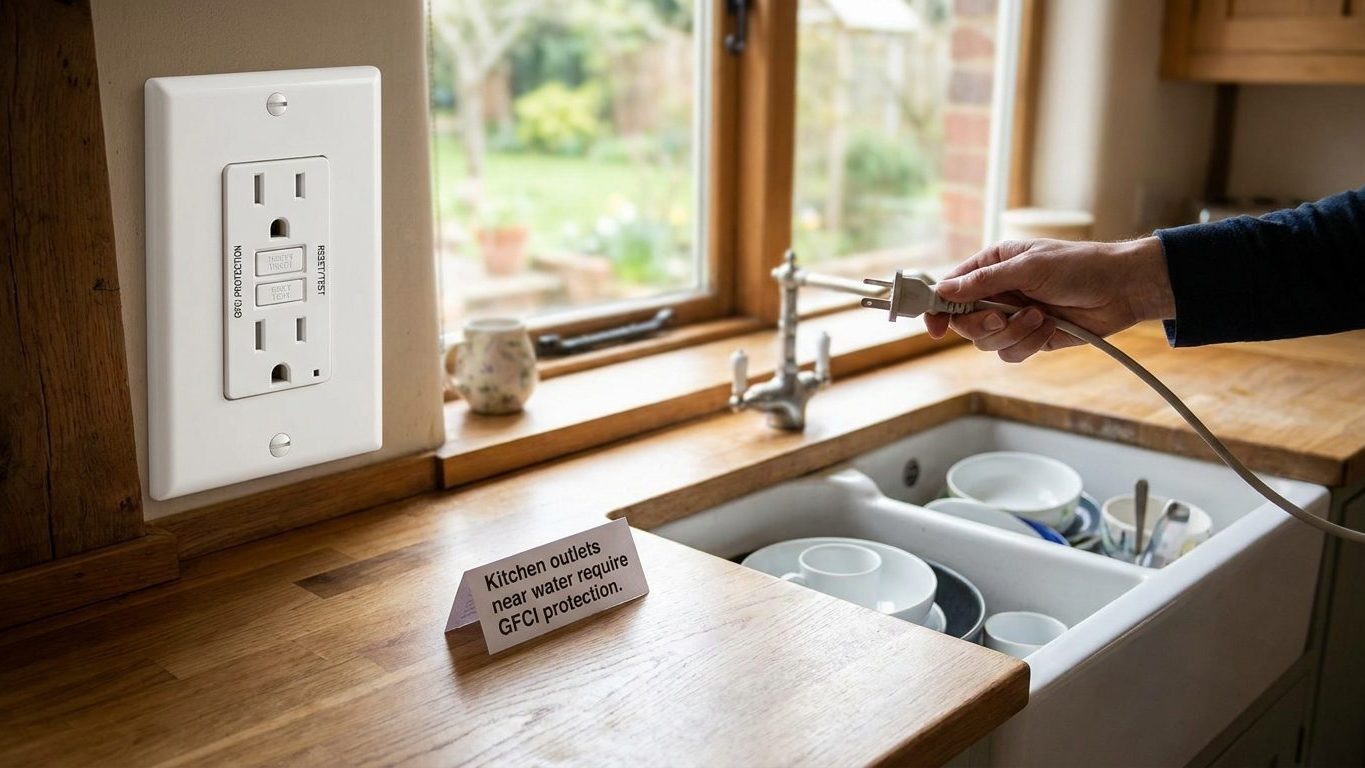

Kitchen countertop receptacles need GFCI protection no matter how far they sit from the sink. That’s the piece people miss: the rule everyone half-remembers, GFCI near water, isn’t the actual kitchen rule. Every 125-volt outlet serving a countertop surface needs it, along with anything within 6 feet of a sink and the dishwasher’s outlet. Check the receptacles running along your counters first, not just the ones flanking the sink.
Every receptacle the rule now covers

The 2020 National Electrical Code requires GFCI protection on every 125-volt receptacle serving a kitchen countertop surface, under section 210.8(A)(6). That’s a code requirement, not a design preference: where a jurisdiction has adopted the 2020 NEC, every outlet mounted along or above a countertop needs it, whether it sits two feet from the stove or ten feet from the sink.
The rule also reaches past the counter itself. Section 210.8(A)(7) requires GFCI protection on any receptacle within 6 feet of the outside edge of a sink, measured from the sink’s rim rather than the faucet or the cabinet below it. That distance catches outlets that aren’t technically serving a countertop at all, an outlet on a peninsula end panel, or one mounted low on a wall near a bar sink.
Then there’s the dishwasher. Section 210.8(D) requires GFCI protection on the outlet that feeds the dishwasher, whether that outlet sits in the cabinet next to it or the receptacle is wired in below the sink. This is a separate provision from the countertop and sink rules, so a dishwasher outlet needs protection even in a layout where it happens to fall outside the 6-foot sink radius and off any countertop run.
Put together, the three provisions mean a typical kitchen ends up with GFCI protection on nearly every outlet in the room except ones serving a dedicated appliance circuit the code treats differently, like a built-in wall oven. That requirement’s applicability to your kitchen, and how strictly it gets enforced during a remodel permit, comes from whichever code cycle your city or county has adopted, not from the national code book on its own. Some jurisdictions amend the NEC when they adopt it, so the section numbers can shift slightly from what’s printed here.
What a GFCI senses, and what it does not protect against
A GFCI receptacle watches the current going out on the hot wire and the current coming back on the neutral wire. In a kitchen outlet with no fault, those two numbers are identical. The device is built to notice the moment they stop matching, because current is leaving the circuit through some other path, a countertop puddle, a metal sink rim, a person standing on a wet floor, and to cut power before that stray current becomes a shock. That’s the reason section 210.8 asks for protection specifically at counters, sinks, and the dishwasher outlet: those are the places in a kitchen where water and a live receptacle are routinely close together.
A GFCI is not the same device as the circuit breaker in your panel, and it doesn’t do the breaker’s job. A standard breaker trips on overload, too many appliances pulling too much current, or on a dead short between hot and neutral. It has no idea whether current is leaking to ground through a person’s hand. A GFCI has no idea whether a circuit is overloaded. It watches for one specific condition, the imbalance, and it will let a circuit run hot right up to the point something else trips it.
Two receptacles, two different wiring setups
Two kitchen outlets can look identical from the front and behave completely differently. One might be wired to a two-pole breaker at the panel with its own ground-fault sensing built in. The other might be a standalone GFCI receptacle with a downstream “load” terminal that passes protection along to outlets wired after it on the same run. Both satisfy the same code sections. The wiring behind the wall, not the receptacle’s face, decides which outlets on that circuit are actually protected, which is one reason an electrician traces the circuit rather than just looking at which faceplates have test buttons.
That distinction also explains what GFCI protection can’t do. It won’t stop a frayed cord from starting a fire. It won’t stop a countertop appliance from overheating if it’s failing internally without sending current to ground. The protection is specific, not general, aimed at one failure mode: a person or a puddle becoming the return path for electricity. That happens to be the failure mode most likely to hurt someone standing at a sink or a coffee maker with wet hands, which is exactly why the code names those locations instead of just saying “protect the kitchen.”
The appliances that were added to the rule recently
The dishwasher rule sits in its own part of the code, section 210.8(D), separate from the countertop provision in 210.8(A)(6) and the sink provision in 210.8(A)(7). That reasoning matters more than it looks. A countertop receptacle earns protection because of where it sits, within reach of a wet surface. A dishwasher earns it because of what it is, an appliance that mixes water and electricity by design, whether or not its outlet happens to fall near the sink or a counter at all.
A dishwasher outlet isn’t always in an obvious spot. It might be tucked in the cabinet next to the sink, spliced into a junction box behind the appliance, or run to a receptacle in the basement below the kitchen floor. Wherever it lands, the 2020 NEC requires GFCI protection on that outlet specifically. Getting that outlet placed correctly in the first place is usually worked out alongside the appliance’s plumbing connections, which is the same planning question covered in Where a Dishwasher Can Go, and the Air Gap Nobody Fits.
Older kitchens are where this shows up as a gap. A dishwasher installed under an earlier code cycle, or wired by someone working outside a permit, can be running on a standard outlet with no ground-fault protection at all, even if the rest of the kitchen was updated more recently. Nothing about the appliance looks different from the front. The only way to know is to open the panel and check whether that circuit runs through a GFCI breaker, or check the outlet itself if it’s accessible.
Some jurisdictions amend the NEC when they adopt it, adding or loosening specific sections, so the dishwasher requirement as written in the 2020 NEC may read differently once it’s filtered through your local code. A remodel that pulls a permit typically gets inspected against whatever code version is currently adopted locally, not against whatever was in force when the house was built. If you’re not sure which cycle applies where you live, or whether an exception exists for your situation, that’s a question for your local building or planning department, not a guess based on a national code book.
Testing a GFCI, and what the button proves

A GFCI receptacle has two buttons on its face, usually marked “test” and “reset.” Pressing test trips the internal sensing circuit and cuts power to the outlet, the same way a real ground fault would. Pressing reset restores it. That’s the entire test, and per the 2020 NEC, section 210.8, it’s meant to happen monthly, not once at installation and never again.
The mistake people make is treating a working outlet as proof the GFCI is doing its job. A working outlet only proves the outlet has power, not that the ground-fault sensing inside it still functions. A GFCI can fail in a way that leaves it powering a toaster or a coffee maker normally while the sensing circuit itself has stopped working, silently, with nothing on the outside to show it. The test button is the only thing on the receptacle that actually exercises the sensing circuit rather than just the power path.
To test a kitchen GFCI:
- Plug in a lamp or another simple device to confirm the outlet has power before you start.
- Press the test button. The lamp should go off immediately.
- Press reset. The lamp should come back on.
- If the lamp doesn’t go off at the test step, or won’t come back on at reset, the device needs replacement, and that’s a job for a licensed electrician rather than a guess with a multimeter.
One wrinkle worth knowing before you start testing outlets around the kitchen: a single GFCI receptacle can protect several downstream outlets on the same circuit through its load-side wiring, so pressing test on one outlet can cut power to outlets several feet away that have no test button of their own. Before assuming an outlet has no GFCI protection because it lacks buttons, check whether pressing test somewhere else on the same wall makes it go dead too.
The outlet behind the refrigerator that nobody can reach
A refrigerator outlet doesn’t automatically need GFCI protection just because it’s in the kitchen. It isn’t serving a countertop surface, so section 210.8(A)(6) doesn’t reach it on its own. But plenty of refrigerator outlets end up covered anyway, because the 6-foot sink measurement in section 210.8(A)(7) runs from the sink’s edge in every direction along the wall, and a refrigerator positioned near a kitchen sink or a peninsula can easily fall inside that radius without anyone planning it that way.
When that happens, the outlet behind the fridge needs the same protection as any other, and that’s exactly where the monthly test requirement runs into a wall, sometimes literally. A GFCI receptacle mounted behind a refrigerator that’s been slid flush against it isn’t getting pressed once a month by anyone. If the sensing circuit fails silently, the way GFCIs sometimes do, nobody finds out until the fridge gets pulled out for a repair, a floor replacement, or a home sale inspection, possibly years after the failure happened.
The fix has to happen before the appliance goes back against the wall: put the GFCI protection at the panel instead of at the receptacle, using a GFCI breaker, so the test button sits somewhere you’ll actually reach. If you’re planning a kitchen layout and don’t know yet whether a given outlet will fall inside the 6-foot sink radius, that’s worth sorting out with a licensed electrician before the cabinets and appliances go in, and it’s the same conversation worth having when you’re mapping out how big a kitchen island has to be to keep sink, counter, and appliance outlets from crowding into unreachable corners.
Common questions
Does my microwave outlet need GFCI protection?
It depends on where that outlet actually is, not on the appliance. If it serves a countertop surface, section 210.8(A)(6) covers it, and if it falls within 6 feet of the sink, section 210.8(A)(7) covers it regardless. A built-in microwave wired as its own dedicated appliance circuit is a case worth checking with a licensed electrician, since the wiring path isn’t always obvious from the front of the cabinet.
Can one GFCI outlet protect my whole kitchen?
A single GFCI device can protect multiple downstream outlets wired through its load terminals, so one receptacle can cover several outlets on the same circuit. That’s a wiring decision an electrician makes, not something you can assume just because outlets are in the same room. Every location the code requires still needs to actually sit on a GFCI-protected circuit, whether that protection comes from one shared device or several.
Is a GFCI breaker the same as a GFCI outlet?
Functionally, yes. Both sense the same imbalance between hot and neutral current and cut power the same way. The difference is where the test button lives. A GFCI breaker puts it at the panel instead of at the counter, which is useful for outlets that end up hard to reach, but it also means you have to go to the panel to run the monthly test rather than pressing a button at the outlet itself.
Do I need a permit to add a GFCI outlet to an older kitchen?
That depends on local rules that aren’t the same everywhere, so this isn’t something to guess about. Permit requirements, inspection triggers, and how strictly an older kitchen gets held to the current code during other renovation work all come from your city or county building department. Call them before you start rather than assuming a small electrical swap falls outside permit rules.