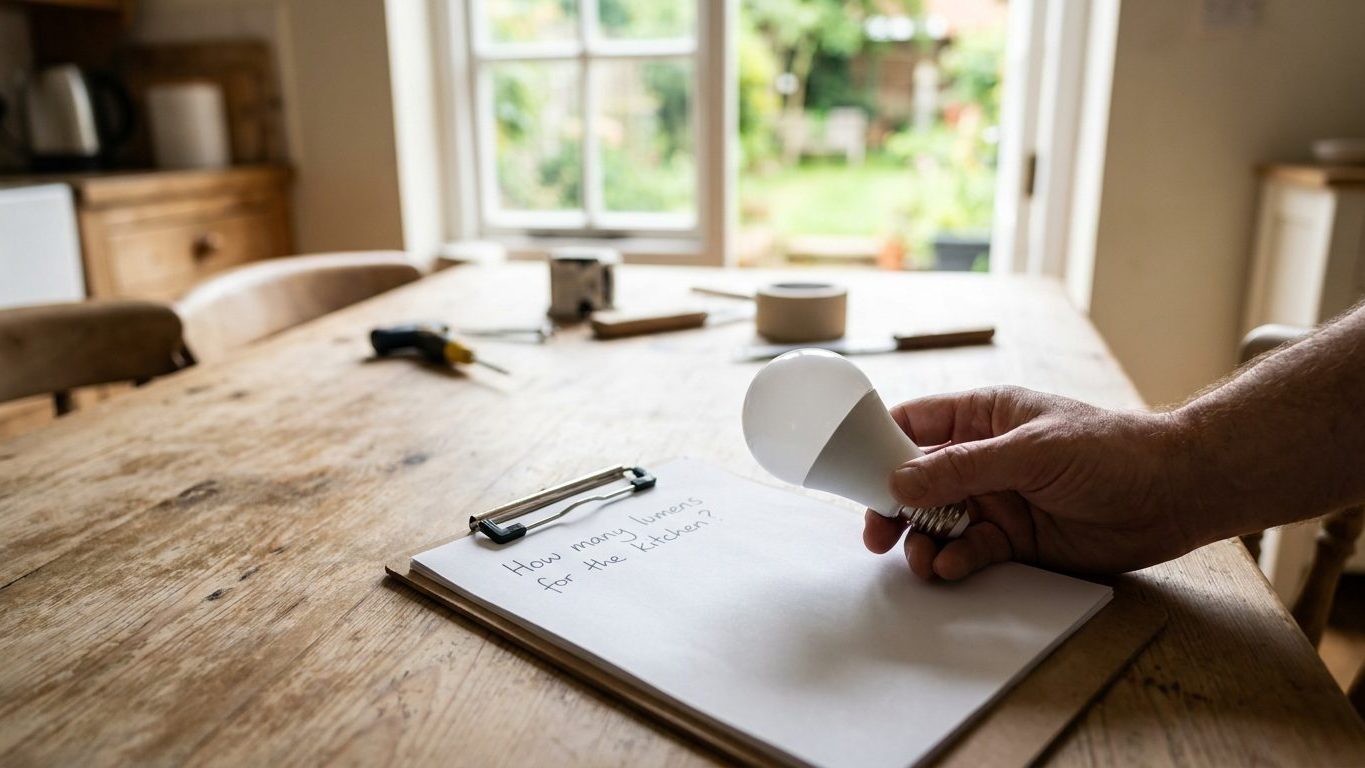

Picture the counter where you actually cook, the strip of laminate or stone under the upper cabinets where you cut vegetables and read the numbers on a recipe card. That surface needs 30 to 40 lumens per square foot landing directly on it. Check the fixture nearest that counter first, because a ceiling light centered in the room almost never aims enough of its output at the six or eight square feet you’re actually working on.
The light level a work surface needs

A countertop where you’re chopping or reading a label needs 30 to 40 lumens per square foot, according to the IES RP-1 recommended practice from the Illuminating Engineering Society. That’s a professional recommendation, not a building code requirement, so no inspector is going to measure your countertop with a light meter and write you up for falling short. It’s the figure a lighting designer works from when laying out a kitchen, and it describes light measured at the surface itself, at counter level, not light measured at the floor or the total lumens printed on a bulb box.
That distinction matters because a single fixture’s rated output and the light that actually reaches your cutting board are two different numbers. A recessed can eight feet away and six feet off to the side is contributing very little to the 30 to 40 lumens per square foot your knife hand needs, even if the bulb inside it is bright. That’s the whole argument for under-cabinet strips: they put the light source twelve to eighteen inches from the surface instead of eight feet above it, so a much smaller lumen output does the job. Getting that placement right matters as much as the lumen count itself, and the guide to where to put under-cabinet lights so they don’t glare covers the mounting position that avoids a hot glare line on the backsplash.
The 30 to 40 lumens per square foot figure applies to countertops, the cooktop, and the sink, the surfaces where you’re doing something with your hands and need to see contrast and detail clearly. It is not the number for the middle of the kitchen floor, the inside of a pantry, or the top of a china cabinet. Those areas fall under a different figure entirely, which is where ambient lighting comes in.
Task and ambient are different jobs
General room lighting in a kitchen only needs 10 to 20 lumens per square foot, according to the same IES RP-1 recommended practice. That’s roughly a third to a half of what the work surfaces need, and the gap exists because the two kinds of light are bounding two different physical demands. Task lighting is bounded by what your eyes need to safely handle a knife, read a thermometer, or tell whether onions are browning or burning. Ambient lighting is bounded by something much less demanding: moving through the room without bumping into the island, finding the light switch, seeing well enough to have a conversation while someone else cooks.
Because those are different jobs with different lumen targets, the IES RP-1 recommended practice treats task, ambient and accent lighting as three separate layers on three separate switches, not one ceiling fixture doing all three at once. A single centered light, even a large or expensive one, is trying to hit two different targets with one tool. Turn it up enough to give the counter 30 to 40 lumens per square foot and the rest of the room is overlit and glary. Turn it down to a comfortable 10 to 20 lumens per square foot for the room and the counter is short of what a knife or a mandoline needs.
Splitting the layers onto separate switches solves that without needing more total light, just better-aimed light. The under-cabinet strip or puck lights handle the task layer, aimed straight down onto the counter from close range. Recessed cans or a flush ceiling fixture spread out over the whole room handle the ambient layer, set for comfort rather than precision. A third layer, accent lighting inside glass-front cabinets or above the range hood, is optional and does neither job, it just adds visual interest. None of this is a code requirement anywhere. It’s a design recommendation from a professional body, and you can wire a kitchen with one switch for everything if you want to, you’ll just be fighting the physics of trying to serve two lumen targets from one source.
Color temperature, and the kitchen that feels like an office
Color temperature changes how bright the same lumen count feels, and the IES RP-1 recommended practice draws the line at a specific number. Light in the 2700 to 3000 K range reads as warm, the same tone as an incandescent bulb or candlelight. Push the same fixture above 4000 K and the kitchen starts to read as a workplace instead of a room you eat breakfast in, even if the lumens per square foot haven’t changed at all. It’s the same wattage, the same coverage, but a different color rendering that most people associate with hospitals, offices and big-box stores rather than a home.
This is a design guideline, not a rule enforced by anyone. There’s no permit office checking the Kelvin rating of your under-cabinet strip, and the IES RP-1 recommended practice is a professional reference, not a law adopted by any city or county. Nothing stops you from lighting your whole kitchen at 5000 K, plenty of people do it deliberately because they want maximum clarity for close work like reading recipes or checking meat temperatures. What the IES figures tell you is what the tradeoff looks like: crisper detail at the higher end, a warmer and more residential feel at the lower end.
If you’re mixing fixtures from different rooms or different eras of a renovation, check the color temperature printed on the packaging or spec sheet before you buy, because a 2700 K under-cabinet strip next to a 4000 K recessed can will look mismatched even though both are working correctly. There’s no code section to point to on this one, so the spec sheet is the authority to check, not a local ordinance.
Working out the lumens a room already has

You can get a rough sense of whether a kitchen is under-lit without hiring anyone, using a light meter or a phone app that reads lux or foot-candles. Take the reading at counter height, held flat and facing up, not aimed at the fixture and not held at your own eye level, since either of those will give you a number that has nothing to do with what’s actually landing on the work surface.
Steps to check a kitchen’s existing light
- Do it at night with the fixtures on and no daylight coming through the windows, since daylight will swamp the reading and tell you nothing about your evening lighting.
- Take the reading directly over the cutting board or cooktop, not the center of the room.
- Hold the meter flat, facing the ceiling, not tilted toward the brightest bulb in the room.
- Take two or three readings along a counter run and average them, since output drops off fast a foot or two from a downlight.
- Check which unit the meter reports, since most inexpensive meters and apps default to lux, and one foot-candle equals roughly 10.76 lux.
The most common measuring mistake is standing over the meter with your own body blocking the fixture above it, which reads artificially low. The second most common one is measuring with a phone flashlight or a nearby lamp still on, which inflates the number. Neither of those tells you anything real about your ambient or task lighting, so clear your own shadow off the counter before you take the reading, and turn off anything you’re not testing.
None of this tells you whether your kitchen meets any code, because there isn’t one governing residential lumens per square foot. What it gives you is a number you can compare against the IES RP-1 figures of 30 to 40 lumens per square foot for task areas and 10 to 20 for ambient, so you know which layer, if either, is falling short.
The single ceiling fixture that lights nothing useful
A kitchen with one centered ceiling fixture and nothing else usually looks fine to a real estate photographer and feels wrong to the person cutting vegetables at 6 p.m. The light source is too far from the counter and too far to the side, so your own head and shoulders cast a shadow across the cutting board exactly where the knife is doing its work. There’s no inspection that catches this, since lumens per square foot is a design recommendation, not a code requirement anywhere, so a kitchen can pass every electrical inspection in the county and still be genuinely hard to cook in.
Over years, that gap shows up as small accidents and bigger renovation regret: a nicked finger because you couldn’t see the cut line clearly, food that scorches because the color on the pan was hard to judge under dim yellow light, buyers who walk through a listing photo taken in bright daylight and then find the kitchen gloomy the first night they cook dinner in it. The fix almost always involves adding a task layer under the upper cabinets and putting it on its own switch, which is a smaller project than most people expect since it doesn’t touch the existing ceiling fixture at all.
If you’re planning that addition alongside other kitchen changes, get a licensed electrician or a kitchen designer involved for the wiring and switch layout, and check any range hood you’re installing at the same time separately, since the hood’s own light and its CFM rating for ventilation are sized against the cooktop’s BTU output, not against the room’s lumens at all.
Common questions
How many lumens do I need for the whole kitchen, not just the counters?
Multiply the IES RP-1 ambient figure of 10 to 20 lumens per square foot by the square footage of the room for the general layer, then multiply the 30 to 40 lumens per square foot task figure by the square footage of your actual counters and cooktop for that layer. The two totals aren’t meant to be added into one fixture, since they’re separate layers on separate switches.
Are lumens and watts the same thing?
No. Watts measure the electricity a bulb draws, and lumens measure the light it actually puts out. Two bulbs can share a wattage and put out very different lumens, which is why the lumens figure printed on the packaging is the one to check against the IES targets, not the wattage.
Does a warmer color temperature mean the kitchen will look dimmer?
It can look that way even at the same lumen count, since the IES RP-1 guidance notes that light in the 2700 to 3000 K range reads as warm and cozy while anything above 4000 K reads sharper and more clinical. If a kitchen feels dim after a fixture swap, check the Kelvin rating before assuming the lumens dropped.
Do I legally have to put task and ambient lighting on separate switches?
No. Separate switching for task, ambient and accent layers is a recommendation from the IES RP-1 recommended practice, not a legal requirement enforced by any code body. You can wire a kitchen however you like, the separate switches just make it possible to actually hit both lumen targets at once instead of compromising between them.