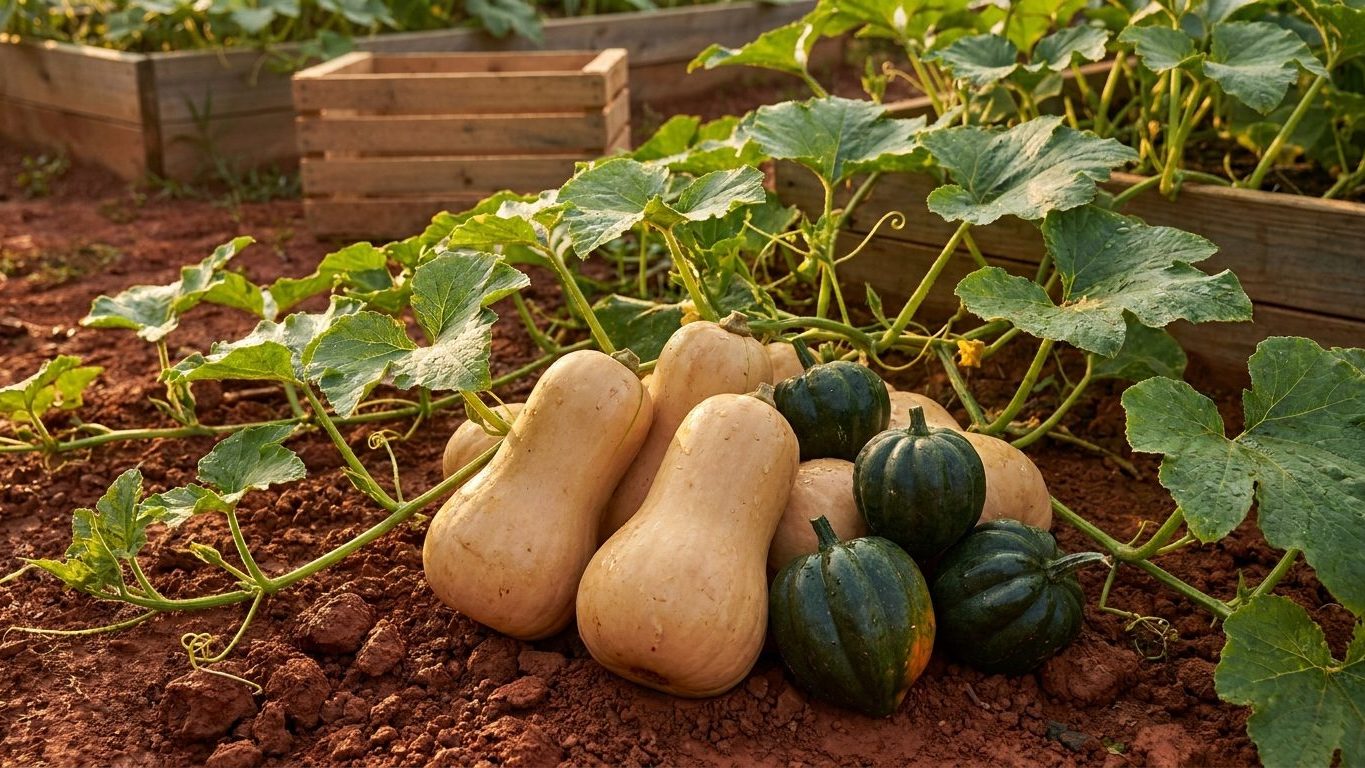

The frost-free window here runs roughly 138 to 158 days depending on where you sit and how the season breaks. That number, not a seed catalog’s “hardiness rating,” is what decides which winter squash actually finish before the vines get hit. Short-season bush types like acorn, delicata and spaghetti squash fit comfortably. Long-season vining types, especially big Hubbard and banana squash, are a gamble most South Dakota gardens lose.
The short answer for South Dakota
Start with the math, because it’s the whole decision. Last spring frost at the reference station (Sioux Falls, station USW00014944) runs April 29 to May 9. First fall frost runs September 24 to October 4. Take the worst-case pairing, a late spring frost on May 9 and an early fall frost on September 24, and you get 138 days of usable growing season. Take the best-case pairing and you get 158 days. Neither number is a promise for your yard specifically, but it’s the range every variety choice has to survive.
Winter squash also needs a few extra days after “days to maturity” to cure on the vine before a hard freeze forces harvest. That effectively shaves 7 to 10 days off whatever window you’re working with. So a squash rated at 100 days needs closer to 110 in the ground to reliably harden its rind.
That math points toward types, not specific brand names:
| Squash type | Typical days to maturity | Fit for South Dakota’s window |
|---|---|---|
| Acorn | 75-85 days | Comfortable fit, wide margin |
| Delicata | 80-100 days | Comfortable fit |
| Spaghetti | 88-100 days | Comfortable fit |
| Short-season butternut | 95-110 days | Fits, but with less margin |
| Buttercup / kabocha | 95-105 days | Fits, less margin |
| Hubbard (large) | 110-120+ days | Tight to failing, especially on a late spring |
Days above 90°F run 13.8 a year on average here, which is moderate heat, not desert heat. That matters for the decision too: it’s not that the state is too hot for winter squash, it’s that the growing season is short enough that a slow-maturing variety simply runs out of calendar before it runs into trouble from heat stress.
What will not work here
Giant Hubbard squash and other 110-to-120-day vining types are the clearest failure case. Even under the best-case frost pairing (158 days), a 120-day variety leaves only about a month of slack for a cool spring, a slow germination, or an early fall cold snap, none of which are rare here. Under the worst-case pairing (138 days), that slack disappears entirely. This isn’t a matter of taste. It’s arithmetic that repeats every season the spring frost lands anywhere near May 9.
Direct-seeding tender squash too early fails for a different reason. Squash seed wants warm soil, and a gardener trying to claw back growing days by planting in mid-April, ahead of that April 29 to May 9 frost window, risks losing the whole planting to a late freeze rather than gaining anything.
Water-hungry, large-leaved vining types also struggle here, not from lack of rain exactly, but from timing. Summer rainfall averages about 10.8 inches across June, July and August, with July, the peak fruiting month for most winter squash, running driest at 3.25 inches. Combine that dry stretch with 13.8 days a year at or above 90°F and a squash variety that wants consistently moist soil, rather than the “deep soak once a week” pattern acorn and delicata tolerate, will show stress right when it should be sizing fruit. This hits hardest on sandy soil, where July’s already-thin rainfall drains through in a day rather than holding a week the way clay does.
Tight spacing on the biggest-leaved vining types (again, Hubbard is the repeat offender) also raises foliar disease risk when the season’s rain arrives as thunderstorms rather than steady drizzle. Wide spacing and good airflow matter more here than in a garden with steadier, gentler summer rain.
What changes across South Dakota
USDA hardiness zones across the state span 3b to 5b, a wide range for one state, and that spread means there’s no single frost calendar that covers South Dakota edge to edge. The 3b-to-5b range (USDA Plant Hardiness Zone Map, 2023, built on 1991-2020 normals) is based on average annual extreme minimum winter temperature, not on summer length directly, but the two track together here: the colder zones tend to sit at higher elevation or further from the moderating effect of the state’s larger rivers, and those same areas typically see later spring frosts and earlier fall ones than the Sioux Falls reference station used in these figures.
A gardener in the colder end of that range should treat the 138-day worst-case window as optimistic, not conservative, and lean harder toward the shortest-season types: acorn, delicata and spaghetti, started as transplants rather than direct-seeded, to buy back two or three weeks of maturity time.
A gardener toward the warmer end of the range, closer to the reference station’s own numbers, has more room to try short-season butternut or buttercup varieties, and even a Hubbard type if row cover or plastic mulch is used to push the effective planting date earlier.
Your own garden’s end of that range is a local question. That’s a job for the official USDA Plant Hardiness Zone Map, checked by ZIP code, not for a state-level average.
Where to check this for your own county
Everything above is a state-level starting point, built from one reference station’s normals. Your county can and often does differ from it by a week or two on both ends of the season, and sometimes by more if you’re at elevation or in a river valley. That gap is exactly why South Dakota State University Extension exists, and it’s the next stop.
Two things are worth looking for specifically once you’re there. First, a local planting calendar for your county or region, which will adjust the state’s frost-date range to something closer to your actual conditions. Second, variety trial results for winter squash, since SDSU Extension and county offices periodically test specific cultivars under South Dakota conditions and publish which ones sized and cured reliably in a given area, information no seed catalog can give you because it hasn’t been tested against your soil, your elevation, or your microclimate.
A county-level recommendation will always beat a state-level one, for the simple reason that it’s measuring something closer to your actual garden.
Checking this against your own garden
Every frost date is a probability, not a guarantee, and your own garden will tell you more than any calendar once the season starts. Three things are worth watching directly.
Soil warmth by feel is the first. Winter squash seed germinates poorly in cold soil no matter what the calendar says, so if the ground still feels cool and damp rather than dry and faintly warm on top when you dig down a couple inches, wait, even if you’re past the average last frost date.
The first flush of male flowers is the second. Squash plants typically throw male flowers before female ones, and that first flush is a signal the plant has shifted from vegetative growth into reproductive mode, useful for judging whether a variety is tracking normally against your expected harvest date or running behind.
The appearance of true leaves, the second set that looks like an actual squash leaf rather than the rounded seed leaves, is the third. How fast that set shows up after germination is a rough read on how favorable your particular spot, sun exposure and soil are running that year compared to an average season, which matters more for your own timing decisions than any station-wide normal.