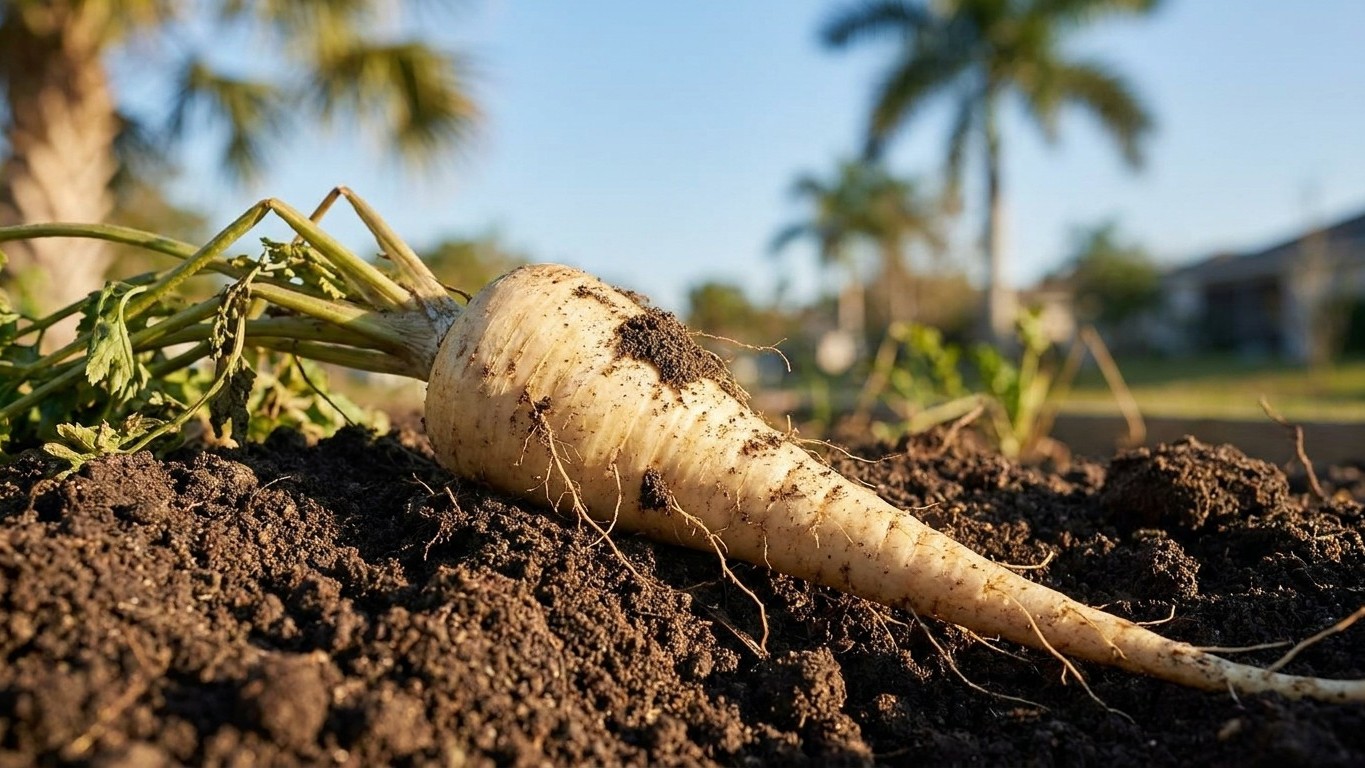

University of Minnesota Extension documents ten pests common to home vegetable gardens across the state, but only one of them, Japanese beetle, has a diet broad enough to reach parsnip foliage at all. The other nine target cabbage, onions, squash, or potatoes and never show up on a parsnip bed. Timing follows the state’s frost-free window: April 17 to April 30 for the last spring freeze and October 11 to October 23 for the first fall freeze in the Twin Cities, with a tighter window farther north.
Which pests attack parsnip in Minnesota
University of Minnesota Extension lists ten insect pests it documents for home gardens in the state: cabbage maggot (Delia radicum), Colorado potato beetle, Japanese beetle (Popillia japonica), onion maggot (Delia antiqua), spotted wing drosophila (Drosophila suzukii), squash bug, squash vine borer, striped cucumber beetle, swede midge, and three-lined potato beetle. That’s the full list, and this site names nothing beyond it.
Run down that list against what a parsnip actually offers a hungry insect, and nine of the ten have no business in that bed. Cabbage maggot and swede midge feed on brassica roots and stems, not the carrot-family root a parsnip grows. Onion maggot needs an allium to survive; a parsnip isn’t one. Colorado potato beetle and three-lined potato beetle are built around nightshades like potato and tomato. Squash bug, squash vine borer, and striped cucumber beetle are cucurbit specialists that won’t cross over to a root vegetable. Spotted wing drosophila lays eggs in soft, ripening fruit, which a parsnip never produces.
That leaves exactly one species on the documented list broad enough in diet to plausibly land on parsnip: Japanese beetle. It’s a generalist feeder known for skeletonizing leaves on a wide range of garden plants, and parsnip foliage isn’t automatically exempt from that habit. It isn’t a parsnip specialist the way it’s a rose or grape specialist, but it’s the only name on this list that isn’t ruled out by diet alone.
That’s a short answer, and it should stay short. University of Minnesota Extension simply doesn’t document a long roster of dedicated parsnip pests for this state the way it does for cabbage or squash. If a gardener sees serious root damage on parsnip, the more useful move is checking with the local extension office rather than assuming one of these nine unrelated insects is responsible.
When each one shows up, and what it does first
Parsnip seed goes into the ground directly, not as a transplant, and Utah State University Extension notes it’s typically sown two to three weeks before the last frost. In the Twin Cities that means working toward a late April sowing window tied to the April 17 to April 30 last-frost range; farther north in Minnesota, growers should plan two to three weeks earlier on both ends of the season. Germination itself takes 14 to 21 days, which matters more than any pest timeline early on, since a bare row at day ten is normal, not a failure.
Once true leaves appear and the canopy starts filling in, that’s the stage where a foliage generalist like Japanese beetle becomes relevant. There’s no published date in the state’s frost data for when adult beetles start foraging, so the honest guide is growth stage, not a calendar month: thin, young foliage in the weeks right after germination has little to offer a beetle looking for a full meal, while a fuller canopy later in the frost-free stretch is a more attractive target. What shows up first, if it shows up at all, is small, ragged, or skeletonized patches on leaflets rather than any damage to the root itself, since Japanese beetle feeds above ground.
Because parsnip runs 100 to 120 days from seeding to harvest, and the crop is often left in the ground deliberately until after several hard frosts to let the roots sweeten, the growing season stretches close to that October 11 to October 23 first-frost window. Foliage feeding that happens early, while the plant still has months of root development ahead, matters more than the same feeding late in the season when the root has already sized up and the leaves are winding down anyway.
Telling the damage apart from everything else
A lot of what gets blamed on insects in a parsnip bed isn’t insect damage at all. A row that looks empty at three weeks is usually still inside the normal 14- to 21-day germination window, not a sign that something ate the seed. Digging up bare soil to check often does more harm than any pest would.
Forked or misshapen roots are the other common source of confusion, and there are two separate explanations worth keeping apart rather than merging into one vague answer.
| Symptom | Likely cause | What distinguishes it |
|---|---|---|
| Forked, split roots | Heavy or stony soil | Roots hit resistance and branch around it; soil feels dense or full of debris when dug |
| Forked, soft roots | Overwatering | Soil stays saturated; roots may also show rot or a spongy texture, unrelated to soil texture |
| Ragged, skeletonized leaves | Japanese beetle feeding | Visible beetles present, damage concentrated on leaf tissue between veins |
| Torn or bruised leaves, no beetles | Mechanical or weather damage | Hail, tool contact, or wind tends to tear rather than skeletonize |
| Pale, small roots at harvest | Not enough frost exposure | Foliage looks healthy; the root simply hasn’t converted starch to sugar yet |
None of this is a substitute for an actual diagnosis. A county extension office can look at a sample and say what’s really going on; guessing from a description usually just adds a second wrong assumption on top of the first.
What actually works here, and what is a waste of time
The one thing that consistently pays off against Japanese beetle on a small planting is a physical barrier, put on before the beetles arrive in numbers rather than after damage is already visible. Lightweight row cover over young parsnip foliage keeps adult beetles off the leaves entirely, and on a crop with a 100- to 120-day season, protecting the canopy early matters more than treating it later once the plant is already established and less vulnerable to a little leaf loss.
Handpicking is a reasonable second option for a home garden, since Japanese beetle is large, slow, and easy to see and knock into a container of soapy water in the early morning when the beetles are sluggish. It won’t eliminate a population moving through from neighboring yards, but it keeps pressure off a small planting without any product involved.
What’s a waste of time is treating a parsnip bed for the other nine pests on the documented list. Spraying or baiting for cabbage maggot, squash vine borer, or onion maggot in a parsnip row addresses insects that were never going to be there, since those species need a brassica, cucurbit, or allium host to complete their life cycle. It also does nothing for the forked-root problems that are actually about soil texture and watering, not insects at all; the fix there is working deep, sandy soil or double-digging a heavy bed, not any pest control step.
Beyond that, this site doesn’t name specific products, active ingredients, or rates. What’s registered for use in Minnesota changes, and the county extension office is the source that knows current label rules for a given situation.
Where to check this for your own county
University of Minnesota Extension is the source for everything documented on this page, and it’s also the right place to go for anything specific to one yard. Its county extension offices handle sample diagnosis and can confirm whether a given garden’s damage matches Japanese beetle, one of the nine unrelated species, or something not on the state’s documented list at all.
Statewide documentation doesn’t mean even distribution. A pest recorded for Minnesota as a whole can be common in one county and rare or absent in another, depending on nearby host plants, soil, and local weather patterns. The frost dates that shape this whole calendar also shift by two to three weeks between the Twin Cities and northern Minnesota, so a sowing or harvest date that works in the metro area can be too early or too late a few hours north.
Anyone seeing unexplained damage on parsnip foliage or roots gets more from a call or sample drop-off to the local extension office than from matching symptoms to a list online. That office can also confirm current guidance for a specific county, which is the level this page can’t reach.
Common questions
Does Japanese beetle actually damage parsnip roots?
No. Japanese beetle feeds on foliage, skeletonizing leaves between the veins. It doesn’t tunnel into or feed on the root itself, so root damage points to a different cause, most often soil conditions rather than an insect.
Why isn’t carrot rust fly on this list if parsnip is a root crop?
This page only names pests University of Minnesota Extension documents for the state. Carrot rust fly isn’t on that documented list here, so naming it would be adding a species this source doesn’t confirm for Minnesota.
My parsnip seedlings haven’t come up after two weeks. Is something eating the seed?
Not necessarily. Parsnip seed takes 14 to 21 days to germinate under normal conditions. A bare row at two weeks is still inside that window, not evidence of a pest.
Why did my parsnips taste bland even though the plants looked healthy all season?
Sweetness comes from exposure to several weeks of frosty weather, which converts stored starch to sugar. A plant can look completely healthy and still taste bland if it was harvested before that frost exposure happened, regardless of pest pressure.