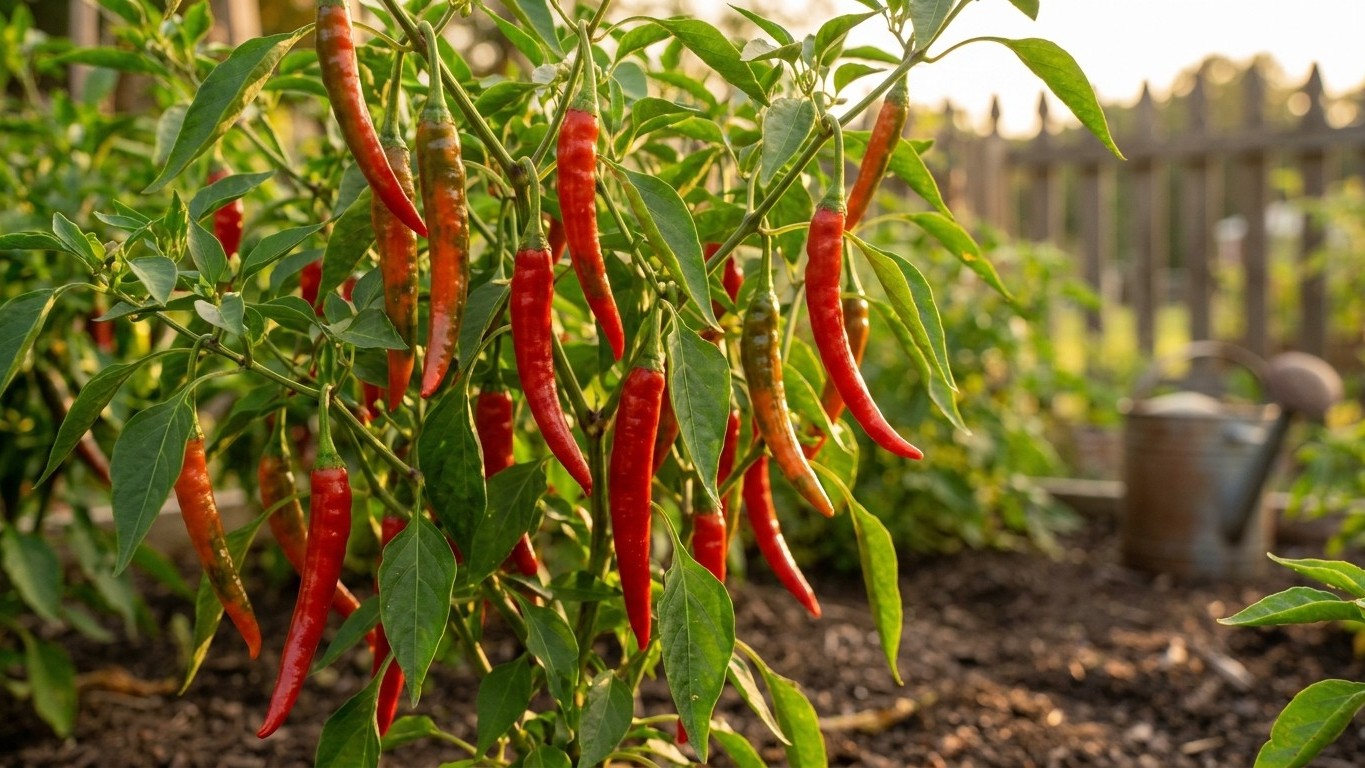

Start pepper seed indoors 8 to 10 weeks before you plan to transplant, and don’t transplant until both the frost risk has passed and the soil has warmed to 60°F. In the Atlanta area, that lands seed-starting in the second half of January. Farther north, in the mountains, push it back a week or two. On the coastal plain, you can often move a week earlier.
The short answer
Georgia averages 35.8 days a year at or above 90°F, based on NOAA NCEI Climate Normals for 1991-2020 at the Atlanta reference station. That’s not a trivia number. Pepper fruit set collapses once daytime highs push past 90°F for any stretch, according to Utah State University Extension. The flowers may still open, but pollen turns sterile in the heat and the plant drops blossoms instead of setting fruit. With close to five and a half weeks of that heat baked into a typical Georgia summer, a pepper crop that goes in the ground too late, or that hits its peak bloom window during a July heat spike, can sit there looking healthy while producing almost nothing.
Now the other end of the range, and it matters just as much: pepper fruit set also fails when nights drop below 55°F, per that same Utah State Extension guidance. This is where a lot of Georgia gardeners get tripped up, because the state’s spring nights can swing wildly. A transplant set out in an early warm spell can sit through a cold snap two weeks later and lose its first flush of blooms before you even notice.
Here’s the catch this site has to be honest about: it tracks daytime heat, specifically that 90°F threshold, but it does not carry summer night-minimum data for Georgia or any other state. There’s no reliable shortcut here, either. You can’t infer how cold your nights run just because you know your latitude, and you can’t use the coldest month of the year as a stand-in for a warm-season overnight low. Those are two different climate variables that don’t move together. If you want to know whether your nights are holding above 55°F in late spring, that means watching an actual thermometer at your own property, or checking recent local weather history for your county, not guessing from a map.
Put those two thresholds together and Georgia’s pepper window is genuinely narrow: too cold in early spring, too hot by midsummer, with a reasonably comfortable stretch in between where fruit set actually happens. Timing your seed start correctly is what gets your plants flowering inside that window instead of on either side of it.
When to start seed here
The math isn’t complicated once you have the two anchor points. Work backward from your transplant date, not forward from an arbitrary calendar date, and the schedule falls into place.
- Find your last spring frost window. For the Atlanta reference station (USW00013874), NOAA’s 1991-2020 Climate Normals put the 30 to 70 percent probability band for a 32°F freeze between March 11 and March 29. That’s a range, not a single date, because freeze risk fades gradually rather than stopping on a specific day. Atlanta itself is an urban heat island sitting at a busy airport, so treat this as a starting reference, not a universal Georgia date.
- Adjust for where you actually garden. North Georgia and the mountain counties typically see their last frost run several weeks later than the Atlanta reference point, and their first fall frost arrives correspondingly earlier. The coastal plain in south Georgia trends milder and often clears frost risk earlier in spring. If you’re outside the metro Atlanta area, shift the window accordingly rather than using the Atlanta dates as-is.
- Wait for 60°F soil, not just a frost-free date. Utah State University Extension is specific on this: transplant peppers only after frost danger has passed and soil temperature has reached 60°F. A calendar date without a soil check can lead you to transplant into ground that’s still too cold, which stalls root growth even if the air feels warm enough.
- Count back 8 to 10 weeks for indoor sowing. If your realistic transplant date lands around the tail end of your frost window, say roughly the last week of March to early April for much of the Piedmont, then indoor seed-starting falls in the range of mid-to-late January. Gardeners in the mountains starting later should push their seed date back correspondingly; those on the coastal plain starting earlier can move theirs up.
- Build in slack for germination lag. Pepper seed germinates slowly compared to many garden vegetables, and cool room temperatures can stretch that further. Starting at the early edge of the 8 to 10 week window, rather than the late edge, gives you a buffer if germination runs slow or a late cold snap pushes your transplant date back.
Redo this arithmetic with your own county’s frost data rather than borrowing the Atlanta numbers wholesale. A gardener in the north Georgia mountains and one on the coastal plain can reasonably be five or six weeks apart on both ends of this schedule, even though they’re in the same state.
What goes wrong here
- Blossom drop during a summer hot spell. Once daytime highs push past 90°F, a threshold Georgia hits an average of 35.8 days a year, pepper flowers often abort before they set fruit. There’s no fix that keeps peppers producing straight through a heat spike, but 30 to 40 percent shade cloth over the plants during the hottest afternoon hours can reduce blossom loss, and keeping soil moisture consistent helps the plant tolerate the stress better than a plant already running dry.
- Blossom drop from a cool night. The flip side: nights under 55°F cause the same failure, flowers open but don’t set fruit. Since this site doesn’t track summer night lows for Georgia, watch your own nighttime temperatures in early spring rather than assuming an early warm stretch means it’s safe. If a cold night is forecast after you’ve already transplanted, a floating row cover pulled over the plants overnight protects the blooms already forming.
- Sunscald on exposed fruit. Georgia’s summer sun is strong enough that peppers left uncovered by foliage, especially after aggressive pruning or leaf loss from disease, can develop pale, papery patches on the side facing direct sun. Avoid heavy pruning during peak summer, and if a plant has thin foliage cover, shade cloth over the row protects the fruit as much as the flowers.
- Blossom-end rot on the fruit itself. This shows up as a sunken, dark leathery patch on the bottom of the pepper, and it traces back to inconsistent water delivery rather than a soil calcium shortage in most home gardens. Erratic watering, heavy rain followed by a dry stretch, is common in Georgia summers and disrupts the plant’s ability to move calcium to developing fruit. A regular watering schedule with mulch to even out soil moisture is the practical fix.
Common questions
Can I skip starting seed indoors and just sow peppers directly in the garden?
It’s not the practical route in Georgia. Peppers need 8 to 10 weeks of indoor growth before they’re ready to transplant, and direct-sown seed outdoors would need soil already at 60°F with the growing season still long enough left to reach maturity before fall frost. Starting indoors and transplanting is the standard approach for a reason: it front-loads the growth that Georgia’s compressed frost-free window can’t otherwise accommodate.
How long after transplanting will my peppers be ready to pick?
Clemson Cooperative Extension puts pepper harvest at roughly 70 to 85 days after transplanting. Combine that with your local transplant date, worked out from your frost window and soil temperature, to estimate when the first peppers will actually be ready.
What’s the right way to store peppers after harvest?
Clemson Extension recommends 45 to 50°F with 80 to 90 percent relative humidity, which can hold peppers for two to three weeks under optimal conditions. That’s warmer than a standard refrigerator, which typically runs closer to 35 to 40°F. Peppers stored at those colder fridge temperatures develop pitting and soften from chilling injury, so a fridge isn’t actually the ideal spot if you have a cooler location, like a root cellar or a basement space, that runs closer to that 45 to 50°F range.
Does the pepper schedule really differ that much between north and south Georgia?
Yes, and it’s worth taking seriously rather than treating Georgia as one climate zone. The Atlanta reference frost window of March 11 to March 29 doesn’t hold for the whole state: north Georgia and the mountain counties see frost linger measurably later into spring and arrive measurably earlier in fall, while the coastal plain tends to clear frost risk sooner. Build your seed-starting and transplant schedule from your own county’s frost history rather than defaulting to the Atlanta dates.