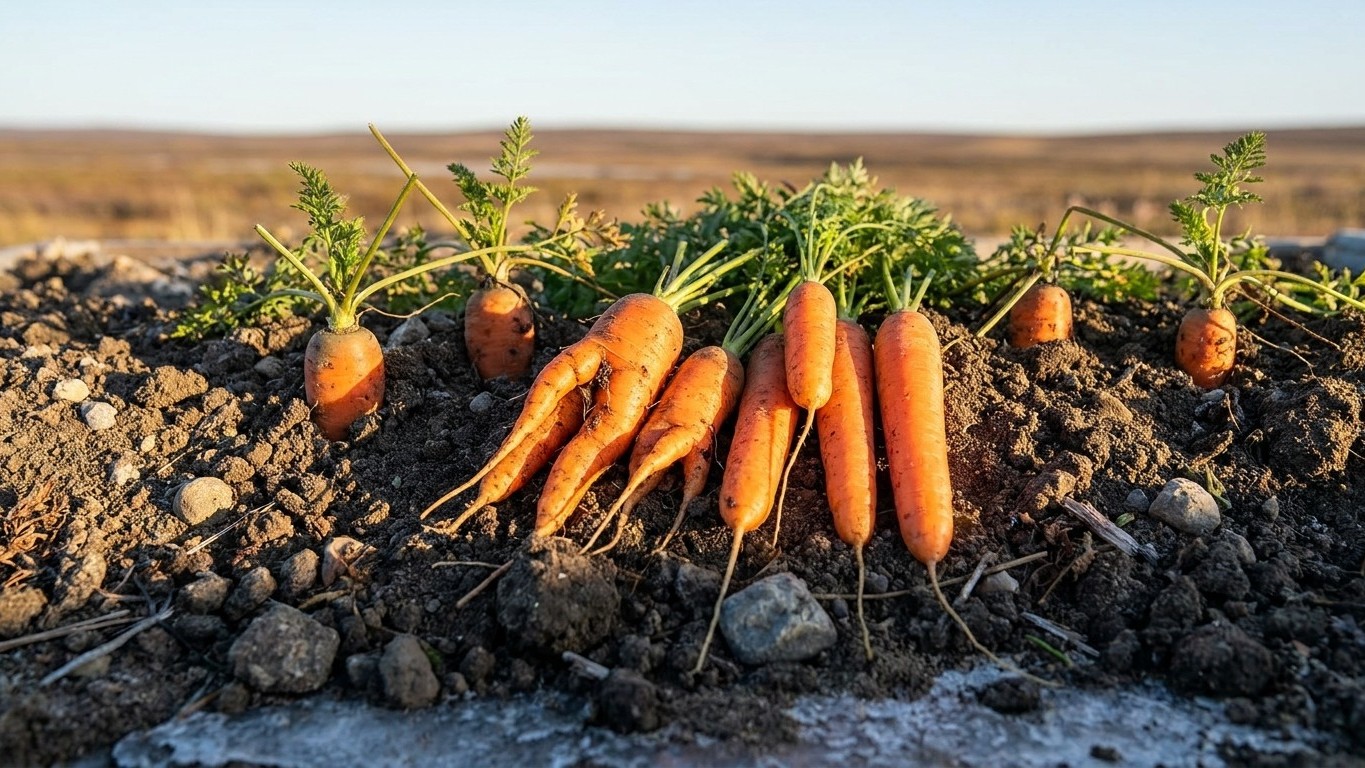

No single published list names which insects feed on carrots across Montana. The soil and storage facts on record for this page explain more about carrot damage here than a pest inventory would: a root that forks, splits, or rots is far more often a soil problem than an insect problem. Confirming an actual pest, and its timing, means calling the county extension office, because presence changes from valley to valley across the state.
Which pests attack carrot in Montana
Search for a Montana-specific list of carrot-eating insects and none is attached to the verified sources behind this page. That gap is worth taking seriously rather than filling with guesswork. Pest presence in a state that stretches from the high plains around Glasgow to mountain valleys near Missoula does not sit still long enough for one statewide list to mean much anyway. What travels with a gardener from county to county is the ground itself, and that is where the record for Montana actually starts.
Montana’s official state soil is the Scobey series, a Mollisol, the same family of deep, dark prairie ground that built the Corn Belt farther east. On paper it looks like decent growing dirt: surface pH near 7.0, organic matter around 2.0 percent, well drained. The texture tells a different story for a root crop. The surface horizon runs 35 percent sand, 31 percent clay and 34 percent silt, a clay load that matters more to a carrot than to almost anything else in the garden.
Carrots, according to Utah State University Extension, want deep, sandy, well-drained soil rich in organic matter. Heavy or rocky ground does not stop a carrot from growing. It stops the root from growing straight. The extension service is blunt about the result: heavy soil makes the root fork, and the fix is compost worked in or double digging the bed, not a different variety.
That mechanism explains a good share of what Montana gardeners report as something eating their carrots. A forked, stubby, or split root pulled at harvest looks like insect damage to someone who has never grown a carrot in loose, sandy ground. It is not the same problem, and it does not call for the same fix. Before blaming an insect for a misshapen root, the soil under it deserves a look first, since the Scobey series describes the state’s representative ground, not any one backyard.
None of this rules out insects entirely. It means the verified record for this page carries no named species list for Montana, and inventing one to answer the title’s question would be exactly what a gardener should not do: guessing at a cause instead of checking it.
When each one shows up, and what it does first
Carrots are sown directly into the bed. There is no transplant date to count from, because moving a carrot root after it starts forming is part of what causes the forking described above. Every stage below counts from the day seed goes into the ground.
In the first weeks after seeding, before a carrot has any root to speak of, trouble shows up as germination failure: patchy rows, seedlings pushing through unevenly, or spots that never come up at all. On ground like the Scobey type that represents Montana on paper, this often traces to a surface that crusts after rain over that 31 percent clay share, sealing the top before a thin seedling can break through. That is a soil and moisture issue, not a feeding issue, and it happens before any insect would find a carrot worth visiting.
Through the middle of the season, while the root thickens underground, damage sets in ways a gardener cannot see yet. A root growing into compacted or rocky ground begins forking at this stage even though the foliage above looks normal. There is no visible warning. The first sign anyone gets is at harvest, when a root that should pull clean comes up split or branched instead.
Utah State University Extension ties carrot maturity to a range of 70 to 100 days from seeding, and Clemson Cooperative Extension puts a working harvest window at about 65 to 75 days after planting. Those day counts, not a calendar month, are the clock that matters, because a short Montana season shifts the whole timeline depending on when the ground was workable enough to seed.
What this page cannot do honestly is attach an insect’s arrival to that clock, since no pest-specific timing for Montana carrots is part of the verified record here. A gardener who wants to know when a particular insect becomes active in their county needs that answer from the local extension office, which tracks emergence with field reports a single state fact sheet does not carry.
Telling the damage apart from everything else
A misshapen or damaged carrot root gets blamed on insects more often than the evidence supports. Before treating for anything, it helps to rule out causes that have nothing to do with feeding.
Forking and stubbing come from heavy or rocky soil deflecting the taproot as it grows down. It shows up at harvest as a root split into two or three legs, or one that stops short and thickens instead of lengthening. The foliage looks fine beforehand, which is exactly why it gets mistaken for something that happened overnight underground. Cracking, where a mature root splits lengthwise, usually follows a swing in soil moisture, heavy rain after a dry spell, rather than a chewing insect. Pale or yellowing tops can point to a nutrient shortfall just as easily as to root damage below.
| Symptom | Likely cause | What distinguishes it |
|---|---|---|
| Root splits into two or three branches | Heavy or rocky soil deflecting the taproot | Foliage normal; damage only visible once pulled |
| Root splits lengthwise, top to bottom | Uneven soil moisture | Follows heavy rain after a dry stretch, not a feeding pattern |
| Patchy or missing germination | Crusted soil surface | Shows up within days of seeding, before roots exist |
| Chewed or tunneled root tissue | Possible insect feeding | Needs local confirmation; a state soil record cannot settle this |
That last row marks the honest limit of what a page like this can tell a reader. Real tunneling or chewing on a carrot root is a genuine possibility, and this page will not pretend otherwise. But confirming which insect caused it, and whether it is common enough in a given county to treat for, is not something a state soil record or a general fact sheet settles. That takes a sample and a local eye, not a guess from a description.
What actually works here, and what is a waste of time
On ground resembling Montana’s representative soil, that clay-heavy Scobey profile, the single most effective move is also the least exciting: work the bed deeper and looser before seed goes in, rather than reaching for a fix after the roots come up forked. Utah State University Extension frames the answer plainly for heavy ground: plenty of compost mixed in, or double digging the bed, not a different carrot variety.
A raised bed filled with a lighter, sandier mix accomplishes the same thing without reworking existing ground, and on a short season it warms up earlier in spring, which matters when every one of those 70 to 100 days from seeding counts.
What wastes time is treating a symptom before naming the cause. Applying anything to a bed because last year’s carrots came up forked will not straighten this year’s roots, because forking is a soil-structure problem, not a pest or a disease. Guessing at an insect treatment without a confirmed pest makes the same mistake in the other direction: a product applied against the wrong target, or at the wrong point in the season, protects nothing and teaches nothing for next year.
Storage deserves the same discipline. Clemson Cooperative Extension is specific that carrots hold at 33 °F with high humidity, and that bunched carrots with tops left on keep only about 10 to 14 days, because the leaves keep pulling moisture out of the root after harvest. Cutting the tops off before storage, and holding roots close to that temperature rather than a cooler-room temperature well above it, is the difference between carrots that last and carrots that go soft within a couple of weeks. No pesticide decision matters if the harvest is lost in the root cellar instead.
Where to check this for your own county
Montana covers prairie, mountain valleys, and high desert bench land, and a soil series or a pest observation documented for one part of that range does not automatically describe another. The Scobey series represents the state on paper; a garden in the Bitterroot Valley or up near Kalispell can sit on entirely different ground. That gap is exactly why a state-level page, including this one, cannot be the last word on what is actually feeding on a specific row of carrots.
The county office of Montana State University Extension is built for that last step, working at the scale where pest presence, soil variation, and local timing actually live. A county agent can look at a chewed or tunneled root sample, confirm whether a particular insect is active in that county this season, and say whether treatment is even warranted, questions a state fact sheet is not equipped to answer with certainty.
Before making that call, two things are worth having ready: a soil test result for the actual bed in question, since the Scobey figures here describe the state’s representative soil and not any one garden’s, and a sample or clear photo of the damaged root if an insect is suspected. Both turn a general question into a specific answer. Get the soil test done ahead of next season’s seeding rather than after a forked crop comes out of the ground, and bring the county office whatever went wrong last time.
Common questions
Does a forked carrot mean insects got to it?
Not usually. Forking traces to heavy or rocky soil deflecting the taproot as it grows, according to Utah State University Extension. Insect feeding leaves chewed or tunneled tissue, a different and less common symptom that needs local confirmation.
How many days does a carrot need before harvest in Montana?
Utah State University Extension gives a maturity range of 70 to 100 days from seeding, and Clemson Cooperative Extension puts a working harvest window at about 65 to 75 days after planting. Both counts run from seeding, since carrots are never transplanted.
What temperature keeps harvested carrots from going soft?
Clemson Cooperative Extension calls for storage at 33 °F with high humidity. Bunched carrots with tops still attached keep only about 10 to 14 days, because the leaves continue drawing moisture from the root.
Is Montana’s state soil a reliable guide to my own garden?
No. The Scobey series is the officially named representative soil for Montana, but it describes one mapped series among hundreds across the state. A soil test on the actual bed is the only way to know its pH and texture.