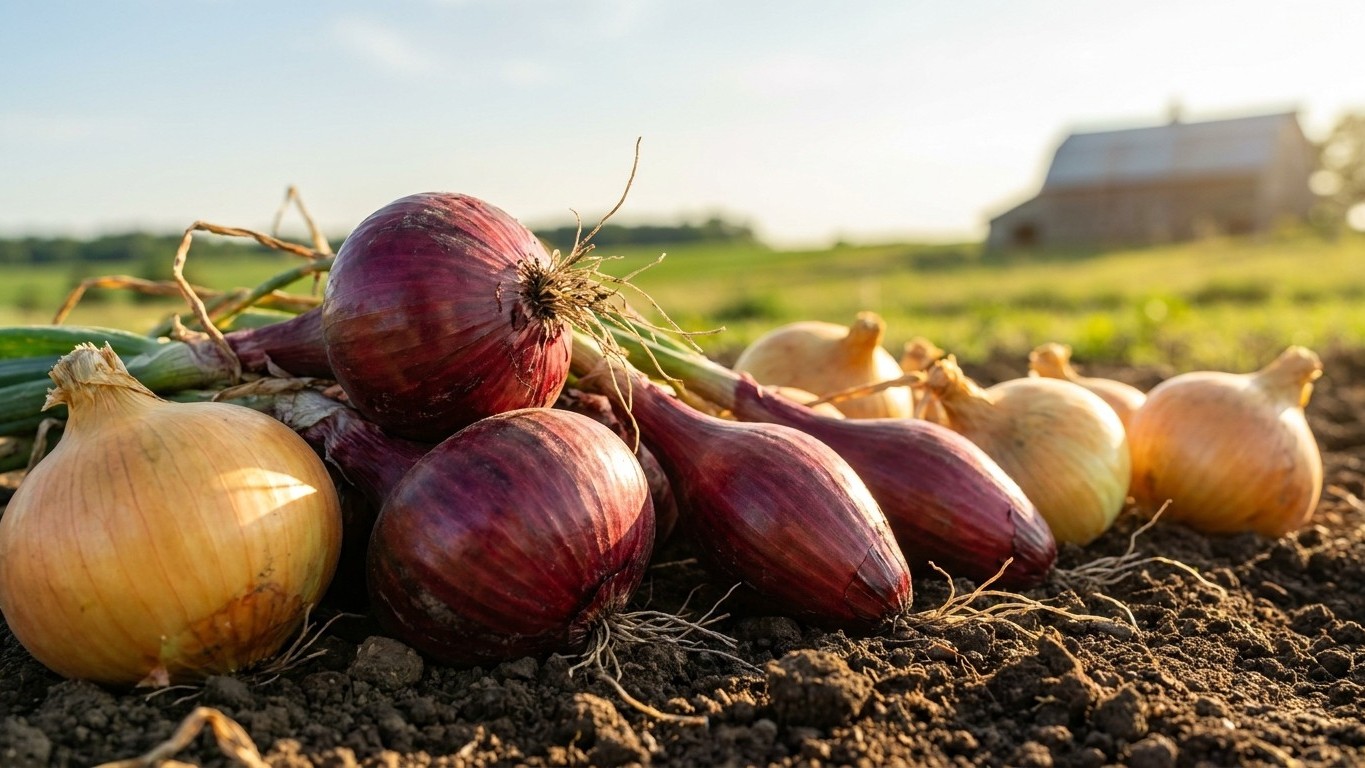

Seedcorn maggot (Delia platura) is the only pest documented for this region that actually targets onion, according to University of Maine Cooperative Extension, the nearest land-grant service with a published pest list for this growing region. Everything else on that list attacks trees, brassicas, cucurbits or fruit, not the onion patch. That narrow focus matters more than it sounds, because it tells you where to look and where not to waste time.
Which pests attack onion in Newfoundland and Labrador
University of Maine Cooperative Extension documents ten pests for this region: Browntail moth (Euproctis chrysorrhoea), Cabbage maggot, Colorado potato beetle, Emerald ash borer, Lily leaf beetle (Lilioceris lilii), Seedcorn maggot (Delia platura), Spotted wing drosophila, Squash vine borer, Striped cucumber beetle, and Winter moth. That is the full list for this territory on this site. No other species gets added here, and the list stays short because that is what the extension service actually records, not because coverage is incomplete.
Sorting out what doesn’t belong on an onion bed
Most of that list has nothing to do with onion. Browntail moth caterpillars feed on oak, apple, and other hardwood foliage, not on garden vegetables. Cabbage maggot larvae tunnel into the roots of cabbage, radish, and turnip, all brassicas with a completely different root chemistry than an allium. Colorado potato beetle strips potato and eggplant leaves and ignores onion foliage almost entirely. Emerald ash borer bores through the trunks of ash trees and never touches soil-grown crops. Lily leaf beetle is easy to confuse with an onion pest because of the name alone, but it feeds on true lilies (Lilium) and fritillaria, not on Allium species like onion, garlic, or leek. Spotted wing drosophila goes after soft-skinned fruit such as raspberries and cherries. Squash vine borer and striped cucumber beetle both stay on cucurbits, squash, pumpkin, cucumber, melon. Winter moth caterpillars defoliate trees and shrubs in early spring and skip vegetable beds altogether.
That leaves just one species from the documented list with any real business in an onion row: seedcorn maggot. Its larvae tunnel into germinating onion seed and into the base of young seedlings, which is a very different kind of damage than chewed leaves or bored stems. A gardener scanning for onion trouble in this region gets more value from watching soil conditions at planting time than from worrying about any of the tree or cucurbit pests on that same list.
When each one shows up, and what it does first
Seedcorn maggot activity tracks soil temperature and moisture rather than a calendar date, and in this coastal, cool-summer climate that means the risk window sits right at seeding, before the ground has had much chance to warm and dry out. Adult flies lay eggs in cool, damp, recently disturbed soil, especially where organic matter is still breaking down, and the larvae move straight into the seed or the base of the seedling stem. Delaying seeding until the soil has warmed and drained is the single decision that does more to limit damage than anything applied afterward.
The first signs, before you know what caused them
What shows up first is rarely a maggot. It is a gap in the row where a seed should have sprouted and did not, or a seedling that emerges, looks fine for a few days, then collapses at the soil line with no obvious chewing above ground. Because the larvae feed below the surface, on the seed itself or on the root and lower stem, the visible symptom lags behind the actual feeding by several days. A patchy stand with uneven emergence, rather than a uniformly thin one, is the pattern that points toward this pest rather than toward seed quality or a soil crust problem.
Onion’s own daylight-driven biology adds a wrinkle here. At this latitude the longest day of the year brings roughly 15 hours and 47 minutes of daylight, which sits inside the range that pushes long-day onion varieties to stop making leaves and start forming a bulb. That has nothing to do with seedcorn maggot directly, but it does mean that any seedling lost early in the season, to maggot damage or to anything else, has less time to build the leaf mass a bulb depends on before the daylight trigger arrives. A late replant in this region rarely catches up to a variety’s daylight requirement, which raises the cost of losing a stand early.
Telling the damage apart from everything else
Below-ground feeding is easy to blame on the wrong cause, because a collapsed seedling can mean insect damage, disease, a nutrient problem, or nothing more than a rough hoe pass. Pulling the affected seedling and checking the root and stem base before assuming a pest is involved settles more of these cases than any leaf symptom does.
| Symptom | Likely cause | What distinguishes it |
|---|---|---|
| Seed never emerges, gap in the row | Seedcorn maggot feeding on the germinating seed | Digging up the seed shows a hollowed-out or tunneled kernel |
| Seedling collapses at soil line, no chewing visible above ground | Seedcorn maggot larva at the stem base, or damping-off disease | A maggot-damaged stem shows a small tunnel or scar at the base; damping-off shows a soft, water-soaked, often discolored stem with no tunnel |
| Yellowing, pale leaf tips across the whole bed | Nitrogen shortage or waterlogged soil | Damage is uniform across the row rather than patchy plant to plant |
| Wilting despite normal moisture | Root disruption from cultivation or transplant shock | Roots show clean breaks rather than tunneling or discoloration |
None of this replaces an actual look at the plant in front of you. A local extension office can confirm what a photo or a written description cannot, and that step matters more for a below-ground pest like this one than it would for something visible on a leaf.
What actually works here, and what is a waste of time
On a growing season this short and this cool, timing beats any product applied after the fact. Waiting to seed until the soil has warmed and drains freely removes most of the conditions the adult fly needs to lay eggs successfully, and it costs nothing but patience. Working in a floating row cover at seeding, left on until seedlings are established, keeps the egg-laying adults off the row during the only window that matters. Rotating away from a bed that had heavy fresh organic matter worked in the previous fall also helps, since decomposing material is what draws the flies in the first place.
Starting onion from transplants rather than direct-seeding sidesteps the most vulnerable stage entirely, since the larvae do their damage during germination and the earliest days after emergence. Once a transplant already has a few true leaves and an established root, it is a much harder target.
What does not help: treating the soil or the seedlings after a stand has already gone patchy. By the time the damage is visible, the larvae have already fed and often already pupated, so anything applied at that point is reacting to a problem that is already finished. Replanting immediately in the same spot without changing the soil conditions that caused the first failure tends to produce the same result twice.
Where to check this for your own county
The pest list behind this page comes from University of Maine Cooperative Extension, the nearest land-grant extension service with published data for a comparable growing region, since a local equivalent list specific to this territory isn’t published here. That borrowed comparison is useful, but it is not a substitute for confirming what is actually present in a given yard.
Pest pressure inside a single region is never uniform. Soil type, drainage, how recently a bed carried a cover crop or fresh manure, and even how sheltered a garden sits from coastal wind all shift the odds of seedcorn maggot showing up in one plot and not the next one over. What an extension service documents at the territory level is a starting point for what to watch for, not a guarantee of what is growing in a specific row.
Bringing a collapsed seedling, roots intact, to a local agricultural or extension office is the next useful step for anyone seeing a patchy onion stand this season. A visual identification, done by someone who handles these cases regularly, settles the question faster than any comparison chart can.