
Newfoundland and Labrador’s own climate records don’t catalog a list of insects that specifically attack pepper plants outdoors. What actually limits pepper here is the province’s short, cool season itself, cold nights, a late average frost, and almost no real summer heat. Insects come second, if they come at all.
Which pests attack pepper in Newfoundland and Labrador

Here’s the honest starting point: the sourced climate and horticultural records behind this page don’t name a single insect species documented as a pepper pest in this province. That’s not an oversight in this article, it reflects how little outdoor pepper is grown at scale here, and how much of what’s grown is started indoors or under cover. Where warmer provinces and states have long lists of aphids, hornworms, and flea beetles tied to their extension bulletins, Newfoundland and Labrador’s growing season is simply too short and too cool for the same insect pressure to build up the way it does further south.
What the records do give us is climate. At the St John’s A station, the average is 0.0 days a year reaching 32 °C, measured over the 1981-2010 period, meaning that in three decades, the thermometer at that station never once hit the temperature that stalls pepper fruit set on the hot end. A related figure from the same records puts the average at just 0.16 days a year above 30 °C, which is the more useful number for thinking about ordinary summer heat here, since 32 °C is really an American benchmark that this coastal climate almost never approaches.
That absence of heat matters more than any bug list would. Pepper fruit set fails at both ends of the temperature scale: nights below 55 °F (about 13 °C) or days above 90 °F (32 °C) can both cause blossoms to drop without setting fruit, according to Utah State University Extension. In Newfoundland and Labrador, the hot-end failure is essentially a non-issue given the recorded heat totals. The cold end is where growers here need to keep watch, and that’s a matter of tracking your own overnight lows rather than assuming anything from the calendar or from how far north you are.
So rule out insect damage as the default explanation for a struggling pepper plant in this province before you rule in cold stress. A chewed leaf still points to something feeding on it, but a plant that’s simply stalled, dropping blossoms, or growing slowly is far more likely reporting on temperature than on appetite.
When each one shows up, and what it does first
Without a documented pest calendar for this province, the more reliable timeline to build a season around is the frost-and-heat calendar the climate records do support. The average last spring frost at St John’s A lands on May 30 — and because this is a mean date, not a guarantee, frost arrives later than that in about half of all years. Treat it as the middle of a window, not a green light.
Pepper transplants need 8 to 10 weeks indoors before they go in the ground, and they should go into soil that has warmed to 60 °F (about 16 °C), and only after frost risk has passed. Working backward from a late-May to early-June frost window, that puts indoor seed starting somewhere in the mid-to-late winter stretch, adjusted for your own microclimate rather than a fixed date on a bag of seed.
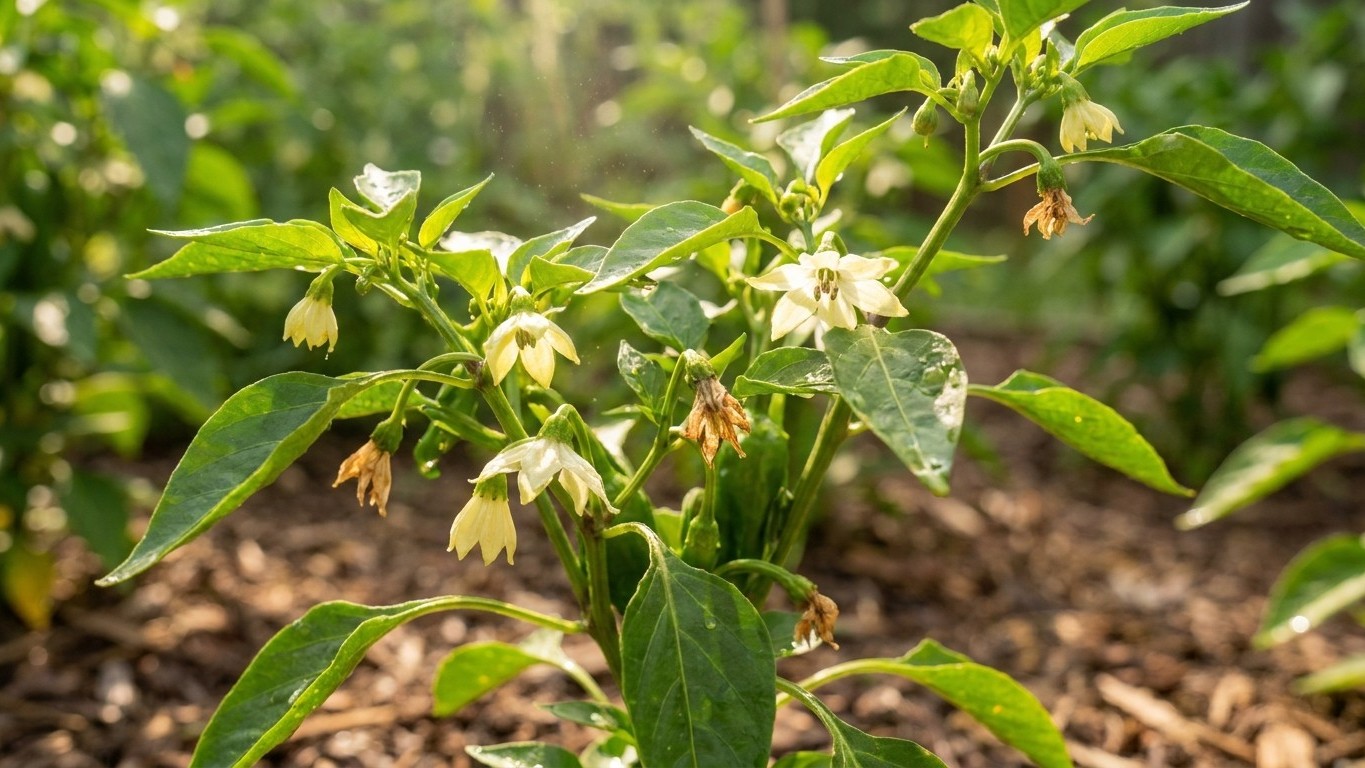
What you’ll actually see first, in the weeks right after transplanting, is rarely insect damage. It’s usually a plant that sits still. Cool nights slow root establishment and can cause blossom drop even before a plant has had the chance to flower properly. If foliage looks pale or growth stalls two to three weeks after the plant goes outside, cold stress and a soil that hasn’t warmed enough are the more probable explanations in this province than anything chewing on it.
Later in the season, once plants are flowering and starting to set fruit, watch for dropped blossoms with no visible feeding damage. That pattern lines up with the temperature thresholds above, not with an insect calendar. If you do see actual chewing, holes in leaves, or insects on the plant itself, that’s a separate observation worth documenting with a photo and a description of what you found, since it isn’t something the available provincial records currently catalog in detail for pepper.
Telling the damage apart from everything else
Misreading a climate problem as a pest problem is the single most common mistake in a season this short, and it wastes time you don’t have much of. The table below lines up what growers commonly mistake for insect damage against what’s actually happening.
| What you see | Likely cause | What tells them apart |
|---|---|---|
| Blossoms dropping, no fruit forming | Cold nights or a cool stretch after transplant | No feeding marks on stems or leaves; drop tracks with a cold snap, not with visible insects |
| Pale, stalled growth soon after transplant | Soil still cooler than 60 °F | Whole plant is affected evenly, not just new growth or edges |
| Soft, sunken, water-soaked spots on fruit | Blossom end rot from uneven watering or calcium uptake | Starts at the blossom end of the fruit, not on leaves |
| Pitted, softened fruit after harvest | Chilling injury from storage that’s too cold | Peppers keep best at 45 to 50 °F (7 to 10 °C) with 80 to 90 percent humidity; a standard refrigerator, typically colder than that, is often the cause |
| Torn or ragged leaf edges | Wind or hail, common on an exposed coastal property | Damage matches the direction of prevailing weather, not scattered randomly |
| Actual holes chewed through leaf tissue | Insect feeding | Look for the insect itself, frass, or egg clusters; this is the one case worth photographing for your local extension office |
That storage line is worth sitting with on its own. A standard kitchen fridge runs colder than the 45 to 50 °F peppers actually need, and pushing fruit below about 45 °F causes pitting and softening that looks a lot like disease or pest damage days after the fact, when the real cause was simply where the peppers sat.
What actually works here, and what is a waste of time
On a season this short, timing beats intervention almost every time. A physical barrier such as a row cover or a cold frame, put in place before that late-May frost window closes, does more for a pepper crop in this province than any treatment applied later in the season. Getting the transplant timing right, soil at 60 °F and frost behind you, prevents more losses than reacting to symptoms after they show up.
Where cover matters most is at both edges of the season: protecting young transplants from a cool snap after the mean frost date, and, if fall threatens an early cold night before fruit has matured, extending the season by a week or two with the same kind of cover.
What’s a genuine waste of time is treating a plant for insects when the underlying cause is temperature. No spray or trap addresses a cold soil or a run of cool nights, and reaching for a pesticide treatment based on a guess, rather than a confirmed insect, burns time and money on a season that doesn’t have much slack in it. This site doesn’t recommend specific products or active ingredients in any case; what’s registered for use varies and is a question for your local agricultural office, not a general gardening article.
Storage deserves the same discipline as the growing season. Harvested fruit held at 45 to 50 °F with high humidity keeps for two to three weeks under those optimal conditions, a maximum rather than a promise, and keeping peppers out of a standard fridge’s coldest zone does more for your harvest than any treatment applied while the plant was still in the ground.
Where to check this for your own county
A province is not one climate, and that’s especially true here. St John’s A, on the Avalon Peninsula, is not Labrador, and it isn’t the west coast either. Whatever a provincial-level record shows for frost dates or heat totals describes conditions at one weather station, not the specific soil in your yard. A garden a few miles inland, or at a different elevation, can run a week or two behind or ahead of the station numbers used in this article.
For anything specific to your own property, whether that’s a pest you’ve actually found on a pepper plant, a frost date closer to your address, or advice on what’s registered for use in your area, the right call is your local agricultural extension or provincial agriculture office. They can look at conditions county by county, or district by district, in a way a provincial climate normal never will.
If you’re trying to figure out what’s affecting your pepper plants right now, take a photograph, note the date since transplant, and get it in front of someone local before assuming a cause. The climate figures in this article can tell you what’s typical across a broad area; they can’t tell you what’s on the leaf in front of you.
Common questions
Does Newfoundland and Labrador have documented pepper pests at all?
The climate and horticultural sources behind this article don’t list specific insect species tied to outdoor pepper in this province. That doesn’t rule out isolated infestations on individual properties, only that no provincial catalog of them is part of the record used here.
Why do peppers struggle here even without pests?
Fruit set fails when nights drop below 55 °F or days climb above 90 °F, and while the hot end almost never happens in this province, cool nights are common enough to cause blossom drop on their own, with no insect involved.
When is it safe to move pepper transplants outside?
Only after your local frost risk has passed and the soil has warmed to 60 °F. The provincial mean last frost is May 30, but that date runs later in roughly half of all years, so treat it as a midpoint, not a deadline.
Why do stored peppers go soft and pitted?
That’s usually chilling injury from storage that’s too cold. Peppers hold best at 45 to 50 °F, warmer than most refrigerators, and dropping below about 45 °F causes the pitting and softening that’s often mistaken for disease.